The Regulatory Necessity of Legal SIM Ownership Transfer
In Pakistan, mobile phone numbers frequently remain in active daily use for decades. However, millions of active cellular subscribers are operating SIM cards that were originally purchased by a parent during their teenage years, registered under an older sibling's name, or provided by a former employer. While this arrangement may seem convenient, operating a cellular connection registered to another individual is a serious legal liability and an operational hazard in today's digitized economy.
Under regulations enforced by the Pakistan Telecommunication Authority (PTA) and the National Database and Registration Authority (NADRA), cellular connectivity is biometrically tied to citizen identities. Your mobile number is the primary authentication gateway for two-factor authentication (2FA), branchless banking wallets (JazzCash, EasyPaisa, SadaPay, NayaPay), Raast instant digital payments, commercial banking OTPs, and the Federal Board of Revenue (FBR) tax portal. If your SIM card is not registered under your personal 13-digit Computerized National Identity Card (CNIC), you are completely vulnerable to sudden service disconnection, SIM-swap account takeovers, and legal disqualification from digital financial services.
Executing an official SIM Ownership Transfer permanently migrates legal title, regulatory accountability, and operational control of the MSISDN directly to your biometric identity.
Statutory Legal Principle: Under the Prevention of Electronic Crimes Act (PECA 2016), the biometrically registered owner is presumed responsible for all communications originating from a SIM. Conversely, third-party operators have no legal ownership rights over the number if the registered subscriber chooses to reclaim or terminate it.
PTA & NADRA Regulations Governing Cellular Title Transfers
Prior to 2015, SIM ownership could be transferred via paper forms, signed affidavits, and photocopied identity cards. Fraudulent syndicates systematically abused these paper-based workflows to hijack high-value VIP numbers and register lines under deceased or fictitious citizens. Consequently, the PTA mandated the Biometric Verification System (BVS) Dual-Handshake Protocol across all licensed cellular mobile operators:
- Elimination of Online / Remote Transfers: PTA regulations strictly prohibit modifying SIM registration through websites, mobile applications, SMS codes, or customer care helplines. No representative has the administrative override to reassign a number without a live NADRA biometric handshake.
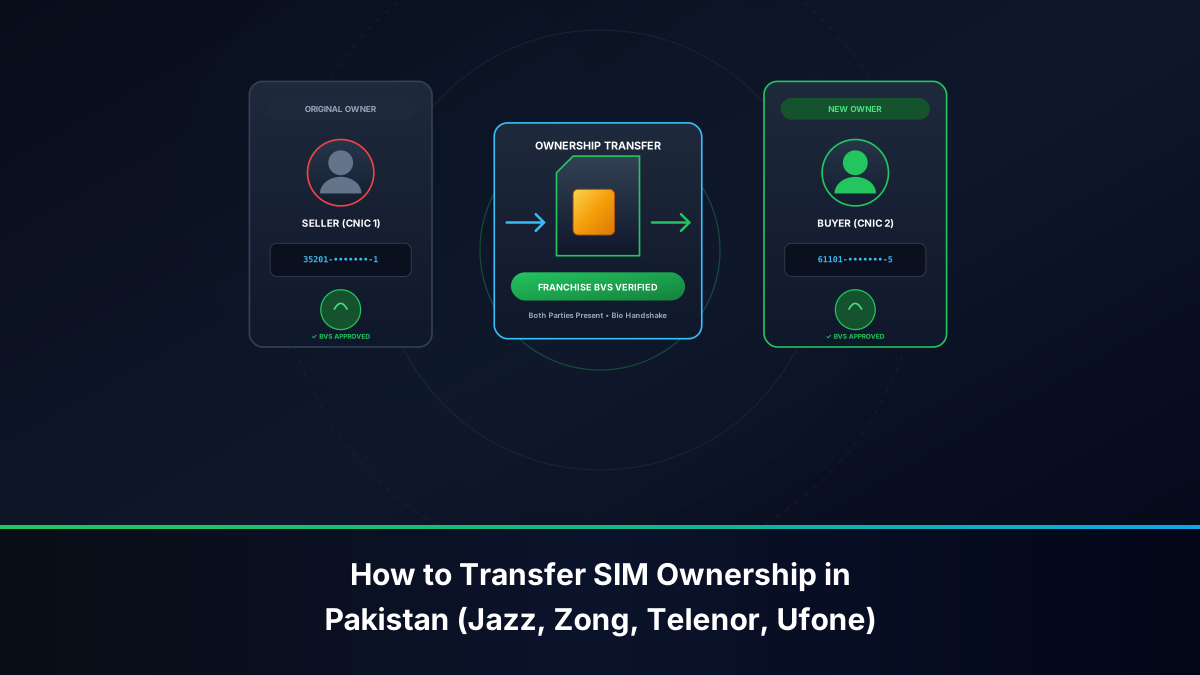
- Dual-Party Physical Presence: To transfer a mobile connection between two living individuals, both the current registered owner (transferor) and the intended recipient (transferee) must physically appear together at an authorized company Customer Service Center or franchise.
- Luhn-Compliant Cryptographic Tokens: The transaction generates encrypted minutiae payloads that are transmitted directly to NADRA's centralized identity clearinghouse. The transfer only commits to the operator's Home Location Register (HLR) upon dual 1:1 biometric match confirmation.
Pre-Transfer Checklist: Mandatory Requirements Before Visiting a Franchise
To avoid wasted visits and regulatory rejection, ensure that both parties fulfill all mandatory criteria prior to visiting a telecom customer center:
Physical Identification Documents Mandate
- Original Physical Smart CNIC: Both individuals must present their original, unexpired, plastic Computerized National Identity Card (CNIC) or National Identity Card for Overseas Pakistanis (NICOP).
- Zero Photocopy Acceptance: Paper photocopies, notarized copies, laminated duplicates, or smartphone photos will be rejected without exception.
- Valid Expiry Status: Neither party's CNIC can be expired. If an identity card is past its expiration date, renew it at a NADRA center before attempting a SIM transfer.
Clearing Outstanding Postpaid Bills & Unbilled Airtime
If the SIM being transferred is a postpaid connection, the telecom billing engine will automatically lock the transfer workflow if any outstanding balance exists. The current registered owner must clear:
- All billed invoices up to the current billing cycle.
- All accrued, unbilled airtime charges and data usage up to the exact hour of the transfer request.
- Security deposit adjustments must be resolved directly with the customer service supervisor.
Transferee 5-Voice SIM Quota Audit
The intended new owner must verify their national SIM quota prior to arriving at the franchise. Under PTA directives, every Pakistani citizen is restricted to a maximum of 5 active voice SIMs nationwide across all operators combined:
- The recipient should send their 13-digit CNIC to 668 or check cnic.sims.pk.
- If the recipient already has 5 voice SIMs registered, the BVS terminal will abort the transfer with the error: "Recipient Quota Exceeded".
- The recipient must first surrender or disown an unneeded line to free up a slot before the transfer can proceed.
The Standard In-Person Transfer Procedure: Dual Biometric Handshake
Once both parties are assembled with valid documents, the transfer follows a standardized four-stage operational sequence:
Step 1: Joint Physical Attendance at Customer Care Center
Both parties proceed to an official, company-operated Customer Service Center (CSC) or authorized flagship franchise of the relevant cellular provider (Jazz, Zong, Telenor, or Ufone). Approach the customer service desk and request an "Ownership Change / SIM Title Transfer".
Step 2: Donor Relinquishment Biometric Scan
The customer service representative inputs the 11-digit mobile number into the operator's provisioning interface. The system prompts the current legal owner (transferor) to place their index finger or thumb upon the NADRA-linked BVS optical terminal. This biometric scan officially authorizes the relinquishment of the MSISDN and releases the line from the donor's CNIC.
Step 3: Transferee Acceptance Biometric Scan
Immediately following the relinquishment confirmation, the terminal prompts the new owner (transferee) to scan their thumbprint. NADRA's identity verification engine validates the recipient's citizen record and verifies that their national quota has an available voice allocation slot. Upon validation, the recipient's CNIC is cryptographically bound to the MSISDN.
Step 4: System Re-provisioning & SIM Handover
Under regulatory guidelines, the customer service representative will physically dispose of the old SIM card and issue a brand new replacement 4G/5G SIM card (or digital eSIM voucher) directly to the new owner. An administrative fee ranging between PKR 50 and PKR 150 is paid at the cash counter. The new SIM card activates on the cellular network within 15 to 45 minutes.
Operator-Specific Guidelines: Jazz, Zong, Telenor, and Ufone
While the overarching BVS protocol is federally standardized by PTA, minor operational nuances exist across operators:
Jazz & Warid Ownership Change Guidelines
- Where to Visit: Official Jazz Customer Experience Centers (CEC) or licensed Jazz Franchises nationwide.
- Warid Numbers (032X): Legacy Warid connections undergo the identical procedure on the unified Jazz core provisioning system.
- JazzCash Precaution: If an active JazzCash account exists on the number, the current owner must withdraw all funds and formally close the wallet prior to transfer; otherwise, the number transfer will be blocked by the branchless banking switch.
Zong 4G Ownership Change Guidelines
- Where to Visit: Company-operated Zong Customer Service Centers (CSC) or flagship franchises.
- Zong MBB Bolt+ Transfers: Mobile Broadband router SIMs can also be transferred between citizens using the same dual BVS scan, provided the recipient has not exhausted their separate 3-MBB data quota.
- Pre-Transfer SMS Verification: It is recommended to send
Vto 7911 prior to visiting to confirm that the existing record matches the donor's CNIC.
Telenor Pakistan Ownership Change Guidelines
- Where to Visit: Telenor Customer Service Centers or authorized biometric franchises.
- Easypaisa De-linking: If the SIM is linked to an active Easypaisa account, the donor must dial 3737 to deregister or freeze the wallet profile before transferring the cellular line.
- Verification Shortcode: Dial
*7711#to verify existing registration credentials before proceeding.
Ufone 4G Ownership Change Guidelines
- Where to Visit: Direct Ufone Customer Service Centers or joint PTCL-Ufone Service Centers.
- Postpaid Deposit Policy: For Ufone postpaid transfers, the original security deposit can either be refunded to the donor or formally signed over to the incoming subscriber via written waiver.
Specialized Scenarios: Blood Relatives, Deceased Owners, and Corporate Lines
Standard transfers assume both parties are living, present, and willing. However, specific legal situations require alternative regulatory pathways:
Transferring Between Immediate Family (Father, Mother, Siblings)
Many consumers ask: "Can my father transfer his SIM to me without visiting the franchise in person if I bring his CNIC?"
The answer is strictly NO. Under PTA anti-terror and identity verification directives, no franchise agent has the legal discretion to bypass biometric presence—even for parents, spouses, or children. Both family members must physically attend. If an elderly parent is bedridden, select operators offer specialized home-visit biometric customer care services in major metropolitan centers for a scheduled fee.
Inheritance Transfers upon the Death of the Registered Owner
When the registered owner of a cellular SIM passes away, it is illegal under telecommunication laws for family members to continue operating the line under the deceased person's identity. To transfer the number to a surviving legal heir:
- Gather Mandatory Inheritance Documents:
- Original Death Certificate issued by the Union Council and verified by NADRA.
- Official Family Registration Certificate (FRC) issued by NADRA reflecting legal heirs, or a court-issued Succession Certificate.
- Original CNIC of the legal heir applying for the transfer.
- Written No-Objection Certificate (NOC) signed by other legal heirs (required by some operators for high-value VIP numbers).
- Visit Customer Experience Center: The legal heir visits the operator's primary Customer Service Center and presents the inheritance dossier.
- Managerial Override & Biometric Scan: The customer service manager verifies the death registration against NADRA's citizen records. Once verified, the deceased subscriber's profile is formally extinguished on the switch, and the heir scans their thumbprint on the BVS terminal to assume lawful ownership.
Converting Corporate Business SIMs to Personal Ownership
If you are departing a corporate employer and have been permitted to retain your company-issued cellular phone number:
- Obtain Corporate Authority Letter: Obtain an official Transfer Authority / NOC Letter printed on the company's official corporate letterhead, signed by an authorized corporate signatory (HR Director or Admin Manager), and stamped with the company seal. The letter must state the employee's name, CNIC number, and specify the MSISDN being released.
- Visit Corporate Sales Desk: Proceed to the operator's Customer Experience Center corporate desk.
- BVS Transfer Scan: The employee presents the corporate NOC, original CNIC, and undergoes live BVS biometric thumbprint verification to transition the number from a corporate commercial account into an individual prepaid or postpaid consumer account.
Post-Transfer Financial Impact: Wallets, Banking & Tax Certificates
Completing a SIM ownership transfer causes an immediate cascade of modifications across digital financial and governmental databases:
- Resetting Branchless Wallets: The previous owner's JazzCash, Easypaisa, or UPaisa account bound to that number is permanently severed. The new owner can immediately register a fresh, clean mobile wallet tied to their own CNIC.
- Re-registering Commercial Bank Alerts: Contact your commercial bank's telephone helpline or visit your branch to update your cellular profile. Inform the bank that the SIM ownership has been transferred to ensure that OTP authorizations and transactional SMS alerts route seamlessly.
- Tax Deduction Certificates: From the exact date of transfer onward, all mobile balance recharges and postpaid bills generate withholding tax certificates (under Section 236) bearing the new owner's CNIC number, enabling full tax credit deductions on FBR Iris returns.
Troubleshooting Common Ownership Transfer Failures & BVS Errors
If you encounter difficulties during the transfer process, review these verified resolutions:
- Error: "Biometric Fingerprint Mismatch at Terminal": Elderly citizens, manual laborers, or individuals with worn dermal ridges frequently fail optical scans. Request the agent to test all ten fingers sequentially, clean the scanner glass with alcohol swabs, or utilize newer contactless facial recognition terminals where deployed.
- Error: "Number Blocked due to Unpaid Postpaid Dues": Ensure all unbilled usage is paid in full at the franchise billing counter prior to launching the transfer module.
- Error: "MNP Porting Tenure Restriction": If the number was recently ported from another network (e.g., Jazz to Telenor), PTA regulations prohibit any ownership change or SIM swap until 60 calendar days have elapsed since the porting date.
Summary Matrix: Documents, Fees, and Timelines by Scenario
The following table summarizes requirements across all transfer scenarios:
| Transfer Scenario | Parties Required | Documentation Required | Approximate Fee | Activation Time |
|---|---|---|---|---|
| Individual to Individual | Both Donor & Recipient | Both Original CNICs | PKR 50 – 150 | 15 to 45 Minutes |
| Deceased Owner Transfer | Surviving Legal Heir Only | Death Certificate, FRC, Heir CNIC | PKR 50 – 150 | 1 to 2 Business Days |
| Corporate to Individual | Individual Employee Only | Corporate NOC / Letterhead, Employee CNIC | PKR 50 – 150 | Same Day (2 to 4 Hours) |
| Postpaid to Prepaid Shift | Both Parties (if changing name) | Original CNICs, Clearance Receipt | Bill clearance + SIM fee | Next Billing Cycle |