The Architectural Division: Voice Telephony vs. Mobile Broadband
In the digital telecommunications infrastructure of Pakistan, the distinction between a Voice SIM and a Mobile Broadband (MBB) Data SIM is fundamental. While both technologies utilize identical physical plastic chips (mini, micro, and nano form factors) or digital eSIM profiles, their operational capabilities, regulatory quotas, tariff structures, and network provisioning protocols are fundamentally divergent.
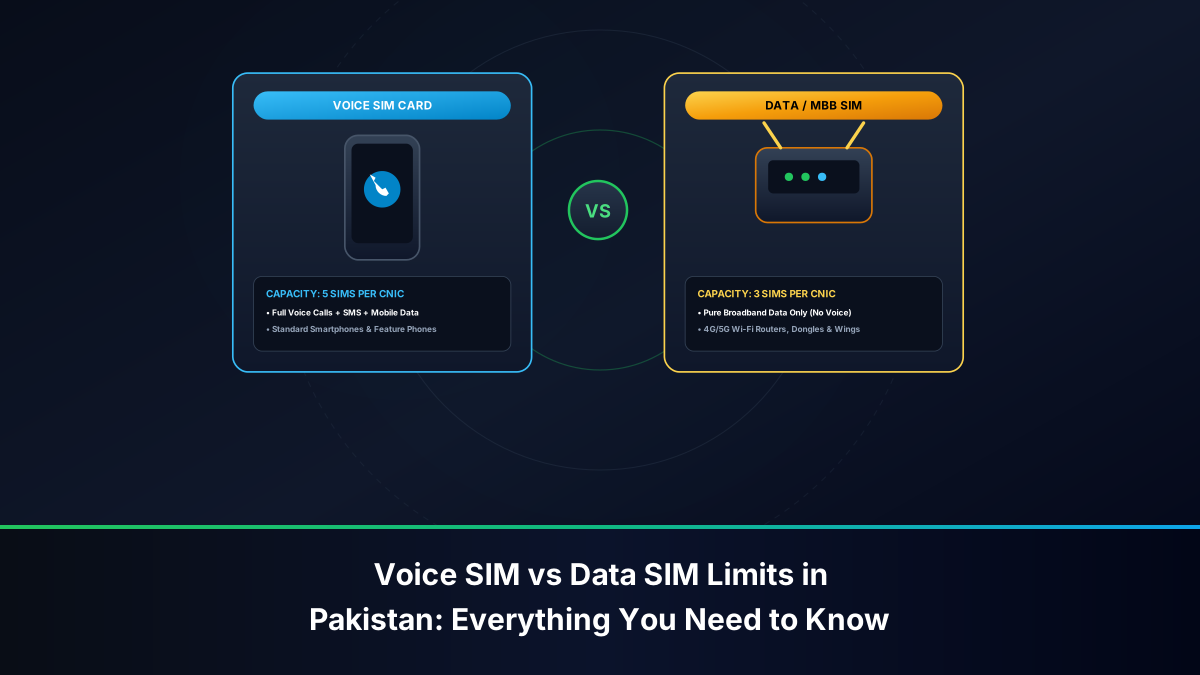
Many cellular subscribers are unaware that the Pakistan Telecommunication Authority (PTA) and licensed operators—including Jazz, Zong, Telenor, Ufone, and SCO—treat voice and data connections as distinct legal asset classes. This separation is reflected directly in the national subscriber quota, which establishes a strict partition of up to 5 voice SIMs and up to 3 mobile broadband (data-only) SIMs per Computerized National Identity Card (CNIC).
Understanding the architectural, operational, and regulatory differences between voice and data lines is essential for avoiding unexpected transaction rejections at franchise counters, optimizing mobile broadband expenses, and maintaining full compliance with Pakistani telecommunication laws.
Core Regulatory Standard: Voice SIMs and MBB Data SIMs exist in non-competing regulatory buckets. An individual citizen is legally permitted to hold up to 5 voice SIMs and 3 MBB data SIMs simultaneously, establishing an absolute national ceiling of 8 active SIM connections per CNIC.
Technical & Network Architecture Differences (HLR/HSS Provisioning)
To understand why a voice SIM behaves differently from a data SIM, one must look inside the cellular operator's core network switches: the Home Location Register (HLR) for legacy 2G/3G circuits and the Home Subscriber Server (HSS) / Unified Data Management (UDM) for 4G LTE and 5G packet cores.
How Voice SIMs Are Provisioned: CS Core & IMS
A standard Voice SIM is provisioned as a full-service telecommunications terminal. In the operator's HSS database, its subscriber profile contains:
- Circuit-Switched (CS) Voice Access: Permission to originate and receive circuit-switched voice telephone calls across GSM/UMTS frequency bands.
- IP Multimedia Subsystem (IMS) VoLTE: Configuration for Voice over LTE (VoLTE) and Voice over Wi-Fi (VoWiFi), allowing high-definition digital voice calls over pure packet data streams.
- Short Message Service Center (SMSC) Routing: Full two-way signaling for incoming and outgoing SMS text messages.
- Packet Data Gateway Access: Access Point Name (APN) routing (e.g.,
jazzconnect.mobilinkworld.comorzonginternet) providing internet packet data.
How MBB Data SIMs Are Provisioned: Pure Packet Core & APN Restrictions
In stark contrast, a Mobile Broadband (MBB) Data SIM is engineered exclusively as a high-throughput data conduit. In the carrier's HSS database:
- Voice Circuit Disabled: Circuit-switched voice call origination and reception flags are set to
DISABLED. If an MBB SIM is placed in a phone and a user dials a standard telephone number, the switch immediately drops the call with a fast-busy tone or network error. - Dedicated Broadband APN Routing: MBB SIMs route through specialized high-priority data APNs designed for continuous streaming, large data volume handling, and low-latency fixed-wireless broadband (e.g.,
zongmbb). - Restricted SMS Handling: Outgoing person-to-person (P2P) SMS is generally blocked, while incoming application-to-person (A2P) SMS remains active to allow subscribers to receive bundle activation tokens, recharge confirmations, and banking OTPs inside the router's web portal.
Why PTA Established Separate Quotas: The 5 vs. 3 Rationale
Why did the Pakistan Telecommunication Authority mandate a split quota of 5 voice SIMs and 3 MBB data SIMs rather than simply allowing citizens an unrestricted pool of 8 generic SIMs?
The 5-Voice SIM Limit: Protection Against Telecom Fraud
Voice telephony is the primary vector for electronic social engineering scams, fraudulent prize calls, illegal telemarketing harassment, grey-traffic call termination, and criminal extortion. Restricting individuals to a ceiling of 5 voice lines ensures that legitimate personal communication needs are met (such as maintaining personal, business, family, and backup lines) while preventing malicious actors from accumulating large batteries of voice SIMs to execute automated spam and fraud campaigns.
The 3-MBB Data SIM Allocation: Enabling High-Speed Multi-Device Work
With the exponential growth of remote freelance work, online education, and e-commerce across Pakistan, households frequently require dedicated 4G wireless broadband routers for home offices, remote work setups, smart televisions, and personal travel MiFi dongles. By establishing an independent allocation of 3 MBB data SIMs, the PTA ensured that citizens could purchase high-volume data connections for their home routers without sacrificing their personal voice calling SIM allocations.
Hardware Ecosystems: Smartphones vs. 4G Routers, Dongles & MiFi Devices
A frequent area of user confusion relates to hardware cross-compatibility: Can you swap SIM cards between smartphones and 4G Wi-Fi routers?
Can You Put a Voice SIM in a 4G Wi-Fi Router?
Yes, from a physical and radio perspective, inserting an active Voice SIM into a 4G Wi-Fi router (such as a Huawei, ZTE, or TP-Link LTE router) will generally provide internet connectivity, provided the router is carrier-unlocked and correctly configured with the operator's standard mobile internet APN. However:
- Tariff Disadvantage: Voice SIM packages are priced primarily for mobile smartphone usage (e.g., 10GB to 30GB bundles). High-volume broadband packages (such as 150GB, 250GB, or 500GB monthly allowances) are exclusive to dedicated MBB data SIMs and cannot be activated on voice SIM numbers.
- Cost Inefficiency: Utilizing a voice SIM as your primary home router connection is significantly more expensive per gigabyte than using a dedicated MBB data SIM.
Can You Put an MBB Data SIM in a Smartphone?
Yes. You can insert an MBB Data SIM into Slot 1 or Slot 2 of any modern 4G/5G smartphone (iPhone, Samsung, Xiaomi, Vivo, etc.):
- High-Speed Data Operates Flawlessly: The smartphone will connect to 4G LTE and provide high-speed mobile browsing, YouTube streaming, WhatsApp messaging, and social media usage.
- VoIP Calling Works: App-based internet calls via WhatsApp, Zoom, Google Meet, and Microsoft Teams function perfectly over the data connection.
- Circuit Voice is Inactive: The device will be unable to make or receive conventional cellular phone calls through the phone's native dialer. Attempting to dial will result in immediate call failure.
How to Determine Whether Your SIM is Voice or Data via 668 & Self-Care
If you possess a SIM card but are uncertain whether it is classified by the regulator as a Voice line or an MBB line, you can verify its classification through official regulatory channels.
Reading the 'Voice SIMs' vs 'Data SIMs' Columns on cnic.sims.pk
The official PTA SIM Information System portal provides unambiguous categorization:
- Navigate to https://cnic.sims.pk.
- Input your 13-digit CNIC number and solve the reCAPTCHA security check.
- Inspect the resulting table. The portal features separate, explicit columns:
- Operator Name (Jazz, Zong, Telenor, Ufone, SCO)
- Voice SIMs (Shows count of standard voice-capable lines)
- Data SIMs (Shows count of dedicated Mobile Broadband connections)
- If a count appears under the "Data SIMs" column for Zong, you possess an active MBB Bolt+ or router connection registered in your name.
Operator MBB Portfolio Breakdown: Jazz, Zong, Telenor, and Ufone
Each cellular operator in Pakistan structures its Mobile Broadband offerings around proprietary hardware and data plans:
Jazz Digit 4G & Super 4G Wi-Fi Devices
Jazz markets its MBB portfolio under the Jazz Super 4G Wi-Fi and Jazz Digit 4G brands. These devices utilize specialized Jazz Data SIMs supporting massive monthly data quotas (e.g., 60GB, 150GB, and 250GB plans) managed through the Jazz World application.
Zong 4G Bolt+ & Fiber Home Wireless Routers
Zong commands the largest share of the Pakistani wireless broadband market with its portable Zong 4G Bolt+ (Huawei/ZTE MiFi devices) and stationary Zong Fiber Home wireless CAT6 routers. Zong MBB SIMs are managed via the web portal at 192.168.8.1 or through the My Zong smartphone app by linking the MBB master MSISDN.
Telenor 4G Connect & MiFi Routers
Telenor offers the Telenor 4G Wingle (USB dongle) and portable Telenor 4G MiFi devices, providing dedicated monthly broadband allowances managed through the My Telenor digital dashboard.
Ufone Super 4G Mobile Broadband
PTCL Group's Ufone delivers dedicated mobile broadband via its Ufone 4G Wi-Fi Devices, providing specialized data packages with high-speed integration into PTCL's national optical backbone.
Can You Convert a Data SIM to a Voice SIM (or Vice Versa)?
Subscribers frequently ask customer care representatives: "I only have 1 data SIM and 5 voice SIMs. Can I convert one of my voice SIMs into a data SIM, or convert an unneeded data SIM into a voice line?"
The answer is technically and legally NO.
- HLR Profile Hard-Coding: In telecommunication switching architectures, SIM cards are provisioned at the factory and cleared through PTA licensing under immutable profile classes. A data SIM chip is hard-coded with an MBB IMSI series and mapped to pure packet-switched routing tables.
- No In-Place Conversion: Telecom franchises do not have the software capability or regulatory authorization to convert a data line into a voice line.
- The Correct Workaround: If you need another voice SIM but have exhausted your voice quota of 5, you must visit an authorized franchise, formally surrender and cancel an unwanted voice line, wait 24 to 72 hours for the 668 clearinghouse to reflect 4 voice SIMs, and then purchase a fresh voice SIM card.
Taxation, Withholding & Compliance Differences
Voice and data SIMs are also taxed differently in practice, and understanding these distinctions matters for salaried professionals, freelancers, and registered businesses. Under the Income Tax Ordinance 2001 as read with FBR clarifications, every prepaid recharge and postpaid invoice on a standard Voice SIM attracts advance income tax (withholding) at the prevailing rate, currently 15% for non-filers and reduced for Active Taxpayer List (ATL) entries. These deductions are recoverable: filers can download the annual tax deduction certificate from their operator's self-care portal (Jazz World, My Zong, My Telenor, or My Ufone) and adjust the credit in their FBR Iris return under Section 236.
MBB Data SIMs carry the same withholding treatment, but because they are overwhelmingly used by households, small offices, and freelancers as a substitute for fixed-line broadband, the cumulative deductions on 150GB-plus monthly bundles can be significant. Keeping the data SIM registered in your own CNIC — not a spouse's or employee's — ensures the withholding certificate is issued in the name of the person actually filing the return. Corporate customers should register MBB lines under company titles with an FBR NTN so that input adjustments can be claimed cleanly at year end.
Tax Tip: A data SIM registered in another person's name means the withholding tax certificate is generated against that person's CNIC, leaving you with no documentary credit in Iris even though you paid the tax at every recharge.
Dormancy, 180-Day Recycling & Expiry Differences
Dormancy and recycling rules apply to both SIM classes, but the practical consequences differ. A Voice SIM that records zero billable activity for 90 days enters a grace phase (incoming-only or suspended), and after 180 consecutive days of complete inactivity, PTA churn regulations authorize the operator to deactivate and eventually recycle the MSISDN to a new subscriber. Because voice numbers are anchored to banking OTPs, CNIC-based registrations, and WhatsApp accounts, losing one to recycling can cascade into financial lockout.
MBB Data SIMs follow the same statutory timeline, yet they are far more likely to hit it in practice: router SIMs are often used seasonally — exam months, winter quarters, or holiday homes — and then abandoned with zero balance. A 4G Bolt+ or Fiber Home SIM that sits unused through the summer will silently drop off the network, and the number may later reappear under a stranger's name on your 668 audit, since the line was churned and reissued before a formal de-registration was ever filed.
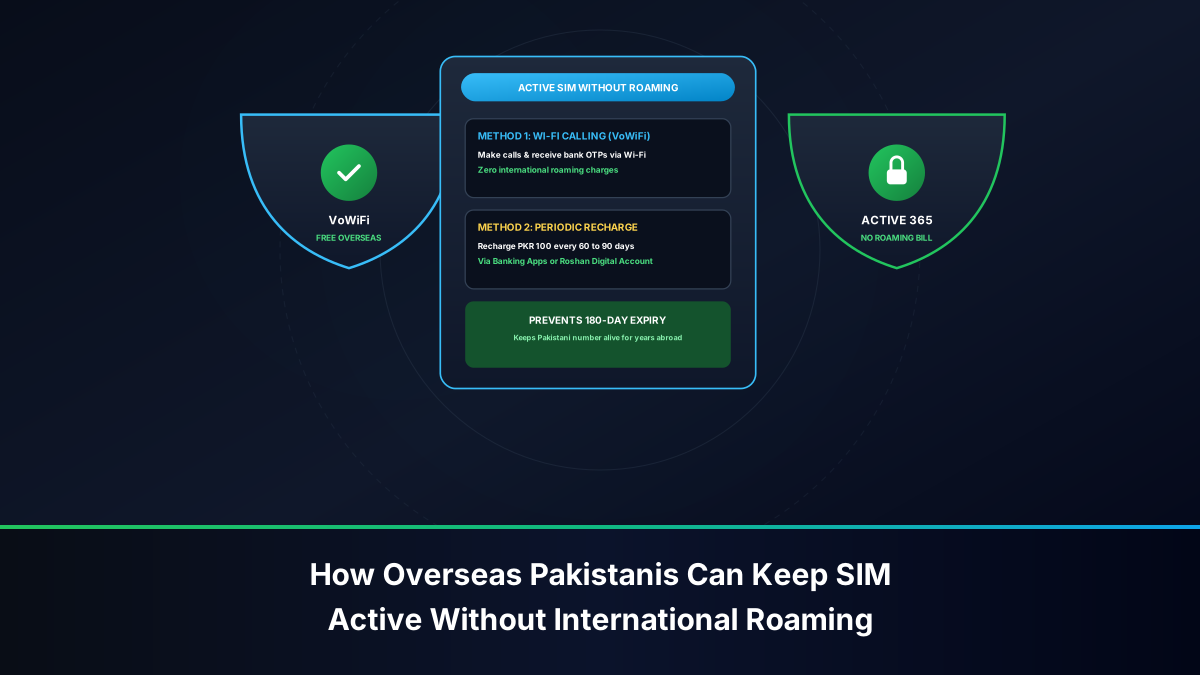
- Keep-alive discipline: Recharge even PKR 50 and dial one USSD code or push a few kilobytes of data every 60 days to reset the inactivity clock on a seasonally used router SIM.
- Audit before discarding hardware: Before selling or shelving an old router, run the 668 check and biometrically disown the MBB SIM at a franchise so it can never return as a ghost connection on your CNIC.
Practical Deployment Scenarios: Choosing Your Optimal Quota Split
Because the voice and data buckets never overlap, strategic families and professionals can plan their 8-connection portfolio deliberately. The following scenarios reflect the most common lawful allocations observed across Pakistani subscribers:
- Remote freelancer: Two voice SIMs (one personal Jazz, one Zong backup for OTPs) plus two MBB SIMs — a Fiber Home router for the workstation and a portable Bolt+ for load-shedding mobility.
- Head of a joint family: Three voice SIMs covering the household elder, spouse, and a shared emergency line, plus all three MBB slots dedicated to routers in the annex, the shop, and the village home.
- University student: One voice SIM for calls and WhatsApp, and one data SIM swapped between a tablet and a MiFi dongle, leaving four voice and two data slots unused — headroom that also protects against ghost registrations exceeding the ceiling.
- Small business owner: Corporate voice lines for sales staff under the company title, while personal data SIMs stay outside the business inventory so that an employee's exit never disrupts family connectivity.
- Security-conscious citizen: A minimal allocation — one or two voice SIMs only — reducing the attack surface for SIM-swap fraud, identity exposure, and unsolicited telemarketing harassment.
Whatever split you choose, remember that the ceiling is enforced at the PMD clearinghouse in real time: a purchase attempt that would exceed 5 voice or 3 MBB connections on one CNIC is rejected at the point-of-sale biometric terminal itself.
Side-by-Side Comparison Matrix: Voice SIM vs. MBB Data SIM
The following table summarizes all critical differences between Voice and MBB Data connections in Pakistan:
| Feature & Parameter | Standard Voice SIM | Mobile Broadband (MBB) Data SIM |
|---|---|---|
| PTA Quota Ceiling | Up to 5 SIMs per CNIC | Up to 3 SIMs per CNIC |
| Combined Maximum Limit | Included in 8-SIM Total | Included in 8-SIM Total |
| Standard Cellular Calls | ✓ Full Two-Way Voice Support | ✗ Completely Disabled at Switch |
| Outgoing Person-to-Person SMS | ✓ Full Outgoing & Incoming SMS | ✗ Outgoing P2P Blocked (Incoming OTPs active) |
| Mobile Data Connectivity | ✓ 2G / 3G / 4G / 5G Mobile Data | ✓ Optimized High-Throughput 4G/5G Broadband |
| App-Based Calling (WhatsApp/Zoom) | ✓ Supported over Data | ✓ Supported over Data |
| Primary Hardware Target | Smartphones & Feature Phones | 4G Routers, Dongles, Tablets, MiFi Devices |
| Typical Bundle Sizes | 5GB to 40GB Monthly | 50GB to 300GB+ Monthly |
| Cost Per Gigabyte | Higher Rate per GB | Significantly Lower Cost per GB |
| BVS Biometric Requirement | ✓ Mandatory 1:1 NADRA Verification | ✓ Mandatory 1:1 NADRA Verification |
| Visibility on 668 Report | Listed under 'Voice SIMs' Column | Listed under 'Data SIMs' Column |
Key Takeaways for Pakistani Subscribers
The voice-versus-data distinction is not a marketing label; it is a hard architectural and regulatory boundary written into every operator's HLR/HSS provisioning scripts and mirrored in the PTA's national quota enforcement. Voice SIMs (5 per CNIC) trade full telephony for higher per-GB cost, while MBB data SIMs (3 per CNIC) deliver router-grade bandwidth with circuit voice disabled at the switch. Audit both buckets separately on cnic.sims.pk, keep every line biometrically anchored to your own CNIC, and maintain light periodic activity so neither bucket leaks into dormancy or ghost ownership. Treated this way, an 8-connection national portfolio remains a productivity asset rather than a compliance liability.