The Evolution of Subscriber Identity Limits in Pakistan
Prior to 2010, the cellular telecommunications landscape in Pakistan operated with minimal regulatory ceilings regarding the quantity of subscriber identity modules (SIMs) an individual citizen could acquire. Mobile operators engaged in aggressive retail distribution wars, resulting in millions of pre-activated, undocumented, and street-vended connections circulating throughout the country. A single individual could hold dozens—and in extreme cases, hundreds—of active connections under a single paper identity photocopy.
This unregulated proliferation created profound national security risks. Unregistered SIMs became the primary conduit for extortion syndicates, criminal kidnapping networks, illicit grey-traffic telephony bypass, and digital financial scams. Following the landmark 2014–2015 National Action Plan (NAP) and the implementation of 100% Biometric Verification System (BVS) controls, the Pakistan Telecommunication Authority (PTA) in collaboration with the Ministry of Information Technology and Telecommunication (MoITT) and NADRA enacted comprehensive quota regulations.
Today, the PTA SIM limit rules are codified into national telecommunications standard operating procedures (SOPs). They establish unambiguous mathematical ceilings governing how many voice and broadband lines an individual citizen may operate, eliminating ghost identities while ensuring legitimate multi-device connectivity for modern digital lifestyles.
Statutory Legal Foundation: Under Section 5(2) and Section 21 of the Pakistan Telecommunication (Re-organization) Act 1996, the PTA possesses sovereign statutory authority to establish consumer identity caps and order the immediate termination of connections exceeding regulatory limits.
Statutory Authority: PTA Standard Operating Procedures (SOPs)
The current SIM quota framework is governed by the PTA Standard Operating Procedures on Biometric Verification System (BVS) for Issuance of SIMs. Key statutory principles include:
- Centralized Gateway Enforcement: The quota is not monitored independently by individual carriers. Instead, it is enforced at the national gateway level by the PTA 668 Clearinghouse interfacing in real time with NADRA's centralized citizen repository.
- Zero Manual Discretion: No retail agent, customer care officer, or telecom executive possesses administrative authority to override a saturated quota. Every activation attempt queries the national central registry; if the limit is reached, the transaction is rejected automatically by the cryptographic handshake.
- 1:1 Biological Binding: Every quota slot is cryptographically bound to a citizen's 10-finger biometric minutiae template, preventing fraudulent proxy issuance.
The Dual-Bucket Quota Model: Voice SIMs vs. Mobile Broadband (MBB)
To balance national security imperatives against the modern consumer's demand for high-speed mobile broadband across multiple smart gadgets, the PTA engineered an intelligent dual-bucket quota architecture.
The 5-Voice SIMs National Ceiling Explained
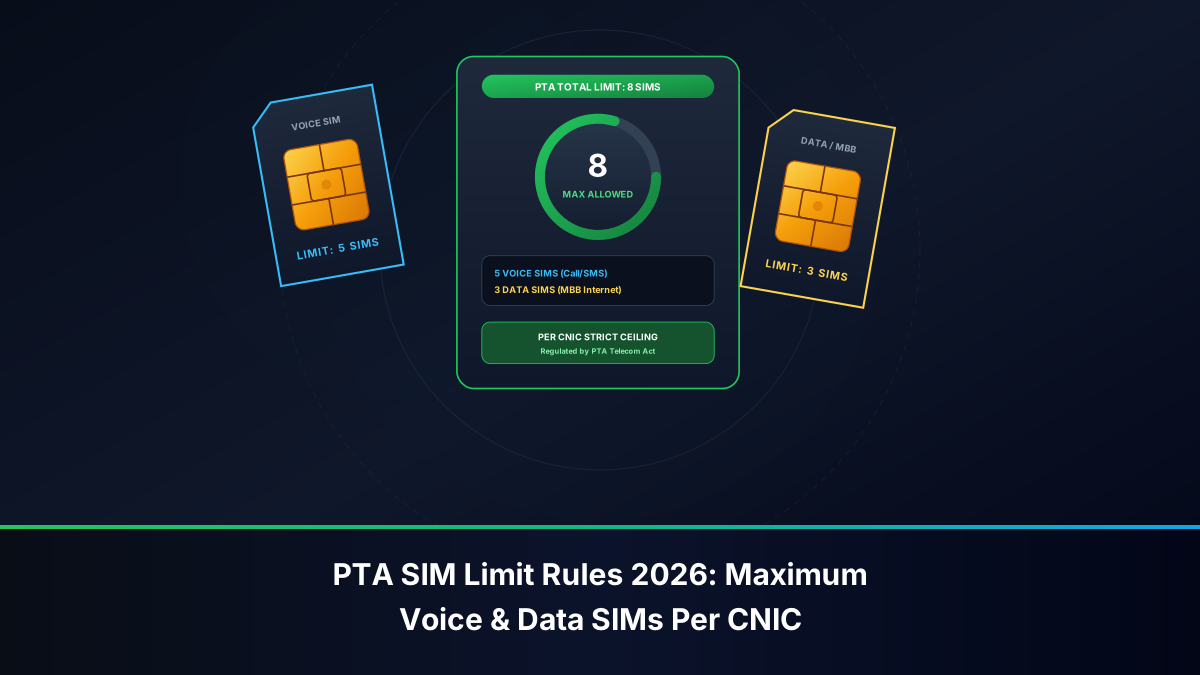
Every Pakistani citizen possessing a valid 13-digit Computerized National Identity Card (CNIC) or National Identity Card for Overseas Pakistanis (NICOP) is entitled to a maximum of 5 active voice SIM cards across all mobile networks nationwide:
- Coverage Scope: Includes all standard GSM cellular lines capable of placing and receiving conventional voice telephone calls, transmitting SMS/MMS messages, and accessing mobile data packets.
- Applies Across All Networks: The cap is cumulative across Jazz (PMCL), Zong (CMPak), Telenor Pakistan, Ufone (PTCL Group), and Special Communications Organization (SCO).
- No Inter-Operator Multiplication: You do NOT receive 5 SIMs per company. Holding 3 Jazz SIMs and 2 Zong SIMs completely consumes your national 5-voice quota.
The 3-Mobile Broadband (MBB) Data SIM Allocation
In addition to the voice allowance, the PTA established an independent supplementary quota of up to 3 Mobile Broadband (MBB) SIM cards:
- Dedicated Hardware Focus: MBB SIMs are intended exclusively for wireless routers, 4G cloud devices, portable dongles (such as Jazz Digit 4G devices, Zong 4G Bolt+ modems, and CharJi units), tablet computers, and smart vehicle telematics.
- Data-Only Provisioning: In the carrier's Home Location Register (HLR/HSS), MBB SIM profiles are structurally disabled from originating circuit-switched voice calls.
- Non-Compromising Allocation: Purchasing an MBB data SIM card does not reduce or affect your available allowance of 5 voice SIMs.
The Cumulative 8-SIM Cap Across All Telecom Operators
When the 5-voice SIM limit and 3-MBB data SIM allocation are combined, the absolute legal maximum ceiling for an individual Pakistani national is 8 active SIM cards nationwide:
Maximum National Quota = [Up to 5 Voice SIMs] + [Up to 3 MBB Data SIMs] = 8 Total SIMsAttempting to activate a 9th connection will trigger an automatic system-wide lock at the NADRA BVS gateway.
Cross-Network Operator Distribution Scenarios (Jazz, Zong, Telenor, Ufone, SCO)
To assist consumers in planning their cellular subscriptions, the following scenarios illustrate compliant and non-compliant quota distributions:
| Scenario & Subscriber Profile | Jazz | Zong | Telenor | Ufone | SCO | Voice Total | MBB Total | Regulatory Status |
|---|---|---|---|---|---|---|---|---|
| Single-Carrier User | 5 Voice | 0 | 0 | 0 | 0 | 5 | 0 | ✓ Compliant (Voice Maxed) |
| Multi-Network Power User | 2 Voice | 1 Voice | 1 Voice | 1 Voice | 0 | 5 | 0 | ✓ Compliant (Voice Maxed) |
| Remote Worker (Broadband User) | 2 Voice | 1 Voice | 0 | 0 | 0 | 3 | 3 (MBB) | ✓ Compliant (MBB Maxed) |
| Fully Saturated Maximum Profile | 2 Voice | 2 Voice | 1 Voice | 0 | 0 | 5 | 3 (MBB) | ✓ Compliant (Absolute 8 Max) |
| Attempted Over-Allocation | 3 Voice | 3 Voice | 0 | 0 | 0 | 6 | 0 | ✗ REJECTED (Exceeds 5 Voice) |
| Attempted Over-MBB Allocation | 1 Voice | 0 | 0 | 0 | 0 | 1 | 4 (MBB) | ✗ REJECTED (Exceeds 3 MBB) |
Technical Enforcement: How the BVS Gateway Locks Saturated Quotas
When a citizen visits an authorized telecom retail center or franchise to purchase a new SIM or upgrade an existing chip, the transaction follows a strict real-time clearing process:
- CNIC & Biometric Capture: The customer care agent swipes the physical CNIC and captures the applicant's live thumbprint on the optical scanner.
- Encrypted API Handshake: The terminal generates an encrypted minutiae payload and transmits it across a secure APN to NADRA's identity verification engine.
- PTA 668 Registry Query: Simultaneous with the identity authentication, NADRA queries the central PTA 668 database to calculate the active SIM count currently mapped to that 13-digit CNIC.
- Automated Logic Gate: If
Active_Voice_Count >= 5(for voice activations) orActive_MBB_Count >= 3(for data activations), the transaction is instantly terminated at the server level.
NADRA BVS Terminal Response Codes
When a transaction is blocked due to quota saturation, the POS terminal renders unambiguous error messages:
ERROR 701: Maximum Voice Limit Reached. Subscriber already has 5 active voice connections.ERROR 702: MBB Quota Exceeded. Maximum of 3 data SIMs permitted.STATUS REJECTED: Transaction blocked by PTA Regulatory Identity Rules.
How Citizens Can Audit Their Available Quota: SMS 668 & Web Verification
Before traveling to an operator franchise to purchase a new connection, every citizen should audit their available quota to prevent unexpected rejections:
- Via SMS Shortcode 668: Send your 13-digit CNIC without hyphens or spaces to 668 from your mobile handset. The clearinghouse responds with your exact operator-by-operator breakdown. (Fee: ~PKR 2.00 + tax).
- Via Official Web Gateway: Open https://cnic.sims.pk in any browser. Input your 13-digit CNIC, complete the reCAPTCHA security challenge, and inspect the tabular report free of charge.
- Calculate Available Allowance: Subtract your current voice total from 5. For instance, if your 668 report reflects 3 voice SIMs (2 Jazz, 1 Zong), you have exactly 2 available voice SIM allocations remaining.
Exceptions & Special Quota Frameworks
The PTA recognizes specific operational environments where strict consumer quotas would impede commercial enterprise or state administration:
Corporate NTN & Commercial Company Connections
Enterprise organizations, multinational corporations, banks, and commercial institutions regularly require hundreds of mobile connections for employees, sales fleets, and IoT devices. The PTA governs corporate connectivity under distinct regulations:
- Corporate SIMs are registered under the company's National Tax Number (NTN) and legal corporate name, backed by an authorized corporate focal person's CNIC.
- Corporate connections issued to an employee do NOT count against that employee's personal 5-voice consumer quota.
- To qualify, the company must provide an official board resolution, NTN certificate, corporate letterhead authorization, and execute periodic PTA corporate audits.
Foreign Diplomats, Tourists & International Passport Holders
Foreign nationals residing in or visiting Pakistan follow a specialized identity framework:
- Registration is conducted against the traveler's valid physical international passport and Pakistani visa.
- Foreign tourists are strictly limited to a maximum of 2 active voice SIM cards.
- Passport SIMs feature an automated hard expiration date linked to the duration of the entry visa (typically 30 to 90 days), after which the line is automatically deactivated unless an official visa extension is presented at a customer service center.
Official Law Enforcement & Government Entity SIMs
Federal and provincial government departments, intelligence apparatuses, and emergency services operate designated operational numbers under institutional exemptions authorized directly by the Chairman of the PTA.
Mobile Number Portability & Quota Interplay
A widespread consumer misconception holds that porting a number to a different network creates fresh quota. It does not. Mobile Number Portability (MNP) changes the serving operator of an existing connection — the MSISDN, its legal registrant, and its quota footprint travel together:
- No Slot Multiplication: Porting your Jazz number to Zong keeps the same single slot occupied. You cannot evade a saturated 5-voice ceiling by cycling numbers between networks.
- Quota Checked at Port-In: Before accepting a port-in, the recipient operator queries the clearinghouse to confirm the receiving CNIC's identity record matches the porting registrant. A port-in request on a full CNIC of a different person fails identity validation, not merely quota validation.
- 60-Day Tenure Lock: PTA anti-churn directives require any ported number to remain with the recipient operator for at least 60 days before becoming eligible to port again, preventing quota games through rapid porting cycles.
- MNP Audit Trail: Because porting history is preserved in the national MNP database, investigators can reconstruct how a number moved between operators during fraud examinations — porting never launders a connection's history.
Dormancy, Recycling & How Slots Are Quietly Consumed
Quota saturation is frequently discovered years after the fact because dormant lines keep occupying slots invisibly. Understanding the lifecycle prevents these silent leaks:
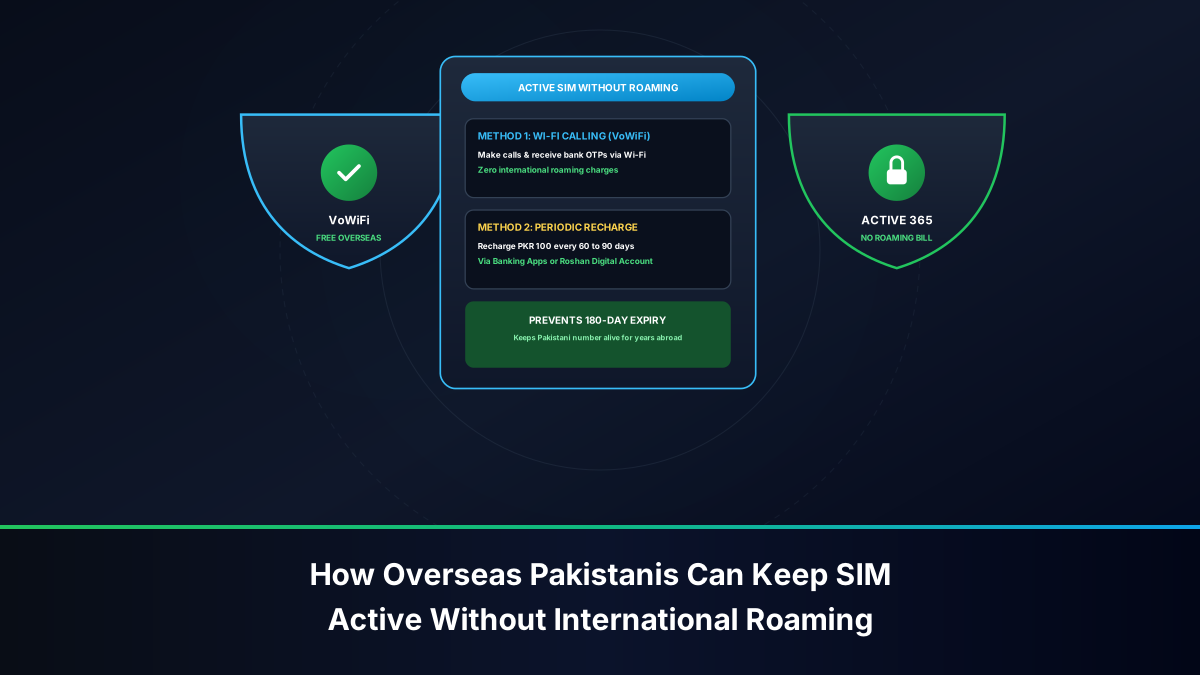
- Dormant ≠ Deleted: A SIM that sits unused in a drawer remains registered against your CNIC until the operator formally deactivates it after roughly 90 days of zero activity and recycles it after 180 days. During that entire window, it counts fully toward your 5-voice or 3-MBB ceiling.
- Ghost Lines Occupy Slots: Fraudulently activated connections on your identity consume quota exactly as your own lines do. A citizen whose 5 slots are consumed by ghost registrations cannot purchase a legitimate SIM until each ghost line is biometrically disowned.
- Recycled Numbers Free Slots: Once the clearinghouse processes a deactivation, the slot is restored automatically — but the recycled number may reappear on your 668 report under a stranger's name if the line was churned without formal de-registration, which is why cancellation with a stamped receipt is always preferable to abandonment.
- Corporate Lines Don't Leak: Company-issued connections under an NTN do not occupy personal slots, but verify with HR that your corporate fleet is genuinely registered under the company title rather than Bulk-activated on individual employee CNICs — a compliance failure that silently consumes staff quotas.
Household & Family Quota Planning Strategies
A five-member household operating informally on one patriarch's CNIC will exhaust 8 slots almost immediately, exposing every member to deactivation risk during audits. Compliant planning distributes connections across the identities that actually use them:
- One Identity, One User: Assign each adult family member their own CNIC for lines they personally use. A wife's SIM, a college student's SIM, and an elderly parent's SIM should each anchor to their own identity, not the household head's.
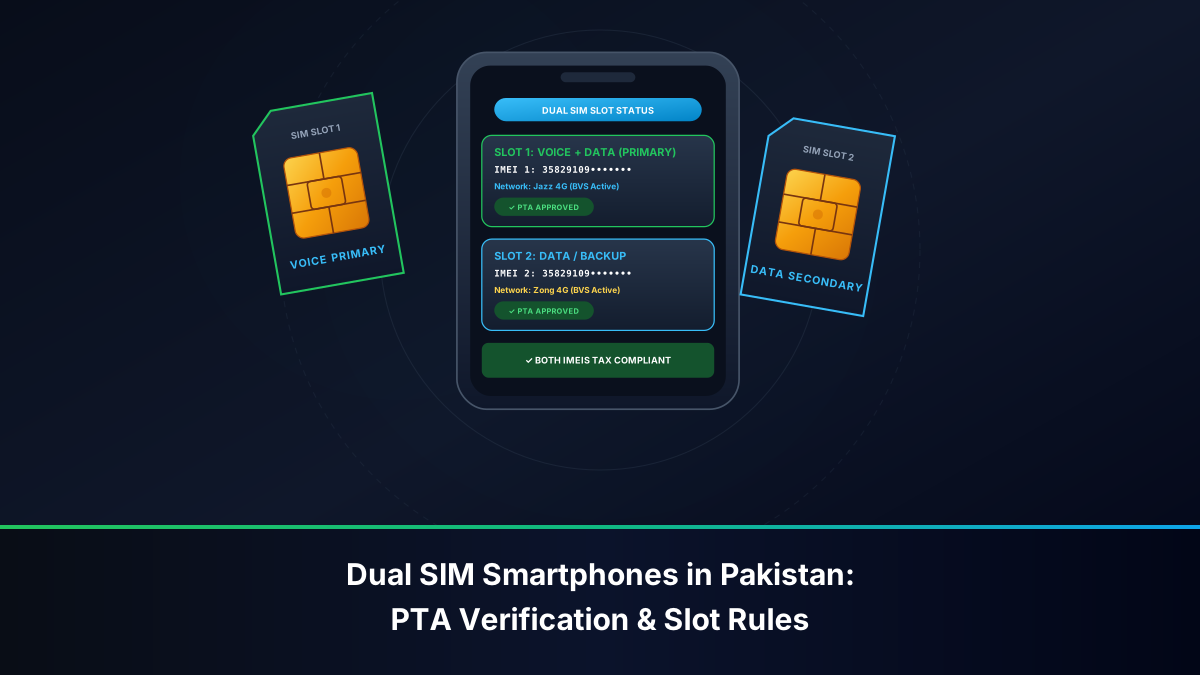
- Use Dual-SIM Handsets: A single phone carrying a personal voice line and a data line consumes two slots across two identities instead of two devices and four lines.
- Reserve MBB Slots for Shared Hardware: Home router SIMs are natural family assets; keep all 3 MBB allocations on one adult CNIC and voice allocations individual.
- Audit Each CNIC Quarterly: Run 668 checks for every adult identity in the household, catching ghost registrations while the quota is still recoverable and before a franchise counter rejection ruins a purchase trip.
- Transfer Beforehand, Not After: When a young adult receives their first CNIC at 18, biometrically transfer lines previously held on a parent's identity rather than leaving the family cluster unbalanced for years.
Common Rejection Scenarios at the Franchise Counter
Beyond straightforward quota saturation, several recurring situations block activation attempts at the BVS terminal, and each has a distinct remedy:
- Saturation by Ghost Lines: The 668 count shows 5 voice SIMs but you physically hold only 2. Remedy: obtain per-operator MSISDN statements at CSCs, biometrically disown the unknown numbers, wait 24–72 hours for clearinghouse sync, then retry the purchase.
- Deceased Identity Hold: Attempting a purchase while a deceased parent's lines remain active on your family cluster triggers regulatory flags once NADRA records the death. Remedy: complete the deceased-person transfer or cancellation process first.
- Identity Mismatch: Presenting a CNIC different from the one typed into the terminal, or a laminated photocopy instead of the original Smart CNIC, fails document validation before quota is even consulted.
- Minors Attempting Activation: Applicants under 18 cannot clear BVS because no adult biometric template exists for a B-Form. The parent must register the line under their own CNIC.
- Foreign Passport Expiry: Tourist SIM activation requires a passport with remaining visa validity; an expiring passport blocks activation regardless of the 2-SIM tourist quota remaining.
Counter Tip: Run the free cnic.sims.pk audit before traveling to the franchise. Arriving with an exact slot count — and disownment paperwork for any ghosts — converts a failed trip into a five-minute transaction.
Resolving a Saturated Quota: Cancellation, Surrender & Disowning
If your 668 audit reveals that your 5-voice SIM quota is completely full, you cannot activate a new number until a slot is restored. Follow this verified protocol to restore quota availability:
- Identify the Obsolete Connection: Determine which active line registered on your CNIC is redundant, unused, or in the possession of an unauthorized third party.
- Visit the Operator's Flagship Franchise: Proceed to an authorized customer care center of the operator that issued the unwanted connection. Carry your original physical Smart CNIC.
- Execute Biometric Cancellation: Request a permanent SIM de-allocation and surrender. Place your thumb on the BVS terminal to authenticate the voluntary disconnection.
- Allow Clearinghouse Synchronization: While the connection is severed from the cellular switch instantly, batch synchronization between the operator and the central PTA 668 database takes 24 to 72 hours.
- Re-audit via 668: Once your 668 count drops from 5 to 4 voice SIMs, visit any telecom center to purchase and biometrically activate your new cellular connection.
Statutory Penalties for Bypassing Quotas Under PECA 2016
Attempting to circumvent national SIM quota limits through fraudulent means carries severe statutory penalties under Pakistani criminal law:
- Section 17 of PECA 2016 (Unauthorized Identity Issuance): Fraudulently obtaining or activating SIM cards using another citizen's credentials, forged photocopies, or unauthorized biometric impressions carries penalties of up to 3 years of imprisonment and fines of up to PKR 5 million.
- Blacklisting Retailer Agents: Retail sales representatives who execute unauthorized double-scanning to activate ghost lines face permanent revocation of their BVS terminal credentials, blacklisting across the national telecom sector, and criminal prosecution by the FIA Cyber Crime Wing.
Comprehensive Regulatory Summary Matrix by Subscriber Category
The following table summarizes quota entitlements across all citizen and resident categories:
| Subscriber Category | Primary Identity Document | Voice SIM Limit | MBB Data SIM Limit | Maximum Total SIMs | Validity Period |
|---|---|---|---|---|---|
| Pakistani Citizen (Resident) | 13-Digit Smart CNIC | 5 Voice SIMs | 3 MBB SIMs | 8 Total SIMs | Lifetime / CNIC Expiry |
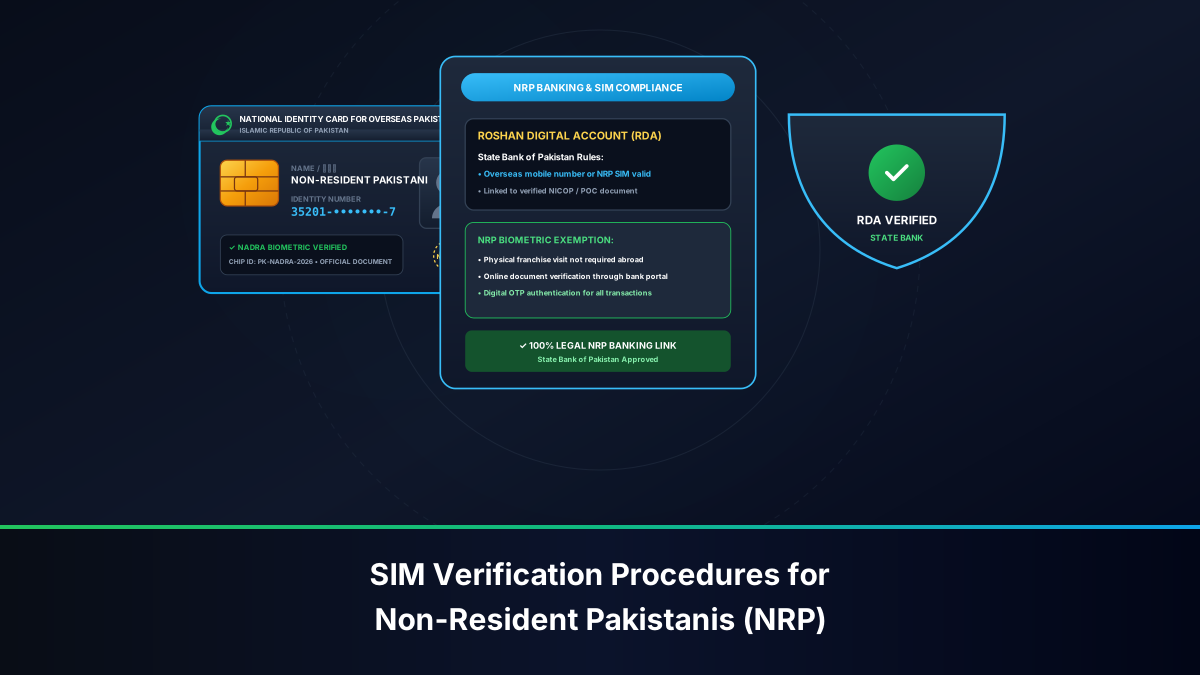
| Overseas Pakistani (Non-Resident) | 13-Digit NICOP / POC | 5 Voice SIMs | 3 MBB SIMs | 8 Total SIMs | NICOP Expiry Date |
| Foreign Tourist / Visitor | International Passport + Visa | 2 Voice SIMs | 0 MBB SIMs | 2 Total SIMs | Visa Expiry Window |
| Corporate Enterprise Account | National Tax Number (NTN) | Custom Approved | Custom Approved | Enterprise Quota | Corporate Contract Tenure |
| Minor (Under 18 Years) | B-Form / Juvenile Card | 0 (Prohibited) | 0 (Prohibited) | 0 SIMs | Parent Must Register |
Key Takeaways: Living Within the National Quota
The 5-voice, 3-MBB, 8-total framework is neither arbitrary nor negotiable: it is enforced cryptographically at the NADRA-PTA gateway on every biometric transaction in the country. Treat your quota as a finite national asset — audit it quarterly through 668, keep dormant lines formally cancelled rather than abandoned, distribute household connections across the identities that genuinely use them, and remember that porting, recycling, and corporate fleets each interact with the ceiling in specific, predictable ways. Subscribers who internalize these mechanics never see an ERROR 701 terminal message, and their identities remain clean anchors for banking, taxation, and lawful communication.