The Architectural Link Between Biometric SIMs and Microfinance Accounts in Pakistan
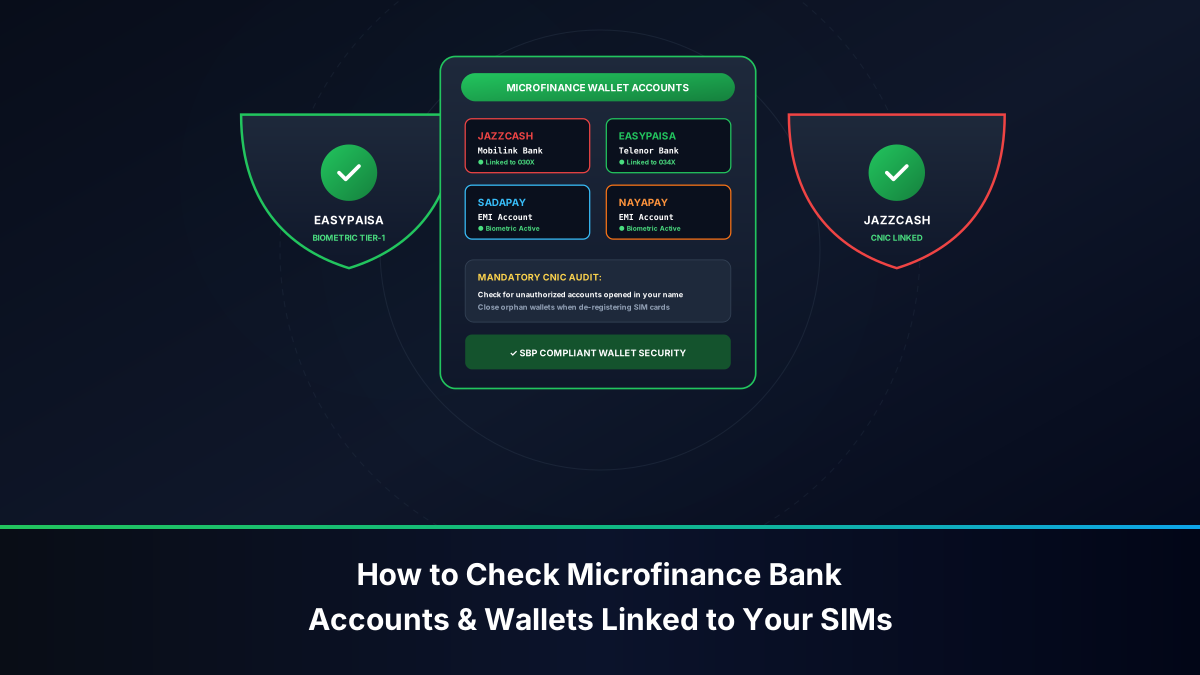
Over the past decade, Pakistan has undergone a dramatic financial inclusion revolution powered by Branchless Banking (BB) and Electronic Money Institutions (EMIs). Platforms such as JazzCash (operated by Mobilink Microfinance Bank Limited - MMBL), Easypaisa (operated by Telenor Microfinance Bank Limited - TCBM), UPaisa (U Microfinance Bank Limited), alongside digital challenger apps like SadaPay and NayaPay, have democratized financial access for over 60 million previously unbanked citizens.
However, the foundational architecture of this financial ecosystem relies completely on a single digital bridge: the 1-to-1 linkage between a citizen's 13-digit Computerized National Identity Card (CNIC) and their cellular mobile subscriber number (MSISDN). Every branchless banking account and microfinance wallet is fundamentally anchored to a biometrically verified SIM card provisioned through the Pakistan Telecommunication Authority (PTA) and National Database and Registration Authority (NADRA) biometric gateway.
When this linkage is breached—either through legacy retail loopholes, corrupt agent collusion, SIM swap fraud, or unauthorized identity theft—victims find themselves exposed to ghost accounts, predatory nano-loans, unexpected tax liabilities, and severe criminal investigations initiated by federal regulatory authorities.
State Bank of Pakistan (SBP) Branchless Banking Framework
The regulatory structure governing mobile financial services is established under the State Bank of Pakistan Branchless Banking Regulations (Circular No. 02 of 2011 and subsequent revisions up to 2026). The framework creates three distinct customer tiers:
- Level 0 Accounts: Designed for mass digital onboarding. Opened with basic CNIC validation, remote liveness capture, or USSD shortcodes. Subject to restricted transaction ceilings (typically PKR 50,000 per day and PKR 200,000 per month).
- Level 1 Accounts: Upgraded via mandatory in-person or digital biometric verification (BVS). Customers place a finger on a microfinance agent terminal or use smartphone camera contactless scanning. Ceilings expand to PKR 200,000 per day and PKR 1,000,000 per month.
- Level 2 Accounts: Full-fledged digital bank accounts requiring comprehensive customer due diligence (CDD/KYC), income proof, and proof of address, functioning essentially like commercial current accounts.
Under SBP regulations, a microfinance bank is strictly prohibited from opening or maintaining an account without real-time API verification against NADRA's Verisys or BVS infrastructure. Furthermore, the mobile number utilized during registration must strictly belong to the same CNIC holder.
How the MSISDN Functions as a Core Financial Account Number
Unlike conventional commercial banks (e.g., Habib Bank Limited, Meezan Bank, or MCB) where an account number consists of a 16-digit internal code mapped to a 24-character International Bank Account Number (IBAN), microfinance wallets use the customer's 11-digit mobile telephone number (MSISDN: 03XXXXXXXXX) directly as the primary account identifier.
All transactional security mechanisms—including One-Time Passwords (OTPs), Mobile Banking PIN (MPIN) resets, authorization alerts, and 1LINK interbank switch handshakes—are routed exclusively through that cellular subscriber identity. If an individual loses control of a SIM, or if an unauthorized SIM is activated under their CNIC, malicious actors can seamlessly access the associated financial conduits.
The Threat of Ghost Wallets and Unauthorized Micro-Loans
While the digitalization of microfinance has accelerated commerce, it has created lucrative avenues for sophisticated cyber syndicates, unscrupulous field agents, and illegal lending networks. Victims frequently remain completely oblivious to accounts opened in their name until bailiffs, bank recovery agents, or federal investigators arrive at their doorstep.
Illegal Nano-Lending Apps and Fraudulent Account Spawning
Between 2022 and 2026, Pakistan's financial regulators encountered an explosion of unregulated, predatory nano-lending applications (e.g., platforms advertising "Instant 5-Minute Cash Loans" across social media). These unauthorized syndicates operated through a multi-tier fraud mechanism:
- Identity Harvesting: Applicants were instructed to upload high-definition photographs of the front and back of their Smart CNIC alongside a live selfie under the pretext of loan eligibility checking.
- Secondary Wallet Creation: Using harvested CNIC images and colluding with unethical retail franchise agents, fraudsters provisioned duplicate or secondary SIM cards and spun up unauthorized Level 0 or Level 1 accounts on JazzCash, Easypaisa, or UPaisa.
- Disbursement & Default: Micro-loans ranging from PKR 5,000 to PKR 50,000 were borrowed from legitimate microfinance institutions (e.g., ReadyCash, Easycash) through the ghost wallets. The funds were instantly transferred across laundering chains to cryptocurrency exchanges or untraceable cash-out points.
- Liability Transfer: The legitimate microfinance bank logged the defaulted loan under the victim's 13-digit CNIC in the national credit repository, ruining the victim's financial reputation.
BISP / Social Welfare Benami Accounts & Money Laundering Mules
Another prevalent abuse involves social welfare disbursements, such as the Benazir Income Support Programme (BISP) or provincial cash transfer programs. Fraudulent networks harvest CNICs belonging to impoverished rural citizens or uneducated laborers under the guise of ration subsidies. These identities are utilized to establish corporate agent accounts or personal wallets through which illicit proceeds from illegal betting platforms, gray telecom traffic termination, and extortion are laundered (functioning as money mules).
Comprehensive Matrix: Pakistan's Microfinance Banks & Digital Wallets
To conduct a comprehensive audit, one must understand the complete institutional landscape of licensed microfinance banks (MFBs) and authorized Electronic Money Institutions (EMIs) operating under SBP oversight:
| Institution Name | Flagship Digital Wallet | Parent / Affiliated Telco | Helpline (from Own Network) | Universal / Inter-Bank Helpline | Primary USSD Code |
|---|---|---|---|---|---|
| Mobilink Microfinance Bank Limited (MMBL) | JazzCash | Jazz (PMCL) | 4444 | (021) 111-124-444 | *786# (Jazz only) |
| Telenor Microfinance Bank Limited (TCBM) | Easypaisa | Telenor Pakistan | 3737 | (042) 111-003-737 | *786# (Telenor only) |
| U Microfinance Bank Limited (UMFB) | UPaisa | Ufone / PTCL Group | 7777 | (051) 111-282-777 | *786# / *878# |
| Khushhali Microfinance Bank Limited | Khushhali Pay / Portal | Independent Consortium | — | (051) 111-047-047 | — (App / Branch only) |
| FINCA Microfinance Bank Pakistan | SimSim / FINCA Digital | FINCA Impact Finance | — | (042) 111-111-562 | — (Mobile App) |
| NRSP Microfinance Bank Limited | NRSP Mobile Banking | National Rural Support | — | (062) 111-011-011 | — (Branch / Mobile) |
| SadaPay Technologies (Pvt) Ltd | SadaPay (EMI Wallet) | Independent EMI (SBP) | — | (021) 3889-7232 | In-App Live Chat Only |
| NayaPay (Pvt) Ltd | NayaPay (EMI Wallet) | Independent EMI (SBP) | — | (021) 111-162-927 | In-App Live Chat Only |
Audit Method 1: Generating Your Official SBP e-CIB Credit Report
The single most powerful, definitive, and legally binding instrument to audit every financial liability registered under your national identity is the Electronic Credit Information Bureau (e-CIB) Consumer Credit Report maintained directly by the State Bank of Pakistan.
Accessing the SBP Consumer e-CIB Portal & Data Verification
Under SBP guidelines, every citizen has the statutory right to inspect their credit record. You can obtain your formal credit report via two established channels:
- State Bank Direct e-CIB Consumer Desk: Visit the SBP Consumer e-CIB online registration portal or the nearest State Bank Banking Services Corporation (SBP-BSC) field office located in provincial capitals and divisional centers (Karachi, Lahore, Islamabad, Peshawar, Quetta, Faisalabad, Multan, etc.). Submit your original CNIC and a verified mobile contact.
- Licensed Private Credit Bureaus: The SBP has licensed private credit bureaus—primarily Tasdeeq (Credit Chex Ltd) and DataCheck (Pvt) Ltd. Through their secure mobile applications (e.g., the Tasdeeq Consumer App), citizens can complete digital identity verification, pay a statutory fee (typically PKR 400 to PKR 800), and generate an instant credit report PDF within 10 minutes.
Interpreting Outstanding Facilities, Loan Inquiries, and Ghost Credit
Once you open your credit report, carefully scrutinize the following sections:
- Credit Facilities Summary: This table categorizes all funded and non-funded limits. Under "Microfinance Sector", examine the total count of active accounts. If you have never opened an account with Mobilink Bank, Telenor Bank, or U Microfinance Bank, but the report lists active credit lines, an unauthorized account exists under your CNIC.
- Facility Breakdown & Lender Names: Check each specific institution row. Look for micro-lending products like "Nano Cash Loan", "Bullet Financing", or "Running Finance". Note the sanctioned limit, outstanding balance, and repayment track record (historical overdue status marked as 30, 60, 90, or 180+ days past due).
- Inquiry History: The report records every instance where any bank, microfinance company, or fintech platform queried your credit history over the preceding 24 months. If an unknown lending company queried your CNIC, it indicates that an entity attempted to process an unauthorized loan application using your identity.
Audit Method 2: Multi-Platform Wallet Query & USSD Audit Protocols
While the e-CIB report captures accounts with credit lines, pure transaction wallets with zero credit exposure might not trigger an e-CIB loan record. Therefore, you must perform direct operational queries across all major branchless platforms.
JazzCash (Mobilink Microfinance Bank): 786# & 4444 Audit Procedures
To verify if JazzCash accounts exist on your CNIC:
- On-Net Check (Jazz SIM): If you hold an active Jazz SIM registered to your CNIC, dial
*786#. If an account is active, the system prompts for your 4-digit MPIN. If no account exists, it prompts you to open a new account by accepting terms and entering your CNIC issuance date. - Off-Net Cross-Audit: Even if you do not use Jazz, an unauthorized person might have registered a Jazz SIM under your CNIC and activated JazzCash. First verify your total SIM count via the PTA 668 SMS service (send CNIC to
668). If an unauthorized Jazz SIM appears on your record, call the JazzCash Fraud Helpline at021-111-124-444. Request the agent to query their core database for any active wallets linked to your 13-digit CNIC. Provide identity verification answers to confirm ownership.
Easypaisa (Telenor Microfinance Bank): 3737 & 786# Inquiries
For Easypaisa:
- Dial *786# on Telenor: Review existing account configuration. Check Account Details -> My Profile to view the registered CNIC and wallet status.
- Helpline Verification: Call
3737(from a Telenor number) or042-111-003-737(from any network). Request a "National Identity Wallet Reconciliation". The banking representative can search their core banking software (T24 / BaNCS) using your CNIC to confirm whether any active or suspended Easypaisa mobile account, Asaan Digital Account, or Nano-loan facility is tied to your identity.
UPaisa (U Microfinance Bank): 7777 & 878# Protocols
For UPaisa:
- Dial
*786#or*878#from an active Ufone SIM. - Alternatively, contact U Microfinance Bank corporate customer support at
7777or051-111-282-777. Request a full audit of all branchless accounts and micro-credit portfolios tied to your 13-digit CNIC.
Auditing EMI Wallets: SadaPay, NayaPay, and Finja
Electronic Money Institutions operate purely via mobile applications and do not provide USSD menus. To check for unauthorized accounts:
- Download the SadaPay and NayaPay applications onto your smartphone.
- Attempt to initiate an onboarding flow using your primary mobile number and CNIC.
- If the application outputs an error message stating: "This CNIC is already registered with an existing account / phone number", an unauthorized party has created a wallet using your identity credentials.
- Immediately contact in-app customer support or email
hello@sadapay.pk/support@nayapay.com, submitting a photograph of your original physical CNIC to trigger an emergency security freeze.
Audit Method 3: Raast Instant Payment Directory Interrogation
The State Bank of Pakistan's Raast Central Directory acts as a universal, authoritative clearinghouse mapping individual Pakistani citizens' mobile numbers to their respective International Bank Account Numbers (IBANs).
How Raast Maps 13-Digit CNICs to Cellular Numbers
When a customer enables Raast in any Pakistani banking application (e.g., Meezan, HBL, Bank Alfalah, JazzCash, Easypaisa), their mobile number (03XXXXXXXXX) is registered as their unique Raast ID. SBP rules strictly enforce a 1-to-1 relationship: an individual mobile number can only be linked to a single destination IBAN at any given moment.
Resolving Conflicting Raast Aliases Across Multiple Bank Apps
You can leverage Raast's architectural design to uncover where your phone number is currently tethered:
- Open your legitimate, daily-use mobile banking app (for example, Meezan Mobile App or HBL Mobile).
- Navigate to the Raast Management or Link Raast ID section.
- Attempt to link your primary mobile number to your primary bank account.
- If your mobile number is already linked to an unauthorized microfinance wallet (such as an unknown JazzCash or Easypaisa account), the app will display a notification: "Your mobile number is already linked with another financial institution (Bank Code: TCBM / MMBL / UMFB). Do you wish to delink and switch?"
- This prompt explicitly reveals the exact institution holding an active wallet under your number. You can force-delink the alias to disrupt unauthorized transaction routing.
Step-by-Step Roadmap: Delinking & Closing Fraudulent Accounts
If your audit reveals an unauthorized microfinance bank account or mobile wallet registered under your CNIC, follow this systematic remediation roadmap to eliminate your liability:
Filing a Formal Written Dispute with the Microfinance Institution
Never rely solely on verbal discussions with customer helpline agents. Establish an undeniable paper trail:
- Draft a formal dispute letter addressed to the Head of Fraud Risk Management / Grievance Redressal Officer of the respective institution (e.g., Mobilink Microfinance Bank, F-8 Markaz Islamabad, or Telenor Microfinance Bank, DHA Phase 6 Karachi).
- Clearly state: "I, [Full Name], CNIC No. [XXXXX-XXXXXXX-X], declare under oath that Account No. [MSISDN/IBAN] was established without my knowledge, consent, or physical/biometric presence. I have never operated this account or received any loan disbursement."
- Attach a clear, verified photocopy of your original Smart CNIC (watermarked across the center: "Only for Dispute Redressal at [Bank Name] - 2026") and your PTA 668 SIM ownership statement proving you do not own the associated phone line.
- Demand a formal Complaint Reference Number and a signed acknowledgment receipt.
Account Termination, Fund Freezing & Securing a No-Objection Certificate (NOC)
Under SBP Consumer Protection Directives, upon receipt of an identity theft complaint, the bank must immediately place the disputed account in Total Debit/Credit Freeze (Post No Debit) mode. The bank's forensic unit must inspect the original BVS logs (IP address, retail agent terminal ID, timestamp, and liveness audit frames).
Once the investigation concludes that the account was fraudulently spawned, demand a written, official No-Objection Certificate (NOC) / Clean Clearance Letter. Ensure this document explicitly states that the CNIC holder bears zero financial liability for any past, present, or future transactions or credit defaults associated with the fraudulent account.
Regulatory Escalation: SBP Banking Mohtasib & FIA Cybercrime
If the microfinance bank fails to resolve your dispute within 30 calendar days, or continues to harass you for loan recovery, escalate the matter through statutory regulatory and law enforcement mechanisms:
Filing an Adjudication Petition with the Banking Mohtasib Pakistan
The Banking Mohtasib (Ombudsman) Pakistan is an independent statutory tribunal established under the Banking Companies Ordinance 1962 to adjudicate consumer grievances against commercial and microfinance banks:
- Visit the official portal at
https://www.bankingmohtasib.gov.pk/. - Submit an online complaint enclosing copies of your CNIC, your formal dispute letter to the bank, the bank's rejection or refusal to respond within 30 days, and your e-CIB report showing the adverse entry.
- The Banking Mohtasib possesses statutory authority to summon senior bank executives, compel the bank to write off fraudulent liabilities, rectify tainted e-CIB records with the State Bank, and award damages for harassment.
Criminal Reporting via FIA CCW under PECA 2016
Opening an unauthorized digital bank account through identity theft constitutes multiple serious federal offenses under the Prevention of Electronic Crimes Act (PECA) 2016:
- Section 13: Electronic Forgery (manipulation of digital account records).
- Section 14: Electronic Fraud (unauthorized acquisition of financial facilities).
- Section 16: Unauthorized Use of Identity Information (harvesting and exploiting a citizen's CNIC).
To lodge a criminal complaint, visit your regional Federal Investigation Agency (FIA) Cyber Crime Reporting Centre or register via the online portal at https://complaint.fia.gov.pk/. An official First Information Report (FIR) shields you from secondary legal persecution by debt collection agencies or law enforcement units tracking financial fraud.
Best Practices for Safeguarding Your Financial SIM Identity
Preventative vigilance is substantially easier than resolving entrenched identity theft. Incorporate these proactive cybersecurity habits into your routine:
- Audit Your PTA SIM Registry Biannually: Send an empty SMS or your CNIC (without hyphens) to
668every six months, or visithttps://cnic.sims.pk/. Ensure every single SIM card listed across Jazz, Zong, Telenor, and Ufone is physically inside your possession. Cancel any unknown or disused numbers immediately at authorized franchises. - Watermark Every Document Photocopy: Never provide an unannotated photocopy of your CNIC to anyone—whether renting property, buying a vehicle, or applying for a job. Draw two parallel lines across the face of the document in blue ink and write: "Submitted solely for [Specific Purpose] - Date: [DD/MM/YYYY]". This prevents corrupt clerks from scanning or duplicating your document for wallet onboarding.
- Enable SIM PIN & eSIM Protection: Configure a 4-digit SIM PIN on your mobile device (via iOS/Android Cellular Settings). If your phone is physically stolen, thieves cannot insert your SIM into another handset to extract OTPs or reset mobile wallet MPINs.
- Guard Your Secret MPIN & OTPs: No bank, telecom representative, PTA official, or military officer will ever ask for your 4-digit wallet MPIN or a 6-digit transaction OTP. Treat any caller requesting verification codes as an active cyber attacker.
- Monitor SBP e-CIB Annually: Pull your official credit report once every calendar year to detect fraudulent loan accounts, phantom credit lines, or unauthorized banking inquiries before they inflict catastrophic damage on your credit profile.
Frequently Asked Questions
Review the comprehensive FAQ section at the top of this guide for detailed regulatory answers regarding branchless banking limits, fraud mitigation, and legal escalation protocols.