The Critical Golden Hour: Immediate Protocol When Your Mobile SIM is Lost or Snatched
Losing a smartphone through street snatching, theft, or misplacement is an intense and disorienting ordeal. However, in modern Pakistan, the physical smartphone hardware is often the least consequential asset at stake. The true crown jewel inside that handset is your cellular Subscriber Identity Module (SIM) card. In the contemporary digital ecosystem governed by the State Bank of Pakistan (SBP) and the Pakistan Telecommunication Authority (PTA), your mobile phone number serves as your primary cryptographic identity anchor. It binds directly to your 13-digit Computerized National Identity Card (CNIC), your Raast instant payment alias, your commercial bank accounts (such as HBL, Meezan Bank, Alfalah, Allied Bank), digital micro-wallets (JazzCash, Easypaisa, SadaPay, NayaPay), and end-to-end encrypted messaging services like WhatsApp, Telegram, and Signal.
If an opportunistic thief or professional cybercriminal obtains possession of an unlocked or un-PIN-protected SIM card, they do not require your smartphone lock screen passcode. By merely popping the physical nano-SIM out of your handset using a paperclip and sliding it into an unlocked burner device, they can intercept high-priority Application-to-Person (A2P) Short Message Service (SMS) One-Time Passwords (OTPs) within seconds. Within the first thirty to sixty minutes—universally known by cybersecurity professionals as the Golden Hour—attackers can initiate unauthorized password resets across financial portals, execute drain transactions via Raast or branchless banking wallets, impersonate you to your personal contacts for emergency loans, or expose private personal media.
Furthermore, under statutory provisions established by the Prevention of Electronic Crimes Act (PECA) 2016 and PTA regulatory enforcement directives, the registered CNIC holder remains legally and criminally accountable for all cellular traffic, transmission metadata, and electronic transactions originating from their assigned MSISDN until an official report of loss or theft is logged with the respective licensed carrier. Consequently, knowing how to execute an immediate remote SIM deactivation via telephonic customer care helplines is a non-negotiable personal security skill for every Pakistani citizen.
Official Operator Helplines & Alternative Numbers for Remote Blocking
When your mobile handset is lost or stolen, you cannot use your own phone to dial standard shortcodes like 111 or 310. You must rely on an alternate communication channel: a family member's smartphone operating on the same network, a friend's connection on a competing cellular network, or a traditional landline connection (such as PTCL). Each mobile network operator (MNO) in Pakistan maintains dedicated 24/7 inbound trunk lines engineered to handle urgent customer assistance, fraud containment, and lost SIM deactivations.
| Cellular Carrier | Calling from Same Network | Calling from Competing Network / PTCL Landline | Overseas Roaming Emergency Helpline | Digital Self-Care Channels |
|---|---|---|---|---|
| Jazz (PMCL) | 111 |
042-111-300-300 / 021-111-300-300 |
+92-300-8200111 |
WhatsApp Self-Service: 0300-3008000 |
| Zong (CMPak) | 310 |
051-111-222-111 |
+92-310-9222111 |
My Zong Portal / Corporate Web Chat |
| Telenor Pakistan | 345 |
042-111-345-100 / 051-111-345-100 |
+92-345-1110345 |
My Telenor Self-Care / WhatsApp: 0345-1800444 |
| Ufone 4G (PTML) | 333 |
051-111-333-100 / 042-111-333-100 |
+92-333-5100033 |
My Ufone Web Portal / WhatsApp: 0335-9333333 |
Pro Tip: Keep these UAN numbers saved in the contacts of family members or documented in a secure cloud repository so you are never caught scrambling during an unexpected street crisis.
Step-by-Step Interactive Workflow for Urgent Remote Blocking
Navigating automated Interactive Voice Response (IVR) phone trees during a high-stress crisis can feel frustratingly slow. Telco customer menus are frequently congested with promotional marketing, package subscription options, and tune services before reaching a human representative. Follow this structured roadmap to bypass promotional delays and secure an immediate connection to the fraud and loss division:
- Initiate the Telephonic Call: Dial the appropriate operator helpline listed above using any available working phone. If you are calling from a competing carrier (e.g., using a Zong SIM to block a lost Jazz line), you must dial the regional area code prefix followed by the 111 UAN string (e.g.,
042-111-300-300). Standard call rates apply according to your current provider's out-of-bundle tariff. - Select Language: The automated system will first prompt you to select your preferred language. Press
1for Urdu or2for English. Opting for Urdu often links you to larger call center queues with shorter average hold times. - Navigate to Value Added Services & Complaints: Listen closely to the top-level menu. Avoid options for internet bundles, balance recharges, or call packages. Typically, the IVR assigns key
0,4, or9for "Complaints, Lost SIM, or Speak with a Customer Care Executive". - Enter the Target Lost Mobile Number: The IVR will ask whether you are calling regarding the number you are dialing from or an alternate number. Select "Alternate Number" and input the 11-digit mobile number of the lost SIM card (e.g.,
03001234567), ending with the pound key (#). - State Emergency Purpose Directly: Once connected to a live customer service representative, immediately assert: "My mobile phone was lost/snatched ten minutes ago. I need an emergency temporary outgoing and incoming suspension placed on my SIM card immediately to prevent fraudulent usage." This instruction signals high priority and prevents the agent from attempting cross-sell retention conversations.
The Identity Verification Matrix: Security Questions Asked by Telco Agents
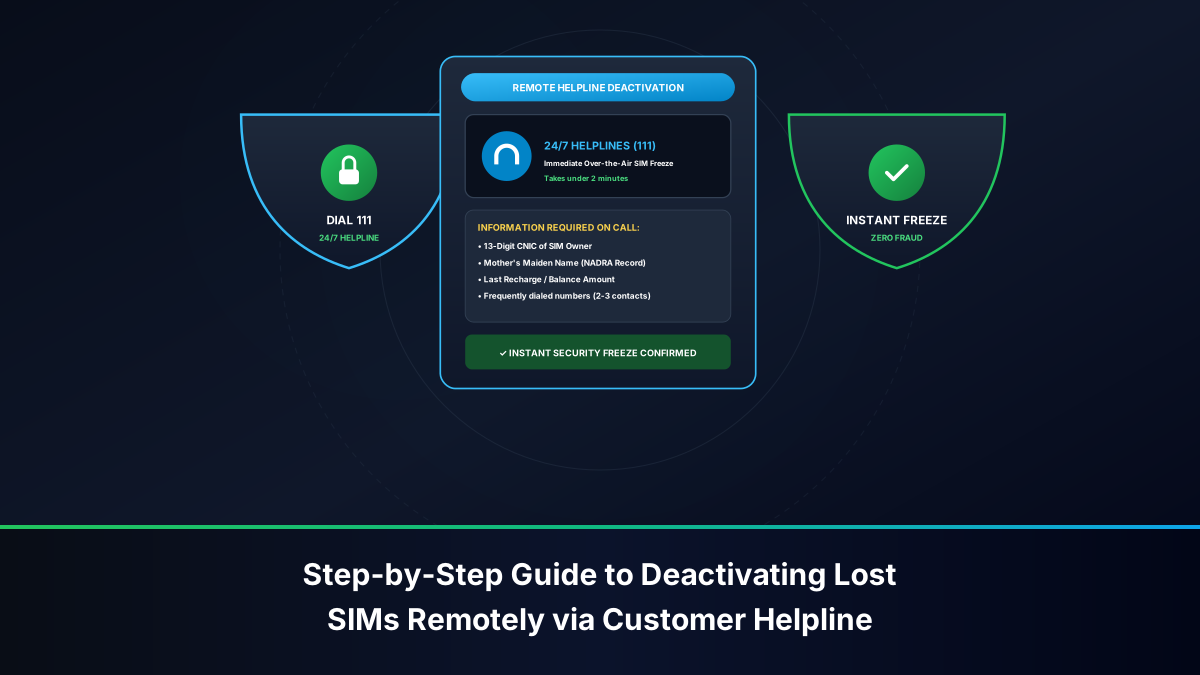
Because malicious actors could attempt social engineering attacks by calling telco helplines to arbitrarily shut down an adversary's business or personal line, PTA regulations require customer care personnel to conduct a rigorous telephonic interrogation. You must establish conclusive proof that you are the lawful, biometrically verified owner of that MSISDN before the agent toggles the deactivation flag in the carrier's Home Location Register (HLR) or Home Subscriber Server (HSS).
Prepare yourself mentally to answer the following verification parameters accurately without hesitation:
- Full Name as Registered with NADRA: Provide your complete legal name exactly as printed on your Smart CNIC, National Identity Card for Overseas Pakistanis (NICOP), or Passport. Avoid using nicknames, shortened family names, or commercial aliases.
- 13-Digit CNIC Number: State your full identity card number clearly without pausing. Example:
35201-1234567-1. The agent's interface matches this against the centralized Pakistan Mobile Database (PMD) repository. - CNIC Expiration or Date of Issuance: Representatives frequently request either the date of card issuance or the exact expiry date printed on your physical card. This filters out adversaries who may possess your CNIC number through a public data breach but lack sight of the physical document.
- Mother's Maiden Name / Place of Birth: In compliance with NADRA identity screening standards, customer service representatives may request secondary demographic data, such as your mother's legal name or district of birth.
- Recent Financial Activity (Last Recharge Details): This is one of the strongest live authentication factors. You will be asked: "What was the exact amount of your last mobile balance recharge or Easyload?" and "On what date or through which payment channel (e.g., JazzCash, banking app, retail scratch card) was it processed?" Even an approximate figure (e.g., "PKR 250 loaded three days ago via bank transfer") satisfies the compliance threshold.
- Frequently Dialed MSISDNs: You must supply two or three mobile numbers that you regularly call or message. Representatives cross-examine your responses against recent Call Detail Records (CDRs) stored in their real-time mediation engine.
- Active Value-Added Services (VAS) & Packages: Mentioning active recurring packages—such as a monthly hybrid bundle, weekly YouTube package, or caller tunes—provides immediate corroboration of legitimate account ownership.
Temporary Suspension vs. Permanent Line Deactivation: Key Differences & Repercussions
When communicating with customer support personnel, precision of terminology is paramount. Subscribers frequently confuse Temporary Suspension with Permanent Deactivation, leading to unintended administrative headaches and potential loss of cherished phone numbers.
| Evaluation Metric | Temporary Helpline Suspension | Permanent Line Termination | Franchise Duplicate Replacement |
|---|---|---|---|
| Channel of Execution | 24/7 Telephone Customer Helpline | Official Franchise Visit / Formal Written Request | Official Franchise / Customer Care Center |
| Biometric BVS Requirement | None (Telephonic Verification Only) | Mandatory Live Thumbprint Scan | Mandatory Live Thumbprint Scan |
| Network Radio Signaling | Completely Disabled (No Calls, SMS, Data) | Connection Terminated on HLR/HSS | Transferred Instantly to Fresh SIM IMSI |
| Preservation of Mobile Number | Guaranteed (Number remains reserved to CNIC) | Forfeited (Transfers to 180-Day Recycle Pool) | Guaranteed (Same number activated on new card) |
| Account Balance & Bundles | Frozen and preserved | Completely forfeited | Carried forward seamlessly to new SIM |
| Reactivation Protocol | Requires physical franchise visit for duplicate | Cannot be reversed once churn cycle finishes | Immediate restoration upon BVS thumbprint |
Always instruct the helpline executive to execute a temporary emergency suspension due to loss or theft. Never instruct them to "cancel my connection" or "delete my SIM from the system". If a line is permanently terminated, you risk forfeiting your primary contact number forever. Under PTA's mandatory Subscriber Churn and Number Allocation Regulations, any prepaid number that remains permanently deactivated or un-recharged for 180 consecutive days is returned to the public pool and re-issued to a total stranger.
Financial Protection Protocols: Safeguarding SBP Bank OTPs, Raast, JazzCash & Easypaisa
While placing an emergency block on your cellular SIM card terminates incoming radio transmission, your financial security checklist is only halfway complete. In sophisticated cybercrime rings operating across major metropolitan centers in Pakistan, perpetrators specialize in high-speed digital account draining. If your smartphone was snatched while unlocked, or if the perpetrator manages to bypass your lock screen security, they may exploit active sessions in mobile banking applications before the telecom helpline agent finishes updating the cellular network switch.
Execute this mandatory financial containment protocol immediately after finishing your call with the cellular operator:
- Call Your Bank's 24/7 Fraud Contact Center: Dial your commercial bank's emergency customer service line (e.g., Meezan Bank:
021-111-331-331, HBL:021-111-111-425, Bank Alfalah:021-111-225-111). Instruct the fraud representative to: "Immediately freeze my internet banking credentials, revoke mobile application device binding, and place a temporary hold on all outgoing Raast and 1Link fund transfers." - Deactivate Linked Debit & Credit Cards: If your physical cards were carried in a wallet that was stolen alongside your mobile handset, instruct the bank agent to block your physical debit and credit cards immediately to prevent unauthorized contactless (NFC) POS tapping or domestic ATM withdrawals.
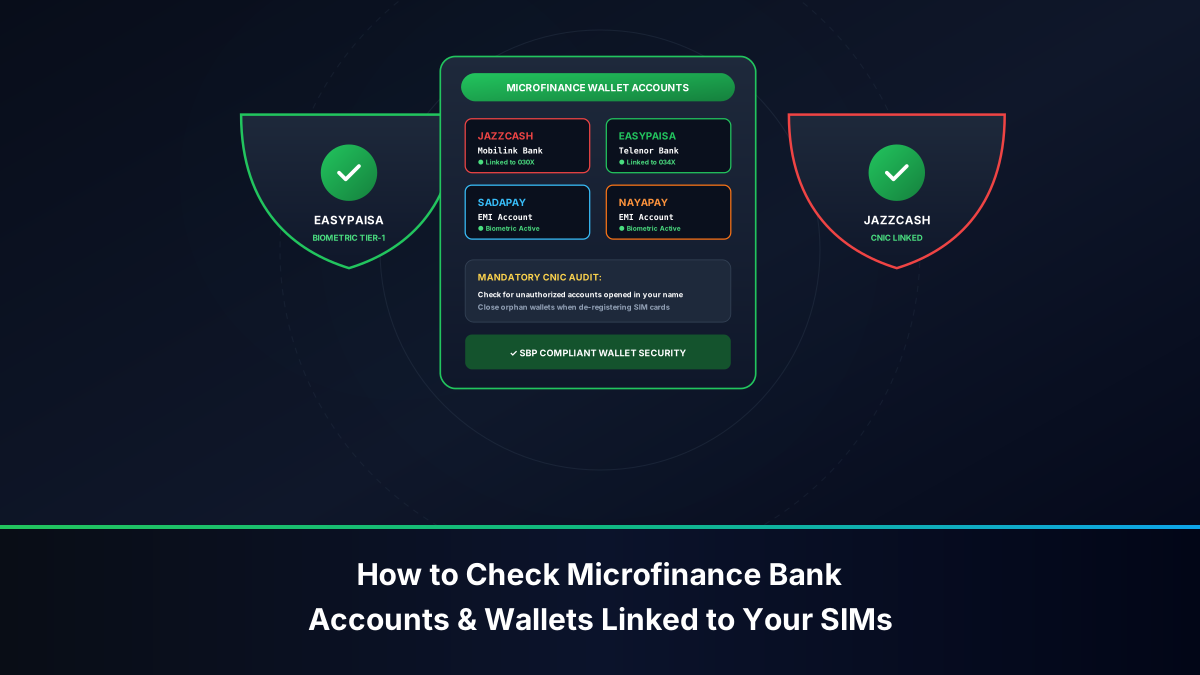
- Suspend Branchless Wallets (JazzCash & Easypaisa): Digital micro-wallets present immense vulnerability because their transaction PINs are typically short 4-digit codes. If you lost a Jazz SIM, call JazzCash at
4444(or042-111-124-444from an alternate carrier). If you lost a Telenor SIM, contact Easypaisa at3737(or042-111-003-737). Request a full emergency wallet lock. - Understand the SBP 24-Hour Cooling Off Period: The State Bank of Pakistan mandates that whenever a duplicate SIM card is issued at a telecom franchise, the operator's signaling network broadcasts an automated
SIM_SWAP_FLAGto the centralized Pakistan Mobile Database (PMD). Core banking gateways ingest this feed in real time. Consequently, high-risk financial transactions and mobile app logins will be automatically restricted for 24 hours following your eventual SIM replacement. This regulatory safeguard is deliberately designed to protect your life savings from rogue SIM-swap cyber syndicates.
Dual Layer Defense: Blacklisting Handset IMEI via PTA DIRBS & CPLC 1102
Deactivating your lost SIM card neutralizes communication and OTP interception risks, but it leaves the stolen physical hardware fully functional. A thief can simply wipe the smartphone via recovery mode, insert an alternate unregistered or illegal SIM card, and resell the phone in the grey market (such as Hall Road in Lahore, Saddar in Karachi, or Singapore Plaza in Rawalpindi). To transform your stolen smartphone into a useless electronic paperweight, you must blacklist its International Mobile Equipment Identity (IMEI) across all cellular base stations in Pakistan.
The Pakistan Telecommunication Authority operates the globally recognized Device Identification, Registration and Blocking System (DIRBS). When an IMEI is flagged as stolen in DIRBS, all national telecom carriers (Jazz, Zong, Telenor, Ufone) automatically reject cellular handshakes originating from that physical hardware, rendering it incapable of placing calls, receiving SMS, or establishing 4G/5G mobile data sessions.
- How to Obtain Your IMEI Number: Your handset's unique 15-digit IMEI number is printed on the original retail packaging box, documented on your purchase invoice, and accessible via your Google Find My Device or Apple iCloud account profiles. Dual-SIM smartphones possess two distinct IMEI numbers (IMEI-1 and IMEI-2); both must be reported.
- Reporting to PTA Consumer Support: Call the PTA toll-free helpline at
0800-55055(operating Monday through Friday, 9:00 AM to 5:00 PM) or lodge an electronic incident report via the PTA Consumer Management System (CMS) web portal atcms.pta.gov.pk. Provide your CNIC, mobile number, lost date, city, and 15-digit IMEI strings. - Reporting via CPLC (Sindh / Karachi Residents): If the incident transpired within Karachi or broader Sindh, contact the Citizens-Police Liaison Committee (CPLC) by dialing
1102or calling021-35682222. CPLC maintains real-time operational integration with Sindh Police and PTA DIRBS to expedite handset blocking and assist in police recovery raids. - Punjab Safe City Authority (PSCA): In Punjab, notify the Safe City 15 emergency center. Surveillance cameras operating under automated number plate recognition (ANPR) and facial recognition systems cross-reference incident timestamps and street geo-coordinates to track escape trajectories.
Issuing a Duplicate SIM at the Franchise: Biometric Verification & Fees
Once you have stabilized your emergency situation by executing telephonic helpline deactivations and locking linked banking gateways, you can proceed to restore your cellular service. To regain full control over your mobile phone number, you must physically visit an authorized service center or company-owned franchise to procure a Duplicate SIM Card.
- Locate an Official Customer Center or Franchise: Whenever feasible, visit a primary, company-owned flagship customer experience center rather than a third-party retail mom-and-pop shop. Official corporate centers possess higher security standards, surveillance cameras, and senior supervisory staff equipped to handle compromised or stolen accounts smoothly.
- Mandatory Documentation: You must present your original, unexpired physical Smart CNIC or NICOP. Photocopied identity cards, soft copies on other smartphones, or expired manual identity papers are strictly rejected under PTA consumer verification regulations.
- Biometric Fingerprint Authentication: Place your designated fingers on the NADRA-integrated Biometric Verification System (BVS) optical scanner. The terminal connects to the central NADRA database via encrypted API tunnels, validating your live fingerprint ridges against national civil records. Once a positive biometric match is verified, the carrier's provisioning engine unbinds your mobile number from the lost SIM's IMSI and binds it immediately to the new, blank micro/nano SIM card in the representative's hands.
- Standard Replacement Fees: The standard tariff for a duplicate prepaid or postpaid SIM card ranges from PKR 100 to PKR 300 (inclusive of applicable government taxes), depending on the operator and whether you are receiving a physical SIM or an electronic eSIM profile. Always demand an official, computer-generated sales receipt to prevent retail overcharging.
- Reactivation Timeline: The new physical SIM card activates cellular signaling within 15 minutes to 2 hours of completing the biometric scan. Simply insert the new SIM into your replacement smartphone, restart the device, and verify signal bars. Outgoing voice calls, SMS, and data connections will function immediately, though banking OTPs will remain subject to the mandatory SBP 24-hour financial cooling freeze.
Overcoming Common Remote Deactivation Roadblocks & Edge Cases
While the remote deactivation workflow is theoretically straightforward, real-world execution often runs into frustrating operational friction. Here is how seasoned telecom technicians troubleshoot common edge cases:
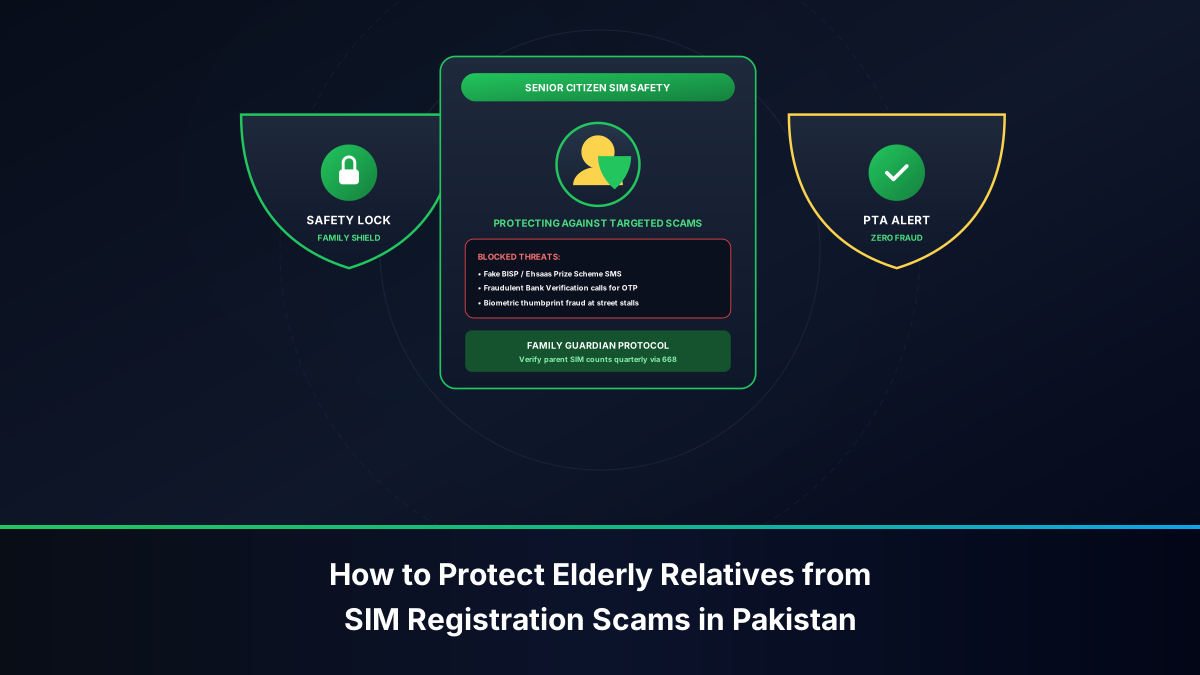
- Problem: The SIM is Registered Under a Relative's CNIC: If you are using a mobile connection that is legally registered under your father's, spouse's, or sibling's CNIC, telco customer service agents are strictly prohibited by law from executing a helpline deactivation on your word alone. The individual whose CNIC is registered on the system must get on the call to answer the verification questions. Once the immediate crisis is contained, visit a franchise together to execute a formal Biometric Ownership Transfer to bring the line under your personal CNIC.
- Problem: Inability to Recall Exact Last Recharge Details: If you cannot remember the precise amount of your last Easyload, inform the agent honestly. Offer alternative corroborating facts: provide the approximate date of balance consumption, recent data bundle activations, international dialing history, or your home billing address for postpaid connections. Tier-2 supervisory agents can authorize suspensions based on comprehensive secondary metadata.
- Problem: Losing Your SIM While Traveling Overseas: If you are on an international business trip or performing Umrah in Saudi Arabia when your phone is lost, standard domestic shortcodes (111, 310) will not connect. You must dial the international roaming trunk line (e.g.,
+92-300-8200111for Jazz). If international call balances are inaccessible, use verified corporate web portals or reach out via official verified WhatsApp self-care channels using hotel Wi-Fi connections. - Problem: Repeated Fingerprint Verification Failures at Franchise: Senior citizens, manual laborers, and individuals with worn dermatoglyphic finger ridges often suffer repeated verification failures at BVS kiosks. If NADRA scanners fail after multiple attempts, request the franchise staff to invoke Two-Finger Biometric Verification or NADRA OTP Bypass Mode (where verification tokens are routed to an alternate verified family member's CNIC).
Legal Safeguards & Criminal Liability Under PECA 2016 for Delayed Reporting
Many cellular subscribers fail to appreciate the severe legal and criminal hazards associated with an unreported, lost SIM card in Pakistan. Under the comprehensive statutory umbrella of the Prevention of Electronic Crimes Act (PECA) 2016 and the Pakistan Telecommunication (Re-organization) Act 1996, ownership of a biometrically verified cellular connection carries strict legal duties:
Under Section 13 (Unauthorized use of identity information) and Section 14 (Unauthorized electronic transmission), an individual who permits or facilitates illegal electronic communications through negligence can face criminal indictment. Furthermore, under Anti-Terrorism Court (ATC) jurisprudence, if a lost SIM is utilized by criminal elements for extortion (bhatta), kidnapping ransom communications, or terrorist coordination, law enforcement agencies (including the Federal Investigation Agency Cyber Crime Wing and Counter-Terrorism Departments) will initially arrest the registered CNIC owner whose credentials reside on the carrier's Home Location Register.
Calling the operator helpline to record an emergency temporary suspension generates an immutable, digitally timestamped Call Detail Log and Helpline Ticket ID within the operator's compliance database. In the unfortunate event that a sophisticated criminal syndicate managed to initiate illicit activity using your line before the radio towers severed the signal, your official helpline complaint reference number provides unassailable legal proof that you exercised due diligence and formally relinquished control over the connection prior to the criminal act.
Always conclude your helpline call by explicitly asking the representative: "Please provide my official Complaint Tracking Reference Number for this deactivation request." Transcribe this alphanumeric ticket code into your personal notes; it serves as your primary legal defense shield should local law enforcement inquiries ever arise.
Frequently Asked Questions: Lost SIM Deactivation & Remote Blocking
Authoritative, verified answers addressing citizen inquiries regarding emergency SIM shutdowns, biometric safeguards, and device tracking in Pakistan.