The Growing Threat: Why Senior Citizens Are Targeted in Pakistan
Across Pakistan, the rapid digitisation of telecommunications, government services, and branchless banking has brought immense convenience to millions of households. However, this transition has created a profound vulnerability for the nation's elderly population. Senior citizens—parents and grandparents who grew up in an era of manual paperwork, landline telephones, and high institutional trust—are now navigating an aggressive digital ecosystem dominated by smartphone apps, one-time passwords (OTPs), biometric sensors, and sophisticated social engineering networks.
In Pakistani society, elders frequently hold Computerized National Identity Cards (CNICs) with spotless legal standing, unencumbered credit histories, and substantial life savings stored in commercial bank accounts, National Savings Schemes (Qaumi Bachat), or mobile wallets such as JazzCash and Easypaisa. Cybercriminals, rogue retail vendors, and syndicated scam networks deliberately target senior citizens because they recognize three critical structural vulnerabilities:
- Digital Literacy Gaps: Seniors often struggle to distinguish between genuine system notifications dispatched by licensed telecom operators (such as Jazz, Zong, Telenor, or Ufone) and forged SMS lures originating from unverified 11-digit numbers.
- Psychological Vulnerability to Authority & Benevolence: Pakistani elders possess a cultural deference to institutional authority. When an aggressive caller claims to be an officer from the State Bank of Pakistan, the General Headquarters (GHQ), or the Benazir Income Support Programme (BISP), seniors are far more likely to comply out of civic respect or fear of legal penalties.
- Sensory and Physical Challenges: Diminished eyesight makes reading small fine-print SMS warnings difficult, while age-related skin elasticity loss and epidermal ridge wear create severe friction at biometric fingerprint scanners, forcing seniors to rely on assisted roadside retail agents who exploit their dependency.
The Caregiver Imperative: Protecting elderly family members from cellular identity theft is not merely about preventing a lost mobile balance; an unauthorized SIM registered under an elderly parent's CNIC can be weaponized in financial extortion, terrorism financing, or digital fraud, exposing the family patriarch or matriarch to criminal liability under the Prevention of Electronic Crimes Act (PECA 2016).
Anatomy of Telecom Fraud Exploiting Elderly Citizens
To establish an effective caregiver defense protocol, one must thoroughly understand the primary deceptive methodologies utilized by threat actors across Pakistan.
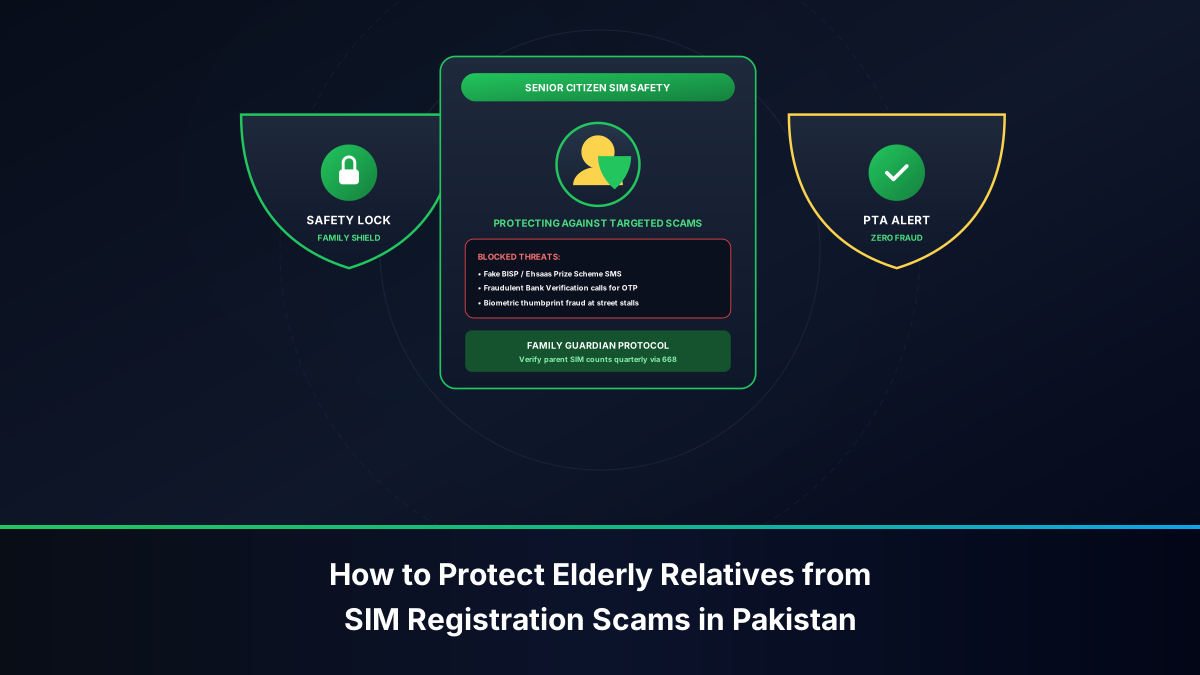
The BISP, Ehsaas, and Poverty Relief Scam Traps
One of the most persistent social engineering attacks in Pakistan involves fraudulent notifications claiming the recipient has been selected for financial disbursements under the Benazir Income Support Programme (BISP) or the Ehsaas Kafalat Programme. Fraud syndicates dispatch bulk SMS messages from spoofed sender IDs or standard prepaid mobile numbers stating:
"Mubarak Ho! Aap ko Benazir Income Support Program ki taraf se Rs. 25,000 ki mali imdad manzoor ho chuki hai. Raqam wasool karnay ke liye fori call karein: 03XX-XXXXXXX"
When an elderly individual calls the provided number, the fraudster impersonates a senior government disbursement officer. The caller instructs the senior to walk to a nearby branchless banking ATM or Easypaisa/JazzCash merchant, guiding them over the phone to execute specific key sequences on the screen. The senior believes they are receiving cash; in reality, they are entering their secret account PIN and approving an outbound fund transfer directly to the scammer's disposable wallet.
Impersonation of State Bank of Pakistan (SBP) and Commercial Banks
Under this high-pressure vector, the scammer calls an elderly citizen claiming to be from the "State Bank of Pakistan Verification Directorate" or the fraud department of their commercial bank (such as HBL, UBL, MCB, Allied Bank, or Meezan Bank). The caller adopts a stern, authoritative tone, informing the victim that their ATM card, bank account, or CNIC has been "flagged for suspension" due to missing biometric re-verification mandated by the Supreme Court or the central bank.
To "save the account from permanent confiscation", the scammer demands the senior read aloud their 16-digit debit card number, card expiration date, the 3-digit CVV printed on the reverse, and the 6-digit SMS OTP just dispatched to their mobile phone. Once the panicked senior reveals the OTP, the attacker instantly drains the account via online banking or e-commerce purchases.
The 'Jeeto Pakistan' and Cash Prize Social Engineering Scams
Another prevalent vector mimics popular television game shows, most notably Jeeto Pakistan or commercial automotive promotional draws. The fraudster informs the senior citizen that their cellular number was selected in a nationwide computerized lucky draw, winning a brand-new car, gold bars, or several million rupees in cash. To release the prize consignment, the senior is instructed to pay an initial "government withholding tax", "customs stamp fee", or "transportation clearance deposit" via mobile easyload or direct bank transfer. Convinced of their good fortune, seniors frequently liquidate personal savings before discovering the prize does not exist.
The Danger of Roadside Kiosks and Biometric Double-Scanning
Beyond remote phone calls, senior citizens face severe physical exploitation when interacting with unaccredited telecommunication retailers, street carts, and roadside photocopy shops.
How Dishonest Retailers Register 'Ghost SIMs' on Senior CNICs
When an elderly person visits an unauthorized street kiosk or market umbrella vendor to purchase a prepaid SIM, replace a damaged card, or collect cash from a social welfare program, rogue agents exploit the senior's unfamiliarity with the Biometric Verification System (BVS):
- The Initial Scan: The customer places their thumb on the optical glass sensor. The transaction completes successfully on the backend, generating an active cellular connection or disbursement receipt.
- The Fabricated Failure Pretext: The dishonest retail agent feigns frustration, tapping the terminal screen and telling the senior: "Ammi jee/Baba jee, device ka internet slow tha, pehla angootha fail ho gaya hai. Dobara doosri ungli lagayein" (Mother/Father, the internet connection was slow and the first thumb scan failed. Please place another finger).
- The Ghost SIM Creation: Trusting the agent's explanation, the senior places their index finger or opposite thumb on the scanner. In reality, the rogue agent has switched the software module to a new SIM issuance request. The second biometric capture registers an unauthorized Ghost SIM on the senior's CNIC.
- Black-Market Resale: The dishonest agent pockets the newly biometrically verified Ghost SIM and sells it to criminal networks, undocumented aliens, or extortionists for PKR 1,500 to PKR 3,000. Because the SIM is officially registered under the senior's verified biometric record, any criminal activity committed with that number traces directly back to the elderly citizen.
Uncontrolled Photocopy Archiving in Local Photocopy Stores
In residential Pakistani neighborhoods, seniors frequently visit local stationary and photocopy stores to duplicate their Smart CNIC for utility bill transfers, pension collections, medical insurance, or domestic property matters. Unscrupulous copy shop operators routinely print an extra duplicate copy without the senior's knowledge, or save scanned digital PDF copies on unencrypted, publicly accessible shop computers. These identity dossiers are subsequently bundled and sold to illegal telemarketing brokers and fraud syndicates.
The Caregiver Defense: The Mandatory CNIC Cross-Marking Protocol
The single most powerful physical defense against identity document reuse is the implementation of the CNIC Cross-Marking Protocol. Caregivers must educate elderly parents to never surrender an unmarked photocopy under any circumstances.
Exact Textual and Visual Instructions for Invalidation Marking
Whenever an elderly relative must provide a physical photocopy of their CNIC for any legitimate service (such as medical admission, utility verification, or banking), execute this exact marking protocol:
| Step | Marking Action | Technical Rationale |
|---|---|---|
| 1. Pen Selection | Use a permanent blue or black ballpoint pen (never pencil or erasable ink). | Prevents physical erasing or chemical alteration of the handwritten text. |
| 2. Parallel Lines | Draw two bold, diagonal parallel lines across the front and reverse face of the photocopy. | Visually intersects the document so automated optical character recognition (OCR) scanners flag the page as modified. |
| 3. Purpose Statement | Between the lines, write in clear uppercase letters: "FOR [ORGANIZATION NAME] [SPECIFIC PURPOSE] ONLY" (e.g., "FOR SUI NORTHERN GAS METER TRANSFER ONLY"). |
Restricts the legal validity of the photocopy exclusively to that single transaction; any third party using it for SIM activation faces immediate criminal rejection. |
| 4. Date Inscription | Write the current numerical date: "DATE: DD/MM/YYYY". |
Prevents the photocopy from being stockpiled and used months or years later. |
| 5. Critical Placement | Ensure the ink lines and handwritten text physically traverse across the citizen's portrait and the 13-digit identity number. | Prevents rogue agents from digitally cropping or photocopying around the restriction marks. |
Watermarking Digital Scans and Mobile Document Snapshots
If an elderly relative must transmit an identity document digitally (such as via WhatsApp to a family member or service provider), never transmit a raw, pristine JPEG snapshot. Prior to transmission, caregivers should open the image on the smartphone, select the built-in Markup or Text tool, and overlay a bold semi-transparent text watermark across the center of the card: "FOR [SERVICE] SUBMISSION ONLY - DD/MM/YYYY". This ensures that even if the image is forwarded or intercepted, it cannot be processed by automated KYC registration software.
Deconstructing the OTP: Educating Seniors on One-Time Passwords
In modern telecommunications and financial infrastructure, the One-Time Password (OTP) is the final cryptographic gateway guarding access to SIM swaps, digital wallets, bank transfers, and social messaging accounts. Yet, many senior citizens do not understand the technical meaning of an OTP.
Explaining Verification Codes as Irreversible Authorizations
Many seniors mistakenly believe that an incoming 6-digit SMS code is an informational tracking code or a "confirmation receipt" that can be safely read aloud to an inquisitive customer service caller. Caregivers must reframe the concept of the OTP using culturally intuitive analogies:
The Digital Check Analogy: Explain to elderly relatives that reciting an SMS OTP over the telephone is the exact modern equivalent of signing a blank bank check and handing it to an unknown stranger on the street. Once the numbers leave their mouth, all legal and financial protections evaporate instantly.
The Zero-Trust Family Rule: Never Share Any 4-6 Digit Code
Establish a rigid, non-negotiable household rule that seniors can easily remember under high stress:
- Rule 1: No Bank Ever Asks for an OTP: Explain clearly that neither the State Bank of Pakistan, Jazz, Zong, Telenor, Ufone, nor any retail bank's official helpline will EVER call a customer to ask for an OTP, ATM PIN, or CVV code. The computer system that generates an OTP has no human operator reading it.
- Rule 2: The "Hang Up and Call Children" Protocol: Instruct your elderly relatives that whenever an unknown caller asks for any number, password, or urgent action, they should say: "Mera beta/beti ye mamlaat dekhtay hain, main unse baat karwa deta hoon" (My son/daughter manages these matters, let me connect you with them) and immediately terminate the call.
- Rule 3: Disable Preview Banners for SMS: Configure the elderly relative's smartphone to hide sensitive message content on the lock screen. This prevents opportunistic bystanders from glancing at incoming OTPs when the phone is sitting on a table.
Quarterly Caregiver Audit Workflow: Monitoring Identity Footprints
Elderly relatives may unknowingly become victims of biometric double-scanning despite precautions. Establishing a proactive quarterly audit schedule ensures unauthorized lines are detected and eliminated before harm occurs.
Executing Quarterly 668 Audits and Checking cnic.sims.pk
Set a recurring calendar reminder every 90 days to audit your elderly parents' national telecom footprint:
- Free Web Audit: Open your web browser and navigate to the official PTA portal at https://cnic.sims.pk.
- Enter Parent's CNIC: Type their 13-digit identity card number without dashes. Complete the reCAPTCHA challenge and press Submit.
- Verify Registered Line Counts: Inspect the resulting table. Compare the counts against the actual physical SIM cards your parent uses:
- If your mother only owns 1 Jazz SIM, but the table reflects Jazz: 2 Voice SIMs, an unauthorized Ghost SIM is active.
- If networks appear that your parent has never used (e.g., Zong: 1 Voice SIM), initiate immediate investigation.
- Alternative SMS Query: If internet access is unavailable, compose an SMS with their 13-digit CNIC and dispatch it to shortcode 668 from their handset.
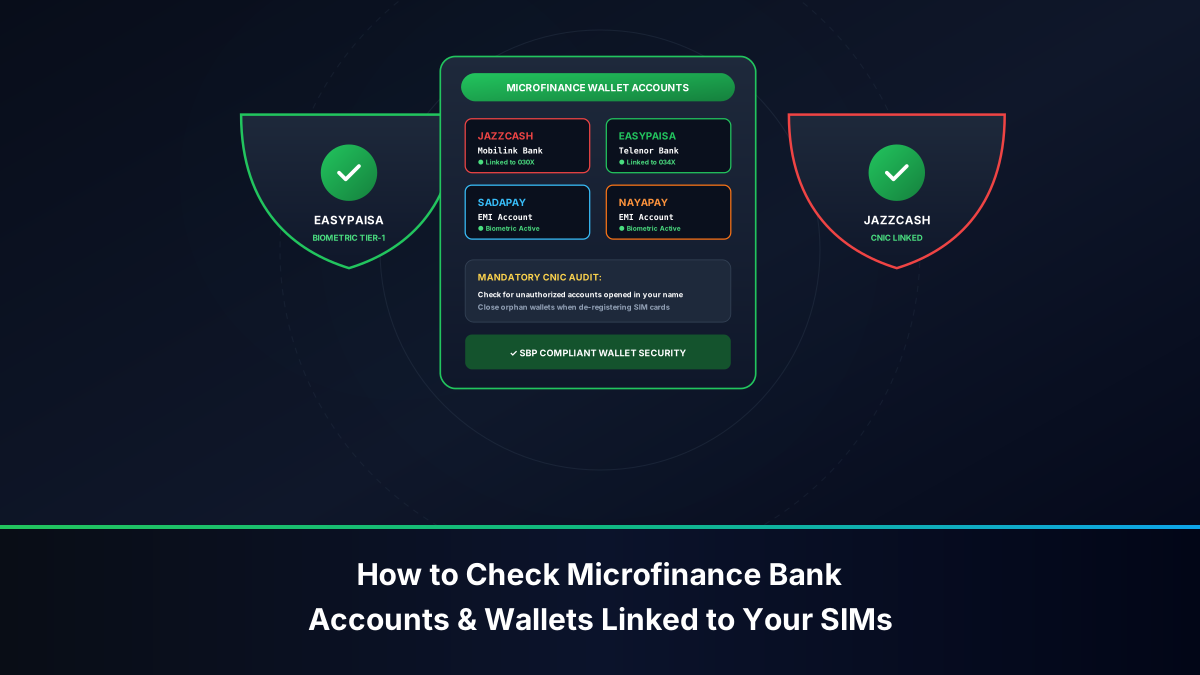
Auditing Linked JazzCash, Easypaisa, and Raast Accounts
Scammers frequently open unauthorized microfinance mobile wallets on Ghost SIMs registered under senior citizens' CNICs to receive stolen funds from other victims, turning your elderly relative into an unwitting money mule:
- JazzCash Audit: Check if an active JazzCash wallet exists on any mobile number linked to the senior's CNIC by dialing
*786#from their handset or contacting the helpline at 4444. - Easypaisa Audit: Confirm active wallet registrations by contacting the Telenor Microfinance Bank helpline at 3737.
- Raast Central Directory Audit: Log into their primary bank application and check the linked Raast ID. Ensure that their mobile number is bound exclusively to their authentic primary bank account, preventing fraudulent redirection of instantaneous interbank transfers.
Overcoming Worn Fingerprint and Biometric Recognition Hurdles
One of the primary reasons elderly Pakistanis fall victim to retail kiosk exploitation is the physical degradation of their fingerprints, known medically as epidermal ridge atrophy. Understanding NADRA's official accommodation protocols eliminates the need for repeated, risky retail attempts.
NADRA's Official Fingerprint Wear Exemption Protocol
Under official statutory regulations issued by NADRA for senior citizens (aged 60 and above):
- Alternative Finger Scanning: BVS terminals are programmed to attempt capture across all 10 fingers. If the primary thumbs fail to match, customer service agents must systematically test the index, middle, and ring fingers.
- Physical Exemption Process: If all 10 fingerprints fail to register on optical sensors due to severe ridge wear, medical conditions, or amputation, the citizen cannot be turned away. NADRA Registration Centers (NRCs) are legally mandated to execute the Biometric Exemption Protocol. Under this procedure, a verified first-degree blood relative (son, daughter, spouse, or sibling) with verified biometrics provides an attestation on the official application, supplemented by high-resolution facial portrait verification and senior supervisor sign-off.
- Dedicated Senior Citizen Counters: All NADRA Mega and Executive centers feature dedicated senior citizen priority queues equipped with specialized high-sensitivity capacitive scanners and ergonomic seating to prevent distress.
Utilizing the Pak-ID Mobile App for Contactless Liveness Verification
Rather than transporting frail elderly parents to crowded physical offices, caregivers can leverage the official Pak-ID Mobile Application published by NADRA:
- Install Pak-ID on an iPhone or Android smartphone equipped with a high-resolution camera.
- Select the identity renewal or verification module.
- The app utilizes Contactless Facial Liveness Detection. Seat the elderly parent in a well-lit room facing natural daylight. Hold the camera at eye level 1.5 feet away.
- The neural network guides the parent to blink or smile gently, instantly authenticating their civil identity against NADRA's master database without touching physical glass scanners.
Emergency Incident Response: What to Do If a Senior Is Compromised
If you discover that an elderly relative has surrendered an OTP to a scammer, transferred funds, or harbors active Ghost SIMs on their CNIC, execute this emergency incident response protocol immediately.
Immediate Action Checklist: Freezing Wallets and Blocking Lines
- Minute 0 to 15: Emergency Banking Freeze: Immediately call the parent's commercial bank helpline. Request an emergency freeze on all debit cards, credit cards, and online mobile banking access. Inform the bank that the customer has been compromised via an unauthorized OTP disclosure.
- Minute 15 to 30: Block Branchless Wallets: Call 4444 (JazzCash) and 3737 (Easypaisa). Request the immediate deactivation and temporary freezing of any wallet associated with the senior's CNIC and mobile number.
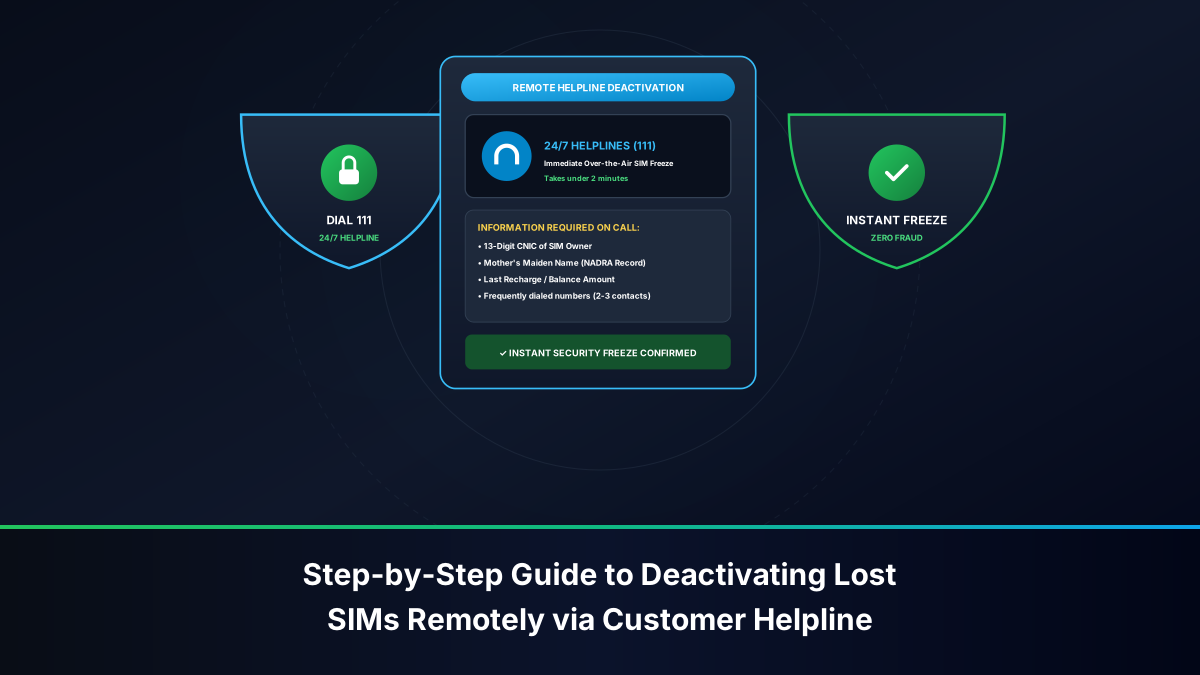
- Minute 30 to 60: SIM Suspension: If the senior's physical SIM card was swapped, lost, or compromised, contact the cellular carrier helpline (Jazz: 111, Zong: 310, Telenor: 345, Ufone: 333) and request an immediate emergency IMEI/SIM suspension.
- Next 24 Hours: Flagship Franchise Disowning: Accompany the parent to a company-owned Customer Service Center of the network hosting any unauthorized Ghost SIMs. Submit a formal Biometric SIM Disowning Form and obtain an official stamped receipt.
Filing Formal Reports with PTA CMS, SBP Consumer Banking, and FIA
To establish a documented legal defense and initiate criminal prosecution against the fraudsters, caregivers should lodge formal reports across three sovereign regulatory portals:
- PTA Consumer Complaint Management System (CMS): Visit https://complaint.pta.gov.pk/ or call 0800-55055. File a complaint under "Unauthorized SIM Registration / Telecom Fraud", submitting the senior's CNIC, franchise complaint ticket number, and proof of disowning.
- State Bank of Pakistan (Banking Mohtasib): If commercial banks fail to assist or delay freezing compromised accounts, file a grievance with the Banking Mohtasib Pakistan at https://www.bankingmohtasib.gov.pk/.
- FIA Cyber Crime Wing (PECA 2016 FIR): For financial theft or extortion, lodge an official complaint on the FIA portal at https://complaint.fia.gov.pk/ or visit the nearest regional FIA Cyber Crime Reporting Center. Bring bank account statements, call logs, SMS transcripts, and the senior's original CNIC.
Summary Matrix: Common Telecom Scams, Target Vulnerabilities, and Countermeasures
Review the comprehensive comparative matrix below to familiarize yourself with prevalent scam tactics targeting senior citizens across Pakistan:
| Scam Modality | Primary Contact Channel | Psychological Lure / Threat | Target Exploit | Caregiver Countermeasure |
|---|---|---|---|---|
| Fake BISP / Ehsaas Aid | Bulk SMS & Follow-up Call | Financial benevolence; urgent grant approval | Tricks senior into transferring funds via mobile ATM | Verify grants exclusively at official BISP tehsil offices; block caller on handset. |
| SBP / Bank Officer Verification | High-pressure voice telephone call | Imminent account freezing, legal penalties | Harvests debit card details, CVV, and SMS OTP | Enforce strict zero-disclosure rule; banks never ask for OTPs via outbound calls. |
| Jeeto Pakistan Prize | Voice call & fake WhatsApp letter | Massive cash or automobile prize | Demands upfront "processing tax" via easyload | Inform senior that legitimate lotteries never demand advance easyload payments. |
| Retail Kiosk Double-Scan | In-person street stall or cart | "Machine failed, please scan thumb again" | Registers unauthorized Ghost SIM on senior's CNIC | Accompany seniors to company flagship franchises; cross-mark all photocopies. |
| CNIC Copy Resale | Local neighborhood stationery shop | Uncontrolled duplicate printing | Sells identity photocopy to illegal marketing brokers | Mandate cross-marking protocol across front/back of every photocopy with date and purpose. |
Practical Caregiver Recommendations and Technical Troubleshooting
Beyond behavioural education, implementing specific technical controls on an elderly relative's smartphone provides a continuous, automated layer of defense.
Configuring Android and iOS Handsets for Senior Safety
- Enable Spam Call & SMS Filtering: On Android devices, navigate to Phone App > Settings > Caller ID & Spam and toggle on "Filter spam calls". On iOS, navigate to Settings > Phone > Silence Unknown Callers to automatically route calls from numbers not in the address book to voicemail.
- Install a Trusted Dialer Shield: Applications like Truecaller or Whoscall can be installed to automatically block known numbers tagged as "BISP Scammer" or "Fake Bank Call". Ensure you configure privacy settings to prevent unauthorized contact book uploading.
- Lock Down App Installation Permissions: On Android, disable "Install Unknown Apps" across all browsers and file managers. This prevents malicious "Pak Sim Tracker" or spy APKs from being installed inadvertently via WhatsApp links.
- Set Up Carrier Spending Limits: For postpaid connections, contact the cellular carrier to impose a strict credit ceiling. For prepaid connections, avoid maintaining massive account balances; keep sufficient funds for monthly packages and auto-recharge as needed.
Escalating Franchise Resistance During Senior SIM Deactivations
Caregivers occasionally encounter unhelpful customer care representatives at retail franchises who refuse to cancel unauthorized lines, claiming: "The system is offline", or "The customer must remember the phone number before we can block it."
- Legal Fact: Under PTA regulations, a customer is NOT required to know the phone number of a Ghost SIM registered fraudulently under their CNIC. The operator's BVS terminal displays all linked MSISDNs upon biometric authentication.
- Demand Franchise Manager Escalation: If a floor agent refuses to assist, request an immediate audience with the Franchise Manager or Floor Supervisor. State clearly that the line is being disowned under PTA Regulation 102.
- Demand Written Acknowledgment: If the franchise still refuses, take down the representative's employee badge number and location, and immediately dial the PTA Consumer Helpline at 0800-55055 from the franchise premises to lodge an on-the-spot regulatory grievance.
Frequently Asked Questions
Explore this comprehensive repository of practical guidance and regulatory answers designed to assist caregivers in safeguarding senior relatives against telecommunication fraud and identity theft in Pakistan.