In Pakistan's rapidly expanding formal business ecosystem, mobile connectivity is the primary backbone of field operations, customer service, two-factor authentication, enterprise sales, and distributed logistics. Small enterprises, multinational corporations, non-governmental organizations (NGOs), and government departments routinely purchase hundreds or even thousands of cellular subscriptions to equip their workforce. However, cellular governance in Pakistan is strictly monitored by the Pakistan Telecommunication Authority (PTA) in close collaboration with the National Database and Registration Authority (NADRA) and law enforcement intelligence agencies. Unlike individual consumer subscriptions—which are strictly bound to an individual's Computerized National Identity Card (CNIC) and capped at a maximum of five voice SIM cards—corporate telecommunications operate under an entirely distinct regulatory and procedural framework known as B2B Enterprise SIM Registration.
Understanding corporate SIM ownership, the statutory responsibilities of enterprise executives, the documentation needed for corporate lines, and the legal obligations under the Prevention of Electronic Crimes Act (PECA 2016) is essential for Chief Information Officers, human resources directors, corporate legal counsels, and employees. This exhaustive guide provides an authoritative roadmap through corporate SIM architecture, verification protocols, employee allocation controls, and decommission procedures across all licensed Pakistani mobile operators including Jazz Business, Zong Business, Telenor Business, and Ufone 4G Enterprise.
Understanding Corporate SIM Architecture in Pakistan
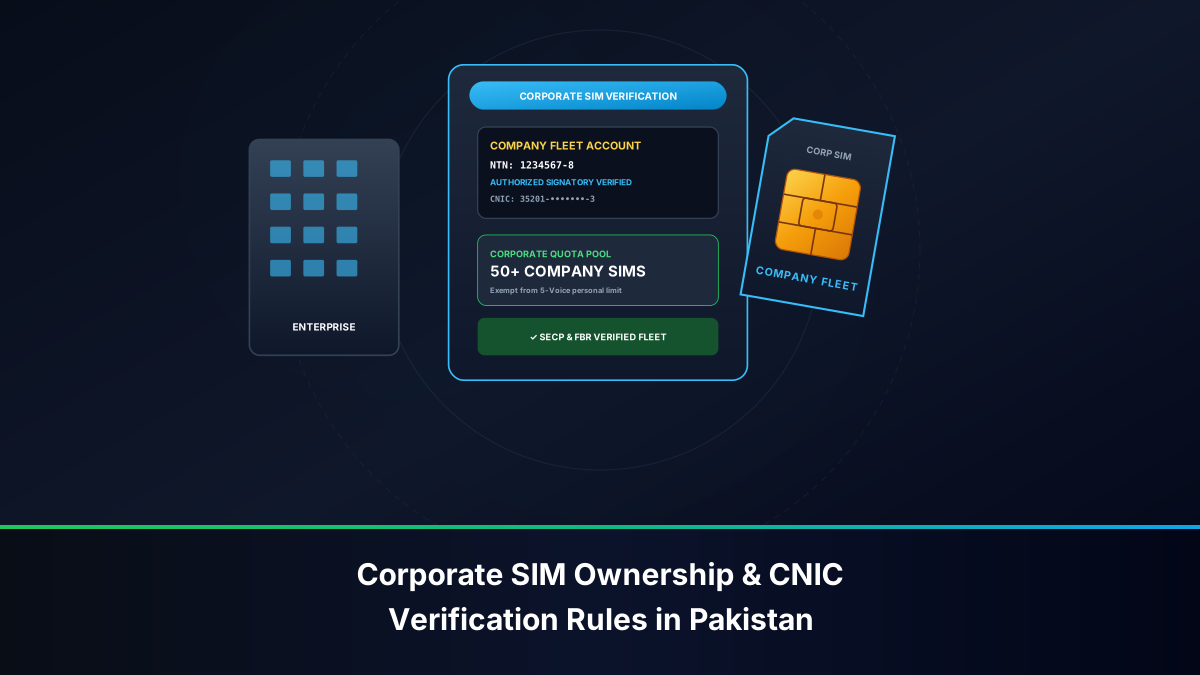
Corporate telephony represents a contractual B2B relationship established directly between a recognized legal commercial entity and a licensed Mobile Network Operator (MNO). In a consumer setup, the subscriber whose thumbprint is scanned at the biometric terminal is the sole legal and financial owner of the MSISDN (Mobile Station International Subscriber Directory Number). In contrast, a corporate SIM is legally owned and financially backed by the corporate organization, designated by its corporate tax credentials.
PTA establishes stringent checks on corporate accounts to prevent the emergence of unregistered or ghost SIM blocks that could bypass national security filters. When an enterprise signs a corporate telecommunications agreement:
- Master Enterprise Account: The operator creates a centralized enterprise billing account linked to the business's National Tax Number (NTN) and incorporation registration number.
- Corporate MSISDN Pool: Numbers assigned under this master agreement belong to the enterprise pool. All voice minutes, data bundles, SMS packages, and specialized Closed User Group (CUG) free intra-company calling facilities are centrally administered and billed.
- Dual-Layer Identification Architecture: The primary legal entity responsible for the SIM is the corporate entity represented by its Authorized Signatory, while the secondary functional user is the specific employee or asset (such as an IoT tracker or POS terminal) assigned to that SIM.
This dual-layer structure ensures that while businesses enjoy operational flexibility and volume scalability, regulatory authorities maintain complete visibility into the provenance and legal custody of every active cellular connection on Pakistani cellular airwaves.
Individual 5-SIM Limit vs Corporate SIM Quota Under PTA Rules
The single most frequent question raised by business executives and hiring managers is whether company-provided mobile connections interfere with an employee's personal SIM limits. Under standard PTA regulations, every citizen of Pakistan is restricted to holding a maximum of 5 active voice SIM cards across all telecom networks combined on their personal CNIC (plus up to 3 separate broadband data SIMs).
| Feature / Dimension | Personal Consumer SIM | Corporate / Enterprise B2B SIM |
|---|---|---|
| Legal Ownership | Individual Citizen (CNIC holder) | Registered Corporate Entity (NTN holder) |
| Maximum Quota | 5 Voice SIMs + 3 Data SIMs per CNIC | Custom Enterprise Quota (Scaled to Business Profile) |
| Impact on Personal Limit | Directly consumes personal CNIC slots | Zero impact on employee's personal 5-SIM limit |
| Billing Liability | Individual Subscriber | Corporate Enterprise Billing Account |
| 668 SMS Verification Query | Shows active count against user's CNIC | Does not list under employee's personal CNIC search |
| Biometric Verification | Personal biometric scan at every purchase | Authorized Signatory BVS + Employee KYC Records |
Because corporate connections are legally anchored to the corporate NTN rather than the employee's personal citizen identity, corporate SIMs do not consume any of the five personal SIM slots allocated to that employee by the PTA. An individual who already possesses five personal Jazz, Zong, Telenor, and Ufone lines can safely be issued an official company phone number without triggering a quota rejection on NADRA biometric verification portals.
However, corporate quotas are not unrestricted. Mobile operators and the PTA assess the financial standing, physical footprint, registered employee headcount, and tax withholding track record of an enterprise before granting bulk allocations exceeding standard thresholds. A shell company or newly established entity cannot arbitrarily request thousands of active lines without substantiating genuine commercial justification.
Statutory Documentation: NTN, SECP, Form 29, & Board Resolutions
Acquiring corporate telecommunication facilities requires formal commercial onboarding. Telecom operators operate dedicated B2B Corporate Sales Divisions that review organizational legal status before issuing SIM cards. The documentation requirements vary depending on the constitutional framework of the commercial organization:
1. Private Limited (Pvt Ltd) and Public Listed Companies (SECP Registered)
- Certificate of Incorporation: Certified true copy issued by the Securities and Exchange Commission of Pakistan (SECP).
- Memorandum & Articles of Association: Defining the objectives and administrative governance of the company.
- SECP Form 29 / Form A: Certified copies listing current directors, CEO, and company secretaries.
- FBR National Tax Number (NTN) Certificate: Verification showing active taxpayer status on the FBR Active Taxpayer List (ATL).
- Board Resolution on Official Letterhead: An explicit resolution passed by the Board of Directors authorizing the procurement of cellular connections, naming the specific designated Authorized Signatory, and granting them authority to execute contracts and provide biometric verification on behalf of the company.
- Authorized Signatory CNIC Copy: Color copies of both sides of the valid CNIC/NICOP of the individual named in the board resolution.
2. Partnership / Association of Persons (AOP)
- Partnership Deed: Legally registered and notarized copy of the formal partnership agreement.
- Form C: Registration certificate issued by the Registrar of Firms.
- FBR NTN Certificate: Issued in the registered commercial name of the partnership firm.
- Power of Attorney / Authority Letter: Signed by all legal partners authorizing one specific managing partner to execute the enterprise telecom agreement.
- Partner CNIC Copies: Clear photocopies of CNICs of all active partners.
3. Sole Proprietorships
- FBR NTN Certificate: Reflecting the business or trade name as well as the proprietor's personal NTN.
- Bank Maintenance Certificate: Verifying that an official current business account is active under the proprietorship's commercial title.
- Declaration Letter on Letterhead: Requesting corporate connectivity signed and stamped with the company's official seal.
- Proprietor's Original CNIC: Mandatory physical presentation for NADRA biometric authentication.
4. NGOs, Diplomatic Missions, and Statutory Bodies
- Registration License: Charter of registration under the Societies Registration Act, Trust Act, or Economic Affairs Division (EAD) MOU for international NGOs.
- Ministry of Foreign Affairs (MOFA) Authorization: Applicable for foreign embassies and accredited diplomatic missions.
- Official Gazette / Statute: For statutory boards, universities, or governmental bodies operating under legislative enactments.
The Role and Biometric Verification (BVS) of Authorized Signatories
In 2015, following the National Action Plan (NAP) and the comprehensive re-verification of all cellular connections across Pakistan, the PTA eliminated non-biometric paper-only activations for both consumers and businesses. To bridge the gap between corporate legal personhood and biological human verification, the PTA instituted the Authorized Signatory Biometric Framework.
Under this mechanism, a corporate entity cannot hold a SIM in absolute anonymity. Instead, the company must formally designate an individual—typically the Chief Executive Officer, Chief Operating Officer, Head of Human Resources, or Head of Procurement—as its legal Authorized Signatory.
The Authorized Signatory Protocol
The designated Authorized Signatory must submit their physical biometric thumbprint verification on a dedicated B2B NADRA terminal. This process binds the master corporate account to that human focal point in the PTA Centralized Biometric Verification System (CBVS). When bulk corporate connections are dispatched, they are legally mapped to the company's NTN through the authorized signatory's verified identity token.
If an Authorized Signatory departs the company or resigns from their position, the enterprise has a strict regulatory obligation to notify the telecom operator's corporate account manager immediately. A revised Board Resolution must be passed, naming a successor, and the new signatory must complete biometric verification to update the corporate account profile. Failing to update signatory profiles leaves departing executives exposed to legal inquiries regarding lines they no longer administer.
Step-by-Step B2B Procurement and Line Activation Workflow
Procuring and deploying corporate cellular infrastructure follows a standardized four-phase operational procedure designed to maintain strict regulatory compliance while meeting commercial turnaround times.
Phase 1: Enterprise Account Application & Credit Review
The enterprise submits its commercial profile, tax certificates, and documentation package to the operator's corporate sales department. The telecom operator's credit evaluation committee reviews the financial credentials of the firm, determines security deposit requirements (or credit limits for postpaid corporate plans), and drafts the Enterprise Service Agreement (ESA).
Phase 2: Execution of Master Agreement & Signatory Biometrics
The corporate contract is executed between authorized legal representatives. A corporate account manager coordinates a formal biometric session where the Authorized Signatory provides biological verification on a NADRA-linked biometric terminal. Once NADRA validates the signatory's biometric authentication against their CNIC record, the master billing account is activated in the operator's core billing engine (e.g., Ericsson, Huawei, or Amdocs telecom platforms).
Phase 3: SIM Inventory Allocation and Number Provisioning
The enterprise selects its desired numbering blocks (often sequential numbering blocks or golden VIP numbers for company helplines) and package structures. Numbers are provisioned as either standard voice/data lines, Closed User Group (CUG) connections, Machine-to-Machine (M2M) IoT connections, or telemetry data SIMs. Operator systems link these MSISDNs directly to the corporate customer ID (CCID) and enterprise NTN.
Phase 4: Physical Dispatch and Handover
The physical or eSIM profiles are securely packaged and delivered to the enterprise's registered corporate headquarters accompanied by an official Delivery Challan and Serial Number Inventory Log. The authorized recipient signs the handover manifest, formally completing the transfer of legal custody from the carrier to the enterprise.
Internal Enterprise Governance: Employee Assignment & KYC Records
Once a company takes physical custody of a corporate SIM pool, regulatory compliance does not end—it shifts internally. Under PTA compliance circulars, any organization utilizing corporate telecom connections is legally required to maintain an internal, up-to-date Corporate Telecommunications Register.
Whenever an enterprise hands a corporate SIM to an employee, the Human Resources or IT Asset Management department must document the following critical data points:
- Assigned Mobile Number (MSISDN): The active 11-digit phone number.
- SIM Card IMSI and ICCID: The 19- or 20-digit hardware identifier printed on the physical SIM card chip.
- Employee Full Name & Father's Name: Exactly as recorded on their NADRA identity card.
- Employee CNIC Number: Validated copy of the employee's CNIC retained on physical or digital file.
- Corporate Employee ID Number: Official employee tracking index.
- Designation and Operating Department: Functional role within the corporate hierarchy.
- Date of Line Handover: Timestamped receipt signed by the employee acknowledging custody.
- Device IMEI (Recommended Best Practice): The International Mobile Equipment Identity number of the company-owned smartphone or tablet in which the SIM is installed.
Maintaining this internal register is not merely an administrative detail; it is a critical legal shield for corporate officers. If an employee engages in financial fraud, harassment, unauthorized data exfiltration, or subversive communications using a corporate SIM, law enforcement agencies (such as the FIA Cyber Crime Wing) will first serve a legal inquiry notice to the corporate Authorized Signatory. If the company can immediately produce an unbroken internal audit trail showing that the line was assigned to a specific individual on that specific date, corporate officers are insulated from direct criminal culpability.
Transferring Corporate Connections to Personal CNICs (Offboarding)
In modern corporate practice, employees often use their company-assigned mobile numbers for many years, sharing them with professional contacts, vendors, clients, and banking services. When an employee resigns or retires, the company frequently agrees to gift or transfer the mobile number to the departing employee as part of their settlement package. However, because the line is registered under an enterprise NTN, an employee cannot simply walk into a retailer and request a standard transfer.
Executing a Corporate-to-Individual Ownership Transfer requires adherence to a formal, multi-step regulatory procedure:
Procedure for Releasing a Corporate Number to an Individual
- 1Clearing Corporate Financial Liabilities: All unbilled postpaid charges, roaming dues, and interim balances associated with the specific line must be fully settled by the enterprise or deducted from the employee's final clearance.
- 2Issuance of Official No Objection Certificate (NOC): The enterprise must draft a formal Transfer NOC on official corporate letterhead. The document must state: "We, [Company Name], confirm we have no objection to transferring mobile number 03XX-XXXXXXX from our corporate account (NTN: XXXXXXX) to the personal CNIC of Mr./Ms. [Employee Name], CNIC: XXXXX-XXXXXXX-X."
- 3Signatures and Corporate Seal: The letter must be signed by the registered Authorized Signatory and stamped with the company's official corporate seal.
- 4Carrier Back-End Line Detachment: The company's enterprise account administrator or Key Account Manager flags the number in the operator's portal for enterprise detachment, moving it to an individual transfer-pending state.
- 5Biometric Verification at Franchise: The employee visits an official carrier customer care center with the original NOC, copy of company NTN, original CNIC, and current physical SIM. The franchise agent verifies the documentation, submits the employee's thumbprint to NADRA BVS, and re-registers the line as an individual consumer account.
Note that during this transfer, the employee's personal SIM quota is checked. If the employee already possesses five active voice SIMs registered to their CNIC across all operators, the NADRA biometric terminal will reject the transfer. The employee must first surrender or permanently cancel an existing personal line before accepting the incoming corporate number.
Legal Liabilities Under PECA 2016 for Corporate Number Misuse
Operating a corporate telecom pool involves serious legal responsibilities under Pakistani law. The Prevention of Electronic Crimes Act (PECA) 2016 and the Pakistan Telecommunication (Re-organization) Act 1996 define rigorous penalties for cyber offences, unauthorized access, electronic fraud, terrorist financing, and communications harassment.
When cybercrime offenses are committed using an enterprise-registered MSISDN, regulatory bodies and intelligence authorities follow a clear chain of custody:
- Initial Inquiry to the Corporate Signatory: The Federal Investigation Agency (FIA) Cyber Crime Reporting Centres (CCRC) issue summons to the corporate Authorized Signatory whose biometric credentials anchored the master telecom agreement.
- Obligation to Disclose Internal Logs: Under Section 32 of PECA 2016 (Preservation and Acquisition of Data), corporate entities are legally obligated to cooperate with authorized investigative officers and disclose internal user allocation logs upon receipt of lawful warrants.
- Consequences of Non-Compliance: If an enterprise fails to maintain internal employee allocation records, or if lines were casually distributed to unverified contractors, temporary staff, or third parties without documentation, the company and its executives face administrative fines from the PTA and potential prosecution under vicarious corporate liability provisions.
To eliminate these compliance risks, corporate legal departments must establish rigorous Acceptable Use Policies (AUP) that employees sign upon receiving corporate communication devices, acknowledging that line monitoring for regulatory compliance is active and that unlawful communications carry immediate termination and criminal reporting consequences.
Comparing Major Operator Enterprise Portals: Jazz, Zong, Telenor, Ufone
Managing large fleets of corporate mobile connections manually is impractical for medium and large enterprises. Pakistan's tier-1 cellular operators provide self-service digital enterprise portals that allow corporate administrators to manage line states, data limits, bundle assignments, and user records in real time.
1. Jazz Business Self-Care Portal
Jazz (Pakistan Mobile Communications Limited) operates the largest corporate subscriber base in Pakistan through its Jazz Business division. The Jazz Business Portal provides enterprise administrators with extensive control over their corporate mobile pools:
- Real-Time Fleet Visibility: Live dashboards displaying usage metrics, call minutes, international roaming spend, and active data bundle consumption across thousands of lines.
- Centralized Billing & Invoicing: Consolidated monthly enterprise billing with automated sales tax and income tax withholding deduction statements for corporate tax filing.
- Instant Feature Provisioning: Administrators can toggle international roaming, premium rate SMS services, or data caps on individual lines instantly without calling corporate support.
- Automated CUG Policies: Setting customized Closed User Group rules enabling cost-free intra-organization voice communication.
2. Zong Enterprise Solutions Portal
Zong 4G (China Mobile Pakistan) has a dominant footprint in data-heavy enterprise sectors, corporate M2M telemetry, and financial branch connectivity:
- M2M & IoT Fleet Management: Specialized SIM management portal tailored for bank ATMs, smart grid utility meters, GPS vehicle trackers, and retail Point-of-Sale (POS) machines.
- IMEI-SIM Locking: Advanced security feature that binds corporate data SIMs to specific hardware IMEI addresses. If an employee removes the SIM from a corporate POS device and inserts it into a personal smartphone, the network automatically disables data connectivity.
- Dynamic Pool Sharing: Allows companies to purchase massive shared terabyte data pools that dynamically distribute bandwidth among all active enterprise employees based on real-time demand.
3. Telenor Business Portal
Telenor Pakistan provides specialized enterprise self-service tools with a strong emphasis on digital workflow automation and branch networking:
- Role-Based Access Management: Allows large enterprises to delegate portal privileges to regional branch managers while keeping ultimate billing and approval controls with central headquarters.
- Bulk Service Activation: Batch provisioning of customized corporate bundles and short-code SMS notifications for distributed workforces.
- Automated Offboarding Alerts: Integrated reminders to recover or re-verify SIM assets when employees are marked inactive in connected HR management systems.
4. Ufone 4G Business Direct
Operating under the PTCL Group umbrella, Ufone 4G Business specializes in converged fixed-mobile enterprise solutions, government departments, and public sector organizations:
- Converged Telephony Integration: Seamless linking between enterprise PTCL fixed-line PBX systems, primary rate interface (PRI) lines, and mobile Ufone corporate SIM pools.
- Public Sector Specialized Frameworks: Tailored onboarding protocols compliant with Public Procurement Regulatory Authority (PPRA) bidding rules and government security clearances.
Frequently Asked Questions About Corporate SIM Verification
Below are detailed answers to key operational, technical, and regulatory questions regarding corporate telecommunications in Pakistan.
Can a foreigner working in Pakistan receive a corporate SIM card?
Yes. A foreign national legally employed in Pakistan can be issued a corporate SIM card from their employer's enterprise pool. The company must retain a copy of the foreign employee's valid international passport, valid Pakistani work visa or work permit issued by the Board of Investment (BOI), Alien Registration Card (ARC), or POC (Pakistan Origin Card). The internal assignment must be logged in the company's telecommunications register.
What is the procedure if a corporate SIM card is lost or stolen?
When an employee loses a corporate SIM card, two immediate actions must be taken simultaneously: first, the employee must notify their company's IT/Admin department, which uses the operator's enterprise self-care portal or contacts their dedicated Key Account Manager (KAM) to immediately suspend the line; second, the company requests a replacement SIM card (duplicate). The replacement SIM is issued under the master corporate account and can be activated either via corporate KAM dispatch or by an authorized representative at a carrier franchise.
Can corporate SIM cards be converted into eSIMs?
Yes. All major Pakistani telecom operators support corporate eSIM provisioning. The enterprise administrator requests eSIM QR activation profiles from their corporate account manager. The employee scans the encrypted QR code on an eSIM-compatible enterprise smartphone (such as Apple iPhone, Samsung Galaxy S-series, or Google Pixel devices). The line profile downloads securely over an active Wi-Fi connection while remaining bound to the company's enterprise billing account.
By maintaining rigorous compliance with PTA biometric frameworks, keeping accurate internal custody logs, executing formal board authorizations, and leveraging modern digital enterprise self-care portals, Pakistani businesses can securely scale their mobile communications while safeguarding both their corporate reputation and legal standing.