The Geopolitical and National Security Drivers of South Asian Telecom KYC
Across the South Asian subcontinent—home to nearly two billion people and some of the world's most densely populated telecommunications markets—the regulation of cellular Subscriber Identity Modules (SIM cards) is treated not merely as a commercial consumer utility, but as a critical pillar of national security, counter-terrorism strategy, and financial fraud defense. The shared historical context of the region—marked by high rates of cross-border smuggling, gray telephony trafficking (illegal SIM-box termination bypassing international gateway exchanges), insurgent communication networks, and complex digital financial scams—has driven South Asian regulators to establish some of the world's most rigorous, state-controlled Biometric Know Your Customer (KYC) architectures.
In North America and Western Europe, purchasing a prepaid cellular SIM card historically required little to no identity verification, with many jurisdictions still permitting anonymous point-of-sale cash transactions. In stark contrast, countries across South Asia—including Pakistan, India, Bangladesh, Sri Lanka, and Nepal—have universally outlawed anonymous SIM distribution. Each sovereign jurisdiction has tied mobile phone provisioning directly to its respective national digital identity database:
- Pakistan: The National Database and Registration Authority (NADRA) civil registry.
- India: The Unique Identification Authority of India (UIDAI) Aadhaar biometric ecosystem.
- Bangladesh: The Election Commission National Identity (NID) database.
- Sri Lanka: The Department for Registration of Persons (DRP) National Identity Card (NIC) registry.
- Nepal: The Department of National ID and Civil Registration (DoNIDCR) citizenship architecture.
While the strategic imperative across South Asia is uniform—guaranteeing that every active radio transmission can be forensically attributed to a living, biometrically authenticated citizen—the technological implementations, subscriber caps, self-service auditing portals, and international traveler regulations exhibit profound architectural differences.
Pakistan: Centralized BVS, NADRA Integration & PTA 668 Clearinghouse
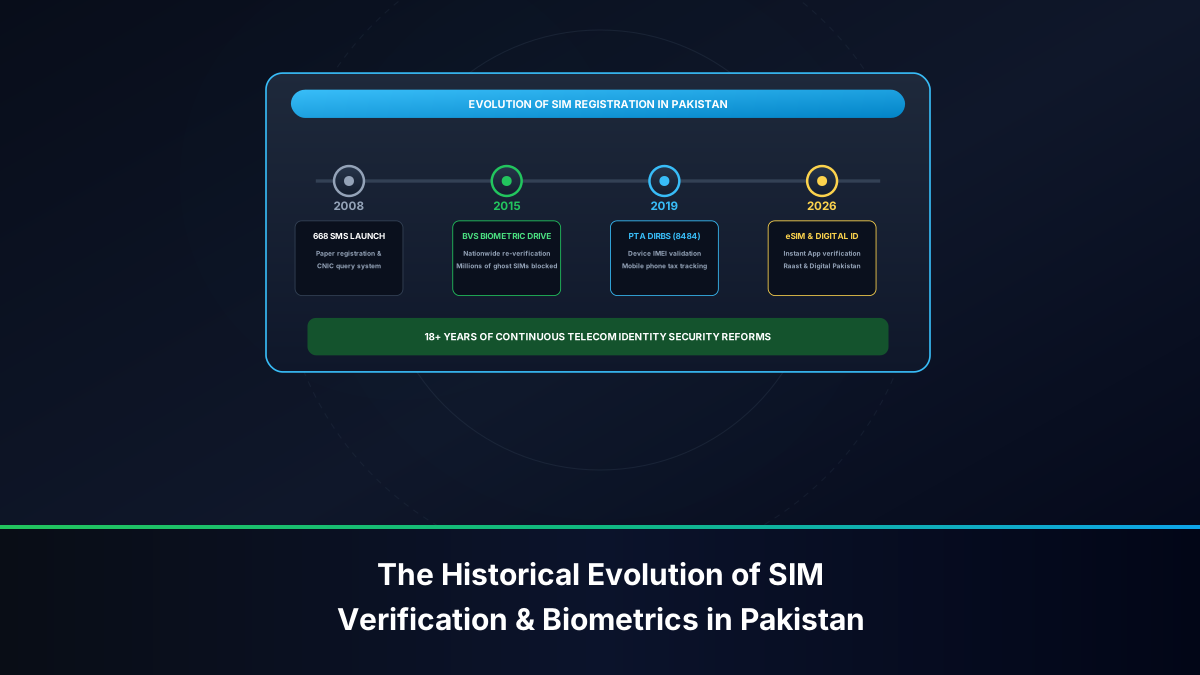
Pakistan stands historically as the first nation in the developing world to execute a comprehensive, nationwide biometric re-verification of its entire active telecommunications subscriber base. Following the tragic terrorist attack on the Army Public School (APS) in Peshawar in December 2014, the Government of Pakistan formulated the National Action Plan (NAP). Under this statutory mandate, the Pakistan Telecommunication Authority (PTA), in conjunction with the nation's cellular operators and NADRA, executed an unprecedented 90-day campaign in early 2015, biometrically re-verifying over 100 million active prepaid connections and permanently blocking tens of millions of unverified, counterfeit, or orphan lines.
The Real-Time NADRA BVS Authentication Sequence
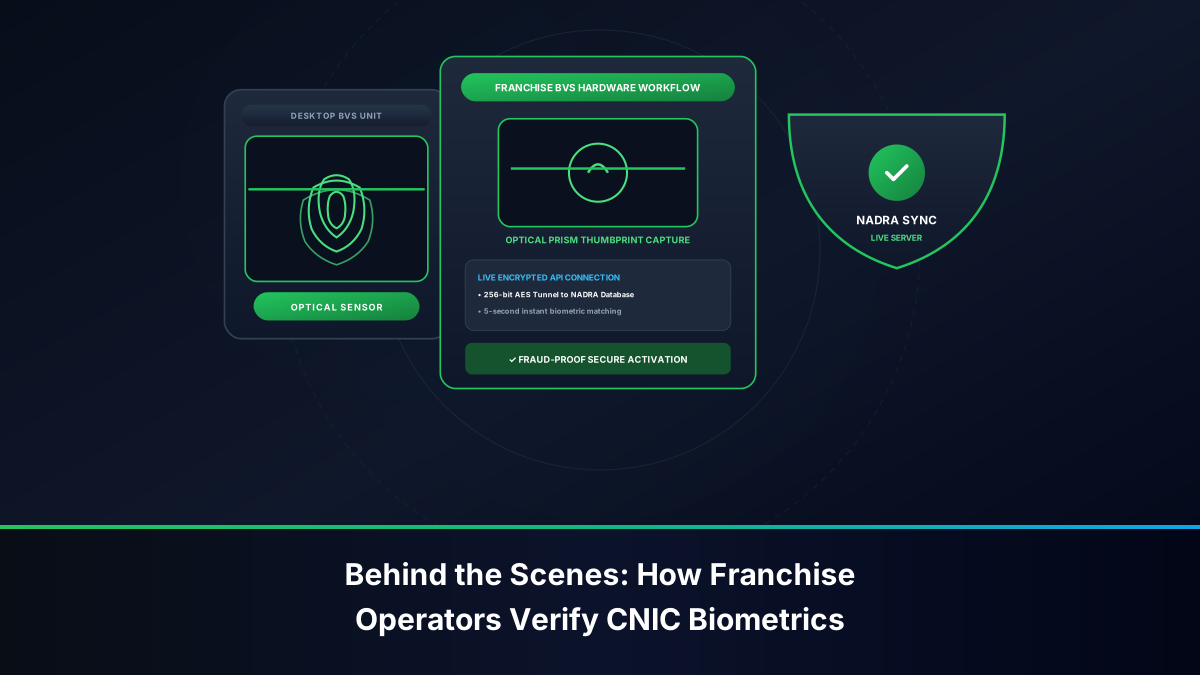
In Pakistan, acquiring any cellular connection (prepaid, postpaid, or data broadband) requires a real-time cryptographic handshake with NADRA's centralized biometric repository:
- Document Presentation: The applicant presents their physical 13-digit Computerized National Identity Card (CNIC), National Identity Card for Overseas Pakistanis (NICOP), or Alien Registration Card (ARC).
- Biometric Thumbprint Scan: The subscriber places their right or left thumb or index finger on a standardized, optical or capacitive Biometric Verification System (BVS) terminal deployed at an authorized operator franchise, customer center, or NADRA e-Sahulat kiosk.
- Encrypted VPN Transmission: The BVS client application captures the minutiae points of the fingerprint, encrypts the biometric template using AES-256 encryption, and transmits the payload across a private APN/VPN tunnel directly to NADRA's central automated fingerprint identification system (AFIS) in Islamabad.
- Boolean 1:1 Match: NADRA executes a 1:1 match against the master biometric file associated with that specific 13-digit CNIC. Within 2 to 4 seconds, NADRA returns an authenticated digital authorization token back to the mobile operator's provisioning engine.
- Home Location Register (HLR) Activation: Only upon receiving this authenticated token does the operator's core network provision the International Mobile Subscriber Identity (IMSI) in the Home Location Register (HLR) and assign an active MSISDN.
The 8-SIM Cap, 668 SMS Gateway & PMD Architecture
To prevent individual citizens from accumulating vast portfolios of SIM cards that could be leased to unauthorized third parties or deployed in gray SIM boxes, the PTA enforces a rigid mathematical ceiling:
- The 8-SIM Regulatory Limit: A Pakistani citizen is legally permitted to hold a maximum of 5 voice SIM cards across all four mobile networks (Jazz, Zong, Telenor, Ufone) combined, plus a supplementary quota of up to 3 dedicated data/broadband SIMs, creating an absolute national ceiling of 8 SIM cards per CNIC.
- The Central PMD Clearinghouse: This cap is strictly enforced in real time by the Pakistan Mobile Database (PMD)—a shared central clearinghouse interconnecting all cellular carriers. When a customer attempts to purchase a 6th voice SIM, the PMD automatically aborts the BVS transaction with an error: "Subscriber quota exceeded."
- The 668 SMS & Web Directory: Any citizen can instantly audit their national SIM footprint by composing an SMS with their 13-digit CNIC (without spaces or hyphens) and transmitting it to shortcode
668, or by visiting the official portal atcnic.sims.pk. The system returns an itemized tally of active connections per operator.
India: DoT, Aadhaar-Based e-KYC, TAFCOP Portal & CEIR
India maintains the world's second-largest telecommunications subscriber base, exceeding 1.15 billion active mobile connections. Overseen by the Department of Telecommunications (DoT) and the Telecom Regulatory Authority of India (TRAI), India's SIM verification ecosystem is anchored around the country's foundational digital identity stack: Aadhaar, administered by the Unique Identification Authority of India (UIDAI).
Aadhaar e-KYC, D-KYC & Facial Liveness Mandates
India's customer acquisition framework has evolved across distinct legal and technological phases:
- Aadhaar-Based e-KYC: The primary onboarding pathway utilizes a 12-digit Aadhaar number. The customer provides either a biometric fingerprint/iris scan or an OTP sent to their Aadhaar-registered mobile phone. Following supreme court rulings on privacy, DoT also implemented a Virtual ID (VID) system to shield the actual 12-digit Aadhaar number from third-party vendors.
- Digital KYC (D-KYC): For citizens lacking Aadhaar or choosing alternate official identification documents (such as Passports, Voter ID cards, or Driving Licenses), DoT introduced D-KYC. This process mandates capturing a live geo-tagged photograph of the customer alongside original proof-of-identity documents within an authorized telecom retailer's mobile app.
- Facial Liveness & AI Fraud Detection: To eradicate paper photo fraud and silicone thumbprint spoofing, DoT has increasingly integrated real-time 3D facial liveness matching, cross-referencing live kiosk camera feeds against UIDAI facial records.
TAFCOP Portal, Regional Circle Caps & Sanchar Saathi
India's subscriber governance architecture incorporates sophisticated consumer portals and nuanced regional ceilings:
- The TAFCOP Directory: Managed under the unified Sanchar Saathi initiative (
tafcop.sancharsaathi.gov.in), TAFCOP (Telecom Analytics for Fraud management and Consumer Protection) allows Indian citizens to input their mobile number, verify via OTP, and view a comprehensive, itemized list of all cellular connections registered under their Aadhaar/identity document across all Licensed Service Areas (LSAs). If an unknown number appears, the citizen can click "This is not my number" to trigger immediate regulatory disconnection. - Subscriber Quotas (9 vs 6 SIMs): Under general DoT guidelines, an Indian citizen can hold up to 9 SIM cards across all mobile operators (Reliance Jio, Bharti Airtel, Vodafone Idea, BSNL). However, in highly sensitive national security jurisdictions—specifically the Jammu & Kashmir (J&K), Assam, and North East telecom circles—the legal ceiling is reduced to a maximum of 6 SIM cards per individual.
- The CEIR Handset Registry: Similar to Pakistan's DIRBS, India operates the Central Equipment Identity Register (CEIR), allowing consumers to block stolen handset IMEIs nationwide through the Sanchar Saathi web interface.
Bangladesh: BTRC Biometric KYC, CBVP & The *16001# Gateway
Under the stewardship of the Bangladesh Telecommunication Regulatory Commission (BTRC), Bangladesh implemented nationwide mandatory biometric SIM registration across 2015 and 2016. The initiative transformed a mobile market plagued by extortion, unregistered VoIP gateways, and mobile financial services (MFS) fraud into one of Asia's most strictly monitored telecom environments.
National ID (NID) Database Matching via CBVP
Bangladesh's biometric architecture operates through a centralized platform known as the Central Biometric Verification Platform (CBVP):
- The customer presents their 10-digit Smart NID or 17-digit legacy National Identity Card issued by the Bangladesh Election Commission.
- The telecom retail agent scans the customer's fingerprint on an authorized biometric POS sensor.
- The biometric print is cross-matched against the National ID server operated by the Election Commission.
- Upon positive verification, the CBVP issues a digital certificate authorizing Grameenphone, Robi Axiata, Banglalink, or Teletalk to provision the mobile connection.
The 15-SIM Ceiling and *16001# Diagnostic Lookup
Bangladesh's regulatory limits and subscriber self-audit mechanics are characterized by high convenience and clear enforcement:
- The 15-SIM Statutory Ceiling: Historically, Bangladesh allowed citizens to register up to 20 SIM cards per NID. To curb SIM resale and unauthorized mobile financial service exploitation (such as bKash and Nagad proxy accounts), BTRC progressively lowered the legal cap to an absolute maximum of 15 SIM cards per National ID. Subscribers holding lines beyond this quota were forced to voluntarily deactivate or transfer surplus numbers.
- The Universal *16001# USSD Diagnostic Code: Unlike Pakistan and India which rely heavily on web clearinghouses or SMS gateways, Bangladesh established an exceptionally simple, universal USSD shortcode for subscriber transparency. A citizen dials
*16001#from any active mobile phone, inputs the last 4 digits of their NID, and immediately receives a detailed SMS displaying all mobile numbers (partially masked for privacy) registered against their identity across every active carrier.
Regional Perspectives: Sri Lanka (TRCSL) and Nepal (NTA)
Other South Asian economies have established distinctive regulatory paradigms suited to their geographic and demographic environments:
Sri Lanka: Telecommunications Regulatory Commission of Sri Lanka (TRCSL)
- Identity Document: Bound to the National Identity Card (NIC) issued by the Department for Registration of Persons (DRP).
- Verification Architecture: Traditionally paper-based CAF (Customer Application Form) accompanied by physical photocopies of the NIC and passport-sized photographs. In recent years, TRCSL has transitioned towards digital e-NIC verification and centralized database queries.
- Subscriber Limits: TRCSL mandates a limit of 5 SIM cards per operator per NIC. Across the country's primary carriers (Dialog Axiata, Mobitel, Hutch, and Airtel Lanka), a citizen can theoretically hold multiple connections, though commercial usage audits are strictly monitored.
Nepal: Nepal Telecommunications Authority (NTA)
- Identity Document: Bound to the official Citizenship Certificate (Nagrikta) or the modern biometric National ID Card.
- Verification Architecture: Customers submit physical citizenship certificates, accompanied by manual thumbprints on paper registration forms, which are subsequently digitized by Nepal Telecom (NTC) and Ncell. The Government of Nepal is currently integrating direct API verification with the Department of National ID and Civil Registration.
- MDMS Handset Compliance: To combat handset smuggling across open Himalayan and southern land borders, NTA deployed the Mobile Device Management System (MDMS), mirroring the DIRBS and CEIR architectures of Pakistan and India.
Master Comparative Matrix: South Asian Telecom KYC Systems
The following analytical matrix provides a comprehensive, side-by-side comparative analysis of telecom identity governance across the five South Asian nations:
| Regulatory Dimension | Pakistan | India | Bangladesh | Sri Lanka | Nepal |
|---|---|---|---|---|---|
| National Regulator | PTA (Pakistan Telecommunication Authority) | DoT / TRAI | BTRC | TRCSL | NTA |
| Primary Identity Anchor | 13-digit CNIC / NICOP / ARC | 12-digit Aadhaar / VID / Passport | 10-digit Smart NID / 17-digit NID | National Identity Card (NIC) | Citizenship Certificate / National ID |
| National Registry Agency | NADRA | UIDAI | Election Commission | DRP | DoNIDCR |
| Biometric Modality | Optical / Capacitive 1:1 Thumbprint Match | Fingerprint, Iris & Facial Liveness | Optical Fingerprint Minutiae Matching | Manual Thumbprint (Migrating to e-NIC) | Manual Inked Thumbprint / Digital NID |
| Individual SIM Limit | Max 8 SIMs (5 Voice + 3 Data) | Max 9 SIMs (Restricted to 6 in J&K/NE) | Max 15 SIMs per NID | Max 5 SIMs per operator | Max 2 to 5 SIMs per operator |
| Consumer Self-Audit Channel | SMS to 668 or cnic.sims.pk |
TAFCOP Portal (sancharsaathi.gov.in) |
USSD code *16001# |
Operator Customer Portals | Operator Helplines & SMS strings |
| Handset / IMEI Registry | DIRBS (Dial *#06#, SMS to 8484) |
CEIR (Sanchar Saathi Portal) | BTRC EIR Database (SMS to 16002) |
TRCSL IMEI White-List System | MDMS (Mobile Device Management) |
| SIM Dormancy Churn Period | 180 continuous days | 90 continuous days | 450 continuous days | 90 to 180 days | 180 to 365 days |
Cross-Border Roaming, Border Area Radio Spillover & Security Controls
One of the most technically complex and sensitive operational aspects of South Asian telecommunications is managing radio frequency emissions along contested or sensitive international land borders. Radio waves do not obey political frontiers; without stringent engineering controls, base transceiver stations erected near international borders can project strong cellular signals kilometers into neighboring sovereign territory.
Engineering Protocols for Border RF Spillover
Both Pakistan and India enforce strict regulatory directives governing cellular towers erected within 10 to 15 kilometers of the international boundary and the Line of Control (LoC):
- Antenna Tilt & Down-Sectoring: Base station antennas operating in border zones are legally mandated to implement aggressive physical and electrical downtilts. Antenna azimuths are oriented parallel or inward toward the domestic hinterland, strictly preventing direct signal propagation across the border.
- Power Attenuation: Regulators mandate strict limits on Effective Radiated Power (ERP) for border-area transceivers to ensure that cross-border signal strength drops below carrier reception thresholds (-110 dBm) at the zero line.
- Border Tower Audits: Joint inspections conducted by regulatory enforcement divisions and military signal corps periodically measure radio frequency spectrum along borders using specialized spectrum analyzer vans to detect unauthorized spillover.
Prepaid Roaming Restrictions in Sensitive Zones
Due to prolonged cross-border security challenges, India's Department of Telecommunications enforces an absolute ban on incoming prepaid international roaming in sensitive border circles, including Jammu & Kashmir and designated northeastern states. Foreign prepaid SIM cards and domestic prepaid SIM cards originating from outside J&K automatically lose network access upon entering the circle; only verified postpaid connections are permitted to roam. In Pakistan, cellular coverage in immediate border districts is subjected to localized security lockdowns and temporary mobile service suspensions during high-threat security operations or major national religious processions.
Tourist, Diplomatic & Expatriate SIM Onboarding Standards Compared
Foreign tourists, international business delegates, and expatriates traveling through South Asia encounter vastly different onboarding friction across borders:
1. Pakistan (PTA Tourist Protocols)
Foreign passport holders entering Pakistan can purchase a local SIM card at international airport kiosks (Islamabad, Lahore, Karachi, Peshawar, Quetta, Multan) or designated flagship customer care centers:
- Documentation: Valid original Passport, valid Pakistani Tourist / Business Visa or Visa-on-Arrival (electronic visa printout).
- Biometric Process: Live digital facial photo capture and BVS fingerprint scan on the NADRA foreigner portal.
- Validity Period: The SIM card is active for an initial duration of 30 to 90 days, strictly matching the expiration timestamp of the entry visa.
- DIRBS Handset Exemption: Foreign tourists can operate their personal imported smartphones tax-free for up to 60 consecutive days. If the stay extends beyond 60 days, the handset IMEI must be registered through the PTA DIRBS portal and customs duties must be paid to prevent baseband transmission blocking.
2. India (DoT Foreigner e-KYC Protocols)
India enforces a rigorous paper-or-digital KYC regime for non-residents:
- Documentation: Original Passport, valid Indian Visa or Overseas Citizen of India (OCI) card, a live photograph captured at the retail center, and proof of address in India (such as a hotel booking confirmation or local resident guarantor reference).
- Validity Period: SIM validity is capped at a maximum of 90 days, or until the exact expiration date of the traveler's visa, whichever is shorter. After this period, the SIM is automatically disconnected.
3. Bangladesh (BTRC Foreigner Registration)
Foreigners visiting Bangladesh must provide:
- Documentation: Original Passport, entry visa endorsement, and physical biometric fingerprint registration at the mobile operator's airport counter.
- Validity Period: Active for 30 days by default, extendable upon presenting a formally approved visa extension certificate from the Department of Immigration & Passports.
Data Sovereignty, Biometric Spoofing & Privacy Legislation (PECA vs DPDPA)
The centralized storage of biometric templates belonging to hundreds of millions of citizens across South Asia has ignited intense judicial and civic debates surrounding surveillance, cybersecurity, and constitutional data privacy.
Biometric Vulnerabilities and Spoofing Countermeasures
Despite the high security of biometric authentication, organized criminal syndicates across South Asia have attempted to circumvent BVS mechanisms using sophisticated spoofing techniques:
- Artificial Silicone Fingerprint Casts: Scammers procure high-resolution latent fingerprints from property deed registries or land record offices, fabricate silicone or gelatin thumb molds, and use them to activate unauthorized SIM cards in collusion with corrupt retail agents.
- Liveness Detection Countermeasures: In response, NADRA (Pakistan) and UIDAI (India) have mandated modern Liveness Detection. Modern BVS hardware incorporates blood-flow pulse sensors, thermal heat detection, and contactless 3D smartphone camera algorithms that evaluate facial micro-movements to ensure the applicant is a living, breathing person.
Statutory Privacy Frameworks: Pakistan vs India
The legal protection of consumer telecommunications data is governed under evolving national statutes:
- Pakistan: Subscriber privacy is protected under the Prevention of Electronic Crimes Act (PECA) 2016 and PTA Consumer Protection Regulations. Section 16 of PECA imposes severe criminal penalties for unauthorized harvesting or distribution of identity data. The pending Personal Data Protection Bill aims to establish a dedicated National Data Protection Commission (NDPC).
- India: In August 2023, the Indian Parliament enacted the Digital Personal Data Protection Act (DPDPA) 2023. The statute establishes severe financial penalties (up to INR 250 crore) for data fiduciaries—including telecom operators—that fail to safeguard consumer identity data or experience unauthorized biometric data breaches.
Frequently Asked Questions: Cross-Border SIM Regulations & KYC
Authoritative legal and technical insights addressing telecommunications identity compliance, SIM limits, and cross-border roaming across South Asian jurisdictions.