The Retail Frontline: The Engineering Behind the BVS Counter
For the average mobile subscriber in Pakistan, purchasing a cellular connection, migrating to an eSIM, replacing a lost SIM card, or transferring ownership appears to be a routine retail interaction. The customer enters an authorized customer service center of Jazz, Zong, Telenor, or Ufone, presents their Computerized National Identity Card (CNIC), places a finger on a small optical scanning platen illuminated by blue or green light, and walks away minutes later with an active cellular connection.
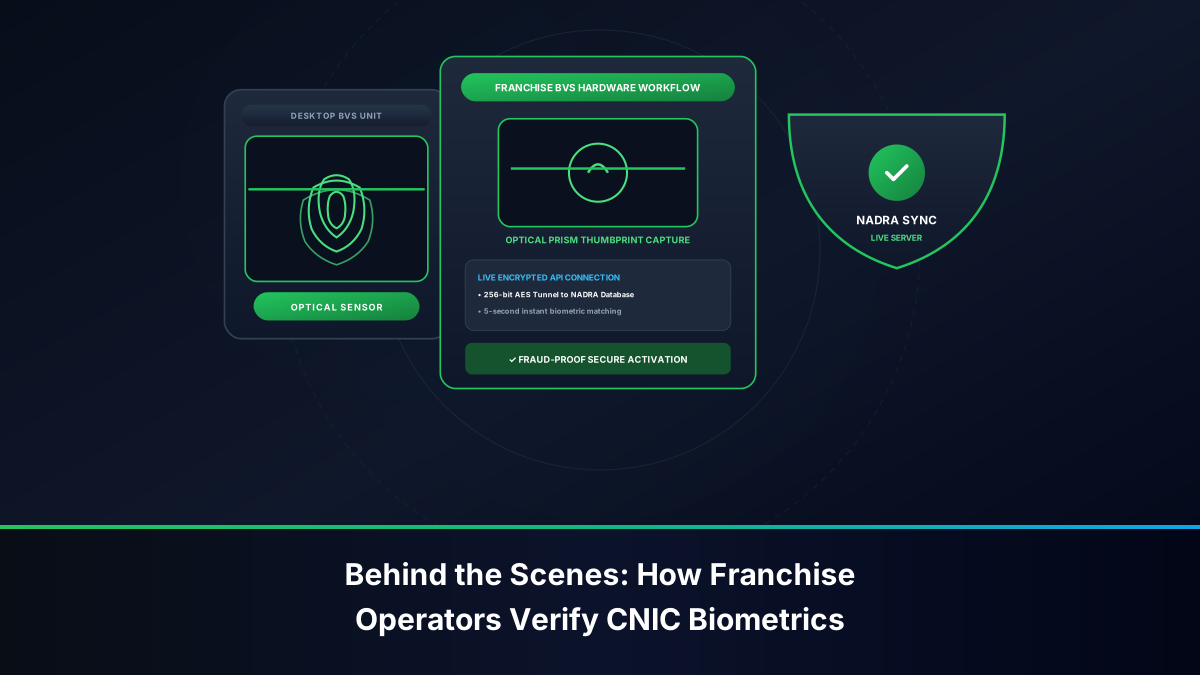
However, beneath this streamlined retail surface operates one of the most sophisticated, high-speed biometric identification and cryptographic routing pipelines in global telecommunications. Every time a citizen presses their finger onto a Biometric Verification System (BVS) terminal at an authorized Pakistani telecom franchise, a complex choreography of hardware liveness detection, cryptographic minutiae abstraction, private virtual routing, and massive-scale database matching is executed in sub-second increments.
Understanding this architecture reveals why Pakistan's biometric infrastructure is celebrated globally for its resilience against identity fraud, while also illuminating the strict engineering boundaries that govern subscriber identity under the regulatory authority of the Pakistan Telecommunication Authority (PTA) and the National Database and Registration Authority (NADRA).
System Integrity Principle: A telecom franchise BVS terminal is not a mere peripheral input device; it is a tamper-resistant hardware security boundary. It bridges local retail transactions with sovereign national civil registry databases across an uncompromising zero-trust telecommunications network.
BVS Terminal Hardware: Optical Sensors & Anti-Spoofing Architecture
The journey of biometric authentication begins at the physical interface: the biometric capture sensor. To prevent corrupt retail agents and criminal syndicates from exploiting low-grade consumer webcams or capacitive sensors, the PTA and NADRA enforce rigorous hardware compliance benchmarks.
500 DPI Optical Transducers vs. Capacitive Sensing Arrays
Every commercial BVS terminal deployed across Pakistani telecom franchises—typically manufactured by tier-1 biometric security vendors such as SecuGen (Hamster Pro 20 series), Suprema (BioMini Plus 2), and IDEMIA (MorphoSmart 1300 series)—relies on high-precision optical scanning prisms:
- Total Internal Reflection (TIR): When a finger touches the prism platen, the raised ridges of the friction skin make physical contact with the glass, while the recessed valleys remain separated by microscopic air gaps. An LED light array illuminates the prism; light striking the air gaps reflects internally, while light striking the skin ridges scatters. A specialized CMOS/CCD sensor captures this contrast pattern.
- 500 DPI Spatial Resolution: The sensor captures uncompressed imagery at precisely 500 dots per inch (DPI) with 256 levels of true grayscale dynamic range. This spatial resolution is mandatory to satisfy the FBI Mobile ID IQS (Image Quality Specifications) and FIPS 201 / PIV standards adopted by NADRA.
- Optical Hardened Platens: Platens are fabricated from hardened optical crown glass or scratch-resistant diamond-coated quartz, capable of withstanding millions of physical abrasions, chemical sanitizers, and extreme environmental dust common in Pakistani urban and rural markets.
Presentation Attack Detection (PAD): Sub-Dermal Infrared & Pulse Analysis
The greatest threat to physical biometric systems is the Presentation Attack—the use of artificial biometric replicas, such as silicone rubber molds, gelatin casts, latex fingers, 3D printed resin casts, or dead organic tissue. To neutralize these attack vectors, certified franchise BVS units integrate multi-spectral Presentation Attack Detection (PAD) conforming to ISO/IEC 30107-3 (Level 1 and Level 2 compliance):
- Sub-Dermal Multi-Spectral Illumination: In addition to visible surface light, the sensor projects dual-wavelength infrared (IR) light into the finger tissue. The system analyzes the optical absorption characteristics of human hemoglobin to verify that live oxygenated blood is circulating through the capillary beds.
- Capacitive Dynamic Impedance: The platen measures the electrical conductivity and dielectric permittivity of the surface touching the glass. Silicone, gelatin, and plastic have fundamentally different electrical impedance curves compared to living human epidermal tissue, triggering an instantaneous hardware abort if an artificial film is detected.
- Dynamic Pulse & Micro-Motion Detection: Advanced sensors detect the microscopic volumetric expansion of capillary vessels corresponding to human cardiac pulsation, ensuring that a static photograph or inanimate cast is instantly rejected.
The End-to-End Cryptographic Handshake: From Glass Platen to NADRA Core
A widespread misconception among consumers is that the BVS scanner transmits an ordinary picture of their thumbprint across the internet. In reality, transmitting raw unencrypted biometric imagery over public networks would represent an intolerable security vulnerability. The transaction follows a rigorous five-stage cryptographic pipeline.
Step 1: On-Device Feature Extraction & ISO/IEC 19794-2 Minutiae Templates
Immediately after the optical transducer captures the ridge pattern, the terminal's onboard digital signal processor (DSP) executes a feature-extraction algorithm. The software filters out skin blemishes, fills superficial scars, and isolates the defining geometric characteristics of the fingerprint, known as minutiae points:
- Ridge Endings: The exact Cartesian coordinate
(x, y)where a friction ridge terminates abruptly. - Bifurcations: The point where a single ridge forks into two distinct branch paths.
- Orientation Angles (Theta): The angular direction in which the ridge vector is traveling at that specific coordinate.
These minutiae points are compiled into an internationally standardized binary data structure compliant with ISO/IEC 19794-2 (Biometric Data Interchange Formats - Finger Minutiae Data). The raw bitmap image is instantly and permanently purged from the volatile memory buffer. It is mathematically impossible to reconstruct the original physical fingerprint image from an ISO minutiae template.
Step 2: Hardware-Level TPM Encryption & Ephemeral Key Generation
Before the minutiae template leaves the terminal enclosure, the device's integrated Trusted Platform Module (TPM) or secure cryptoprocessor initiates an encrypted envelope:
- The terminal generates a cryptographically secure 256-bit symmetric session key (AES-256-GCM).
- The ISO minutiae payload is encrypted using this ephemeral AES key, guaranteeing confidentiality and authenticated data integrity.
- The AES session key is then encrypted using NADRA's public master key via asymmetric RSA-2048 / RSA-4096 encryption. Only NADRA's Hardware Security Modules (HSMs) in Islamabad possess the corresponding private key capable of decrypting this session token.
Step 3: Carrier BSS Ingestion via Dedicated MPLS/VPN Tunnels
The encrypted biometric package is transmitted from the retail desktop application to the mobile operator's core Business Support System (BSS) via dedicated, private Multiprotocol Label Switching (MPLS) telecommunication circuits or encrypted IPsec VPN tunnels (TLS 1.3). The operator's middleware appends critical contextual metadata to the payload:
- Unique Terminal Identifier (TID) and Terminal Serial Number.
- Franchise Location Code and Physical Retailer ID.
- The Franchise Agent's authenticated National Identity Number (CNIC).
- GPS Coordinates captured by the terminal's internal satellite receiver.
- A synchronized UTC timestamp with microsecond resolution to prevent replay attacks.
Step 4: NADRA ABIS/AFIS 1:1 Cryptographic Verification Matching
The carrier BSS dispatches the consolidated request across a dedicated government gateway into NADRA's Automated Biometric Identification System (ABIS) / Automated Fingerprint Identification System (AFIS) datacenter. Here, the system executes a 1:1 Verification Match:
- The NADRA HSM decrypts the AES session key using its private RSA key and extracts the incoming ISO minutiae template.
- NADRA's database engine queries the citizen's master profile corresponding to the submitted 13-digit CNIC number. It retrieves the archived reference minutiae templates captured when the citizen originally registered for their Smart National Identity Card.
- The ABIS matching engine executes high-speed spatial vector alignment algorithms, calculating the mathematical correlation score between the live franchise template and the archived reference template.
- If the match score exceeds the rigorous threshold established by federal security standards (typically a False Acceptance Rate lower than 1 in 100,000), NADRA's gateway marks the verification as AUTHENTICATED.
Step 5: PTA 668 Gateway Quota Enforcement & Token Signing
Once identity is confirmed by NADRA, the transaction triggers an automated webhook into the PTA 668 SIM Information System clearinghouse:
- The system checks the citizen's current aggregate count across all mobile operators (Jazz, Zong, Telenor, Ufone, SCO).
- If the customer has 4 or fewer active voice SIMs, the quota check passes.
- If the customer already possesses 5 active voice lines, the clearinghouse rejects the transaction, returning error code
ERR_QUOTA_CEILING_REACHED. - If all checks clear, NADRA issues a digitally signed, tamper-evident cryptographic authorization token to the operator BSS, permitting the physical SIM ICCID to be paired with the subscriber's MSISDN in the carrier Home Location Register (HLR).
The Multi-Finger MBVS Upgrade: Defeating Silicone Counterfeits
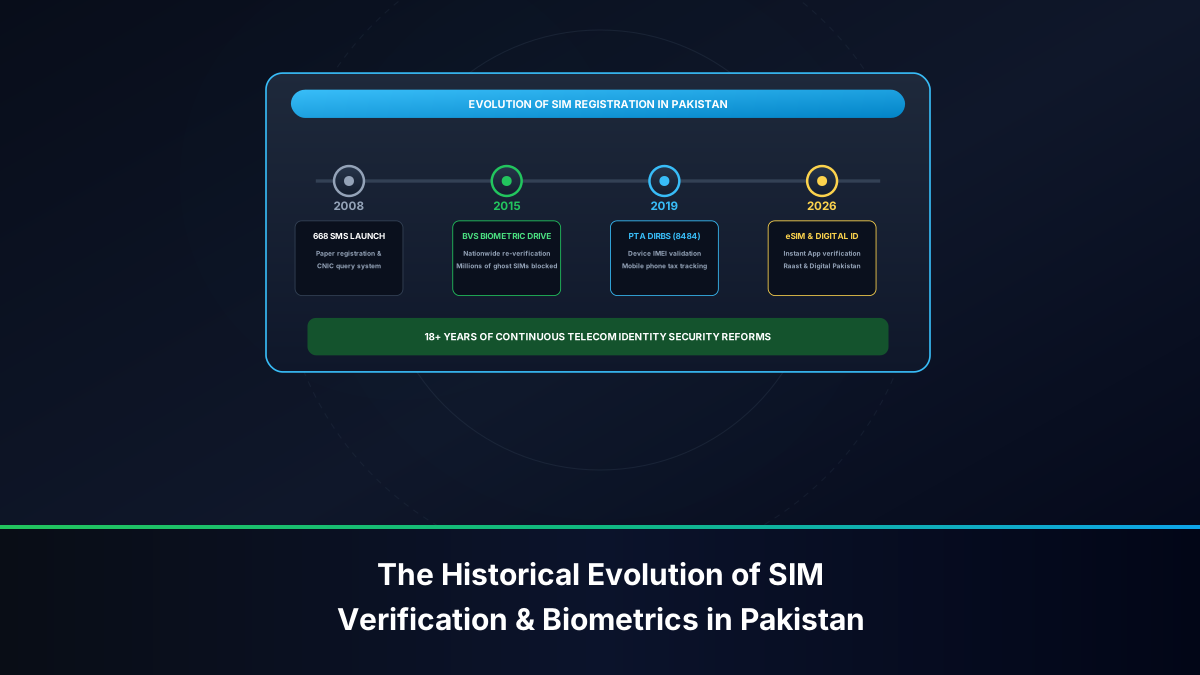
Between 2015 and 2021, BVS terminals in Pakistan operated primarily on a single-fingerprint verification model—traditionally the customer's right or left thumb. While revolutionary, criminal networks eventually identified a vulnerability: rogue retail staff were covertly pressing customers' thumbs into soft wax or silicone putty under desks, later producing synthetic rubber casts to activate illicit SIM cards.
Dynamic Two-Finger Randomization Protocols
In 2022, PTA and NADRA mandated the nationwide transition to the Multi-Finger Biometric Verification System (MBVS). Under MBVS, a static thumb scan is strictly prohibited. The system enforces dynamic, algorithmic randomization:
- When the franchise agent initiates a transaction, NADRA's centralized server dynamically selects two random fingers from the citizen's ten archived digits (e.g., "Request: Finger 2 (Right Index) followed by Finger 9 (Left Ring)").
- The agent and customer cannot predict which fingers will be requested prior to starting the session.
- Both requested fingers must be scanned sequentially within an automated countdown timer. The transaction fails if the agent attempts to substitute a thumb for the requested digit.
Rate Limiting & Three-Strike Security Lockouts
To eliminate brute-force trial attacks, NADRA's gateway enforces strict algorithmic rate-limiting:
- Three-Attempt Threshold: If a customer provides three consecutive non-matching biometric scans within a single session, the system terminates the session immediately.
- 24-Hour Security Quarantine: The citizen's CNIC is placed in a 24-hour verification cooling-off lock across all telecom networks. This prevents criminals from moving from franchise to franchise testing counterfeit molds.
Retail Agent Safeguards: Geofencing, Dual Biometrics & Audit Logs
A critical dimension of BVS engineering focuses on securing the human element—preventing dishonest retail employees from abusing company hardware.
GPS Geofencing & Static IP Whitelisting for BVS Terminals
Every authorized BVS terminal deployed in a franchise or retail shop is bound to a specific physical geographic location:
- Hardware Cryptographic Binding: The MAC address, motherboard UUID, and BVS sensor serial number are registered in the operator's central gateway.
- GPS Geofencing: Certified terminals house internal GPS receivers. The device must report its coordinates within a 50-meter radius of the registered franchise commercial address. If an employee removes the scanner to an unauthorized home location, the terminal enters an immediate hardware lock state.
- Static IP & Network Whitelisting: Terminals communicate exclusively over whitelisted static IP subnets assigned to licensed telecom retail points. Traffic originating from commercial residential broadband or consumer VPNs is automatically dropped by carrier firewalls.
Mandatory Agent Biometric Signing for Every Customer Transaction
Under PTA Consumer Protection Directives, no customer verification transaction can be initiated anonymously. The system enforces a mandatory Dual-Biometric Authentication protocol:
- The franchise employee must first scan their own thumbprint on the BVS platen to unlock the retail software application.
- The employee's biometric identity is validated against the operator's authorized staff registry.
- Only after the agent is authenticated does the software allow the customer's CNIC to be entered.
- Both the agent's digital signature and the customer's verification token are immutably written to an auditable regulatory ledger retained for a statutory minimum of 3 years. If an illegal SIM is subsequently detected, the exact agent who authorized the issuance is immediately identified for criminal prosecution under PECA 2016.
Diagnostic Guide: Resolving Fingerprint Mismatches & Ridge Erosion
Despite the sophistication of the BVS infrastructure, millions of citizens encounter verification failures at franchise counters. Understanding the technical reasons for these failures empowers consumers to navigate official administrative remedies.
Handling Worn Ridges: Elderly Citizens, Manual Laborers & Medical Conditions
The primary cause of legitimate biometric verification failure is Epidermal Ridge Erosion:
- Manual Laborers & Agricultural Workers: Physical friction from construction tools, brick handling, harvesting, and chemical exposure (such as cement, solvents, or fertilizers) flattens the friction ridges of the skin, resulting in faint, unreadable minutiae captures.
- Elderly Citizens: As human skin ages, it loses collagen, moisture, and elasticity. Ridges become shallow and fragmented, causing the optical sensor to capture discontinuous lines that fail to achieve the required matching threshold.
- Medical Conditions: Dermatological conditions (such as eczema, psoriasis, dermatitis) or patients undergoing chemotherapy frequently suffer from temporary or permanent loss of fingerprint ridges.
Official PTA/NADRA Exception Protocols: Verification Letters & Smart Card Chips
When repeated BVS scans fail for a legitimate citizen, the following official exception pathways are established under PTA regulations:
- Hydration & Cleaning Technique: In minor cases of dry skin, applying a tiny drop of alcohol-free moisturizer or moistening the fingertip with a damp cloth can restore optical contrast on the prism platen.
- Biometric Refresh at a NADRA Mega Center: Citizens should visit an executive NADRA office to update their biometric master records. NADRA's enterprise multi-spectral scanners can capture high-resolution records from less-used fingers (such as the little finger or ring finger) that maintain intact ridges.
- Smart CNIC Contact Microchip Reading: Citizens holding a Smart National Identity Card (with an integrated golden contact chip) can request the franchise representative to utilize a certified smart-card reader. The customer inputs their confidential PIN to authenticate identity without relying on optical platen scanning.
- Official Biometric Exemption Verification Letter: For citizens with total permanent biometric degradation (e.g., amputees, severe burn victims, or elderly citizens whose fingerprints are completely unreadable), NADRA issues an official Biometric Verification Exemption Certificate. The citizen presents this certificate alongside two verified blood relatives at a flagship customer service center to complete manual SIM issuance under supervisory managerial override.
Comparative Matrix: Certified BVS Terminals in Pakistan
The following hardware matrix highlights the technical specifications, security standards, and operational features of BVS scanning units deployed across Pakistani telecom franchises:
| Hardware Metric | SecuGen Hamster Pro 20 | Suprema BioMini Plus 2 | IDEMIA MorphoSmart 1300 |
|---|---|---|---|
| Sensor Technology | Patented SEIR Optical Sensor | Single-Prism Optical Transducer | High-Density Optical CMOS Array |
| Image Resolution | 500 DPI / 256 Grayscale levels | 500 DPI / 8-bit Grayscale | 500 DPI / 256 Grayscale levels |
| Active Platen Area | 16.1 mm × 18.2 mm | 16.0 mm × 18.0 mm | 14.0 mm × 22.0 mm |
| Liveness Detection Standard | Auto-On & Smart Capture PAD | Patented MDR Multi-Dynamic Range | Opto-Electronic Pulse & IR Analysis |
| Security Certifications | FBI PIV / Mobile ID IQS, FIPS 201 | FBI PIV, FIPS 201, ISO/IEC 19794-2 | FBI PIV-IQS, FIPS 201, Common Criteria |
| Interface Protocol | USB 2.0 High-Speed / Encrypted Stream | USB 2.0 / Hardware Cryptoprocessor | USB 2.0 with Onboard AES Encryption |
| Operating Temperature | -20°C to +65°C (Heavy-Duty) | -10°C to +50°C (Franchise Grade) | -10°C to +50°C (Enterprise Grade) |
Frequently Asked Questions
For more specific operational queries regarding franchise BVS scanner mechanics, cryptographic protections, and resolving persistent thumbprint mismatches, consult the verified FAQ entries above.