The Transformation of Subscriber Identity Architecture in Pakistan
The telecommunication sector of Pakistan has experienced one of the most dramatic regulatory and technological evolutions in global digital history. Over a thirty-year trajectory spanning from the mid-1990s to the current era of 2026, Pakistan transitioned from an entirely unregulated telecommunications frontier—where prepaid cellular connections could be purchased anonymously off street vendor carts like confectionery—into one of the world's most rigorously authenticated, biometrically secured mobile subscriber ecosystems.
This profound metamorphosis was not driven merely by commercial enterprise or administrative desire for order. Rather, it was forged through severe national security challenges, the rise of international terrorism, the scourge of grey-market telephony syndicates, and the urgent imperative to establish a reliable digital identity infrastructure capable of underpinning national financial inclusion, digital banking, and e-governance. Today, the collaboration between the Pakistan Telecommunication Authority (PTA) and the National Database and Registration Authority (NADRA) serves as a globally recognized benchmark studied by telecommunications regulators worldwide.
Historical Milestone: Pakistan became one of the first sovereign nations in the world to mandate, execute, and achieve a 100% biometrically verified national mobile subscriber base, auditing and authenticating over 100 million cellular lines against encrypted citizen fingerprint records in a historic 90-day campaign.
Era 1 (1994–2007): The Unregulated Frontier & Paper Application Forms
To appreciate the sophistication of modern telecom verification, one must examine the operational chaos that characterized the foundational decade of cellular telephony in Pakistan.
Early Analog Networks & the Explosion of Prepaid GSM Subscriptions
Mobile telephony commenced in Pakistan in 1994 with analog and early digital service providers such as Paktel (AMPS) and InstaPhone (D-AMPS), followed shortly by Mobilink (PMCL), which introduced GSM 900 technology. In these early years, cellular handsets were elite luxury items; subscriptions were predominantly postpaid and required extensive bank documentation, physical home address verification, and hefty cash security deposits exceeding PKR 10,000.
However, following the landmark Deregulation Policy of 2003 and the entry of international telecom conglomerates—including Telenor Pakistan, Warid Telecom, and China Mobile's Zong, alongside incumbent Ufone—the market pivoted aggressively toward prepaid subscriptions. Cellular carriers engaged in intense tariff wars, driving the cost of SIM cards down from thousands of rupees to as little as PKR 50 or giving them away entirely free of charge with bundled airtime.
Subscriber Acquisition Forms (SAF) & Rampant Identity Vulnerabilities
During this hyper-growth era, subscriber verification relied entirely on the physical Subscriber Acquisition Form (SAF):
- The Manual Paper Pipeline: A customer purchased a pre-activated SIM card from a roadside kiosk, general store, or pan shop. The purchaser filled out a paper form with their name, address, and National Identity Card (NIC/CNIC) number, accompanied by a paper photocopy of their identity document.
- Physical Courier Delays: Millions of physical paper forms were bundled into cardboard boxes and transported via postal couriers to regional operator warehouses for manual retrospective data entry. This pipeline took weeks or months to process.
- Rampant Identity Thefts & Ghost SIMs: Corrupt retailers frequently photocopied a single customer's CNIC hundreds of times, forging signatures to activate pre-packaged batches of SIMs that were subsequently sold at a premium to individuals seeking complete anonymity.
- National Security Vulnerabilities: Extortionists, kidnappers, and criminal syndicates operated with total impunity, utilizing untraceable mobile numbers that could be used for a single criminal phone call and discarded into gutters. Law enforcement agencies were left completely blind, as the names recorded on paper SAF archives belonged to innocent citizens whose CNIC photocopies had been stolen.
Era 2 (2008–2013): Early Digital Verification & the 789 / 668 Infrastructure
Recognizing that paper-based verification had completely collapsed under the weight of mobile expansion, the PTA and the Ministry of Interior initiated the first phase of digital modernization.
The 789 IVR System: NADRA Challenge-Question Interrogation
In 2008, the PTA outlawed the sale of pre-activated SIM cards. Under the newly established 789 Verification Mechanism, SIM cards were sold in a dormant, non-functional state. To activate the line, the subscriber was required to follow a multi-step digital challenge:
- The customer inserted the inactive SIM card into a mobile handset. The SIM was restricted to dialing a single universal regulatory shortcode: 789.
- The call connected to a secure Interactive Voice Response (IVR) system or an operator call center agent directly integrated with NADRA's national identity database.
- The agent asked the caller to state their 13-digit CNIC number, followed by three confidential security challenge questions pulled dynamically from NADRA records: "What is your mother's maiden name?", "In which district were you born?", and "What is the issue date printed on your CNIC card?"
- If the caller answered correctly, NADRA dispatched an electronic clearance token to the carrier's HLR, and the SIM card transitioned from dormant to active status within 30 minutes.
The 2009–2010 Deployment of the PTA 668 Clearinghouse Gateway
While 789 improved activation oversight, citizens still had no transparent mechanism to monitor how many unauthorized numbers were fraudulently floating in their name. To solve this transparency void, PTA developed and launched the 668 SIM Information System in early 2010.
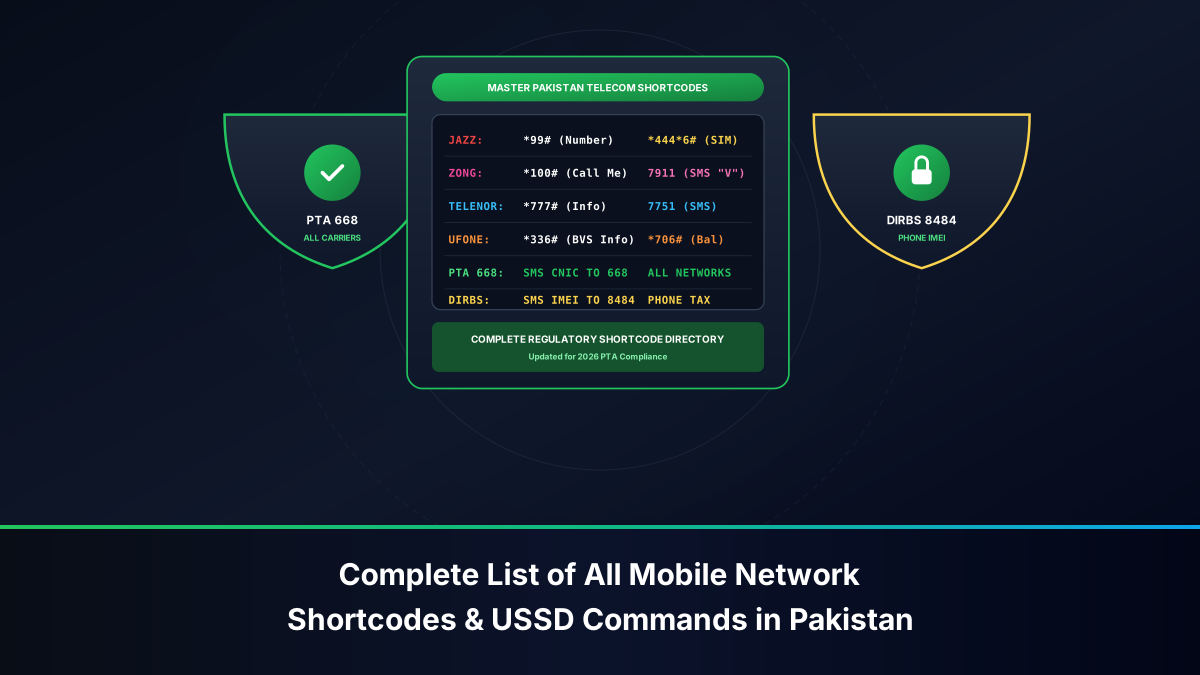
By sending their 13-digit CNIC to shortcode 668 via SMS or accessing the web portal at cnic.sims.pk, any Pakistani citizen could view an instantaneous, multi-operator breakdown of their registered voice and data SIMs. The launch of 668 revealed widespread discrepancies: hundreds of thousands of citizens discovered that their CNIC hosted dozens of unauthorized SIM cards activated by rogue retailers during the paper-SAF era.
Failure Modes of Non-Biometric Digital Verification
Despite the success of 668 and 789, determined criminal syndicates rapidly developed workarounds. Threat actors discovered that the answers to 789 challenge questions—mother's name, place of birth, and card issue date—could easily be obtained by bribing low-level municipal clerks, stealing physical documents, or exploiting family members. The fundamental limitation remained: Knowledge-based authentication is not proof of physical human presence.
Era 3 (2014–2015): The National Action Plan & Mandatory BVS Deployment
The definitive turning point in Pakistan's telecommunication history occurred in late 2014. On December 16, 2014, terrorists launched a horrific attack on the Army Public School (APS) in Peshawar, claiming the lives of 149 people, including 132 school children.
The Monumental 90-Day Biometric Re-Verification Blitz
State intelligence investigations revealed that the attackers communicated using cellular SIM cards registered under fraudulent, stolen identities. In direct response, the Government of Pakistan enacted the comprehensive National Action Plan (NAP) to eradicate internal terrorist infrastructure. A central pillar of the NAP was an uncompromising ultimatum issued by the Ministry of Interior and PTA to all cellular mobile operators:
Every single active SIM card in Pakistan must be re-verified through live biometric thumbprint matching against NADRA's national database within 90 days. Any SIM card failing biometric re-verification by April 12, 2015, must be permanently blocked and severed from the telecommunications network without exception.
Massive Hardware Rollout: Equipping 60,000+ Retailers with Optical Scanners
What followed was one of the greatest operational mobilizations in the history of global telecommunications:
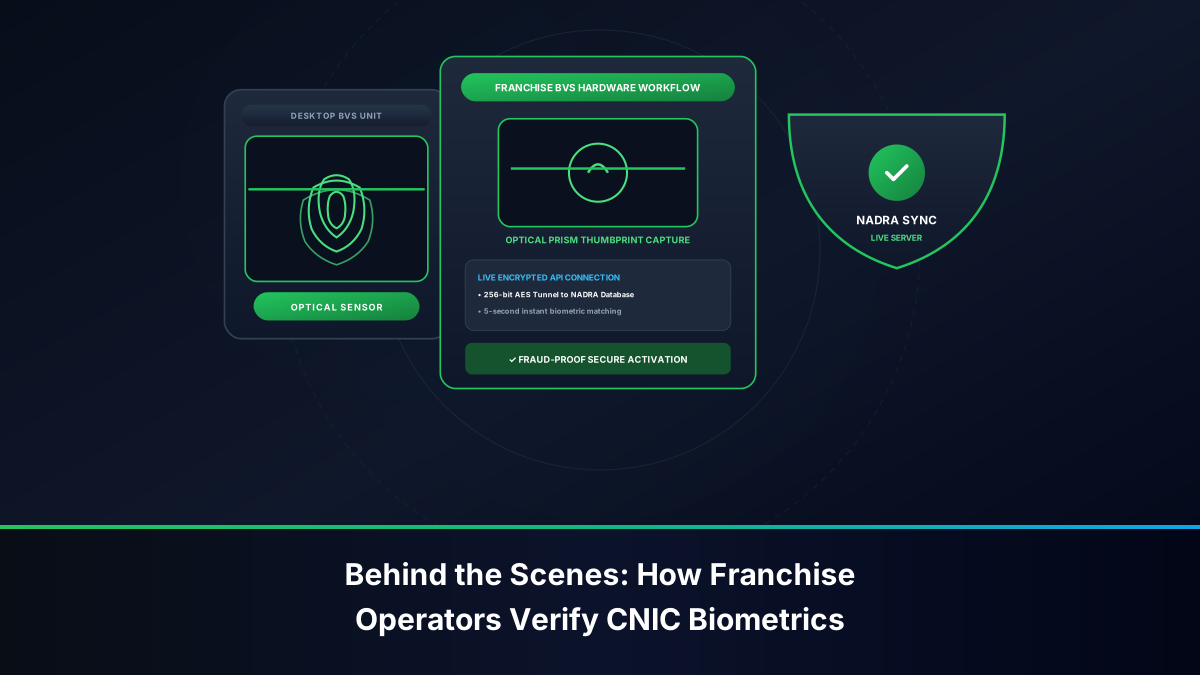
- Private Capital Investment: Cellular operators (Mobilink, Telenor, Zong, Ufone, Warid) collectively invested tens of millions of dollars within weeks, procuring over 65,000 biometric verification system (BVS) terminals manufactured by top security vendors (such as Suprema, Safran Morpho, and SecuGen).
- Nationwide Distribution: BVS devices were deployed to every telecom franchise, retail outlet, and rural distribution point across all four provinces, Azad Jammu & Kashmir, and Gilgit-Baltistan.
- Real-Time NADRA API Backbone: NADRA re-architected its core server infrastructure to handle millions of real-time encrypted ISO/IEC 19794-2 biometric minutiae lookups per day, maintaining sub-second response latencies despite monumental nationwide traffic loads.
- Civic Mobilization: Millions of Pakistani citizens queued outside telecom franchises in extreme weather conditions, pressing their thumbs onto optical scanners to preserve their personal and business phone lines.
Statistical Reckoning: 100M+ Verified vs. 25M Blocked Connections
When the national deadline expired in April 2015, the statistical scale of the achievement stunned international observers:
| Regulatory & Operational Metric | Historical Outcome (April 2015 Milestone) |
|---|---|
| Total SIMs Biometrically Authenticated | 103.2 Million active connections verified via NADRA BVS |
| Unverified / Proxy SIMs Blocked | 25.1 Million connections permanently terminated and removed from HLR |
| Active Retail BVS Terminals Deployed | 68,000+ certified optical biometric units nationwide |
| Daily Peak Verification Volume | Over 2.2 Million biometric transactions handled in a single 24-hour cycle |
| National SIM Quota Enforcement | Strict legal ceiling established: Maximum 5 Voice SIMs per CNIC |
The elimination of 25 million untraceable connections dealt an immediate, paralyzing blow to organized cybercrime, extortion rackets, and militant networks, resulting in an immediate measurable reduction in untraceable criminal communications nationwide.
Era 4 (2016–2018): PECA 2016 & Countering Grey Telephony Traffic
With biometric verification firmly established as the mandatory prerequisite for SIM issuance, the legislative and enforcement focus transitioned toward closing legal loopholes and protecting telecom infrastructure from cyber offenses.
Statutory Codification of Telecom Crimes Under PECA 2016
In August 2016, the Parliament of Pakistan passed the Prevention of Electronic Crimes Act (PECA 2016). PECA provided statutory teeth to telecom regulations that previously lacked severe criminal penalties:
- Section 13 (Electronic Forgery) & Section 14 (Electronic Fraud): Criminalized the manipulation, alteration, or spoofing of electronic subscriber records and transmission channels.
- Section 16 (Unauthorized Use of Identity Information): Established that possessing, transferring, or using another citizen's biometric data or CNIC for telecom issuance was punishable by up to 3 years imprisonment and fines of up to PKR 5 million.
- Section 17 (Unauthorized Issuance of SIM Cards): Explicitly targeted telecom operators, franchisees, and retail agents, making the issuance of a SIM card without genuine live biometric verification a federal crime carrying heavy penal servitude.
The Systematic Dismantling of Illegal International SIM Gateways
During this period, the PTA Enforcement Directorate and the Federal Investigation Agency (FIA) initiated sweeping nationwide raids against Grey Traffic Syndicates. Unlicensed operators were deploying massive "SIM Box Gateways"—hardware arrays holding hundreds of active prepaid SIMs connected to satellite internet links. These arrays intercepted incoming legal international phone calls, bypassing legitimate International Clearinghouse (ICH) termination taxes, and routing them over local GSM frequencies as domestic calls.
By pairing live traffic anomaly detection algorithms with the newly instituted 5-voice SIM limit per CNIC, PTA successfully dismantled thousands of illegal gateway setups, recovering millions of dollars in stolen state revenue.
Era 5 (2018–2022): DIRBS Device Pairing & Multi-Finger BVS
By 2018, while the subscriber identity module (the SIM) was biometrically authenticated, a secondary major vulnerability persisted: the physical smartphone hardware.
DIRBS: Countering Smuggled Handsets & Cloned IMEI Profiles
Over 50% of mobile handsets operating in Pakistan were smuggled into the country without paying Federal Board of Revenue (FBR) customs taxes. Worse, criminals engaged in wholesale IMEI Cloning, flashing a single genuine device IMEI onto thousands of cheap stolen or grey-market feature phones.
In December 2018, PTA officially launched the Device Identification, Registration and Blocking System (DIRBS). Engineered in collaboration with international standards bodies, DIRBS introduced complete end-to-end hardware pairing:
- Every handset operating on Pakistani cellular frequencies had its 15-digit International Mobile Equipment Identity (IMEI) cryptographically validated against the global GSMA Type Allocation Code (TAC) database.
- Unregistered or duplicate IMEIs were issued 60-day compliance notices. Failure to clear FBR customs duties resulted in automated, network-level baseband blocking across all cellular towers.
- DIRBS established the revolutionary Stolen Phone Blacklist: if a citizen's phone was snatched, reporting the IMEI to PTA instantly locked the device hardware across all Pakistani networks, preventing thieves from using the phone even if they inserted a newly verified SIM card.
Upgrading to Multi-Finger BVS & Defeating Fake Silicon Impressions
Around 2020–2021, investigative audits revealed that sophisticated fraudsters were exploiting a weakness in the legacy BVS scanners: silicon rubber and gelatin thumb impressions. Corrupt retail agents were surreptitiously making physical silicone casts of customers' thumbprints during legitimate transactions, later pressing the fake molds onto optical scanners to activate unauthorized lines.
To permanently defeat this attack vector, PTA and NADRA mandated the nationwide rollout of the Multi-Finger Biometric Verification System (MBVS) in 2022:
- Dynamic Finger Randomization: The terminal no longer accepts a simple thumb scan. The NADRA gateway dynamically prompts the agent: "Scan Customer's Left Index Finger, followed by Right Middle Finger." The retailer cannot predict which digits will be requested.
- Hardware Optical Liveness & Pulse Detection: Upgraded BVS scanners incorporate sub-dermal infrared sensors that verify blood circulation, pulse, and skin elasticity, immediately rejecting inanimate silicone, latex, or gelatin molds.
Era 6 (2023–2026+): Contactless Mobile Biometrics, eSIM & AI Systems
The current frontier of subscriber identity in Pakistan represents a seamless convergence of contactless biometrics, embedded software credentials, and instant national digital payment rails.
Contactless Camera-Based Liveness Verification on Mobile Handsets
NADRA's development of the Rahbar and e-Sahulat Mobile Platform broke the historic requirement for specialized physical hardware scanners. Modern smartphones equipped with high-resolution cameras can now perform certified biometric capture directly through mobile applications:
- The user places four fingers in front of the smartphone rear camera.
- On-device machine-learning algorithms detect finger ridges, calculate spatial depth, and perform micro-texture liveness analysis to eliminate photograph spoofing.
- The cryptographic minutiae payload is packaged and transmitted directly to NADRA's cloud verification engine, clearing transactions in under 3 seconds without requiring the customer to step into a brick-and-mortar store.
GSMA eSIM Provisioning & Deep Integration with Raast Instant Payments
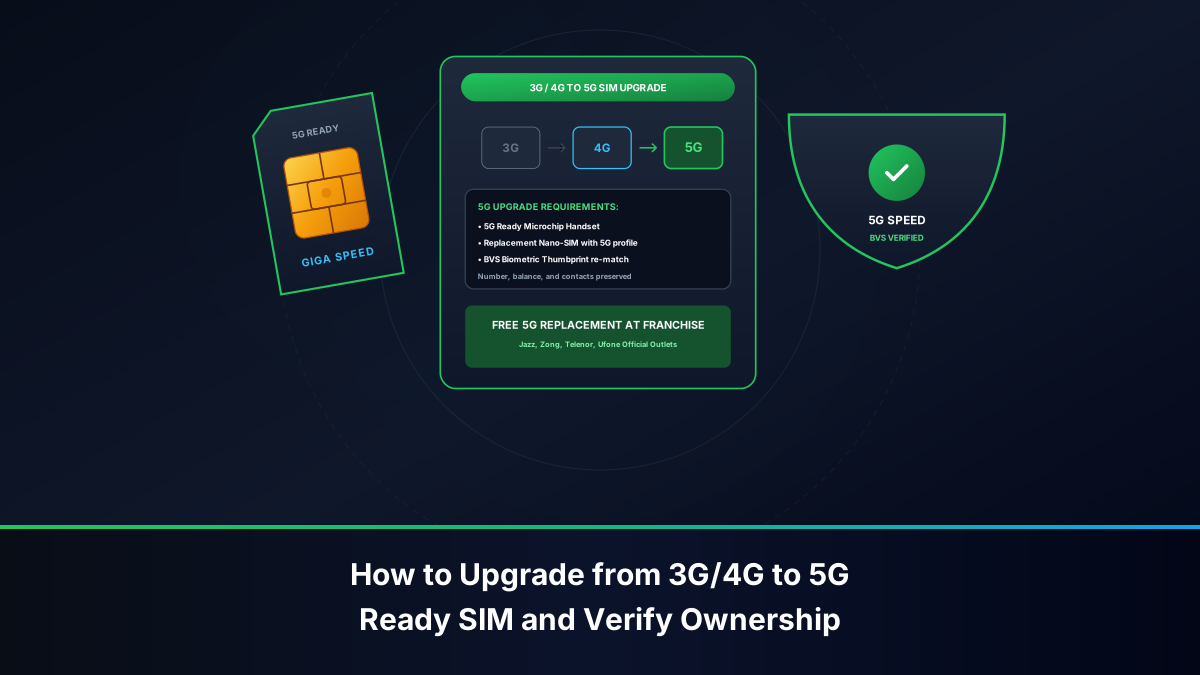
The rollout of consumer eSIM (eUICC) technology across Jazz, Zong, Telenor, Ufone, and ONIC has decoupled subscriber authentication from plastic delivery entirely. Today, an eSIM profile is provisioned dynamically via GSMA SM-DP+ servers, while remaining strictly bound to the 5-voice SIM quota enforced by the PTA 668 system.
Furthermore, SIM ownership verification has become the structural backbone of Pakistan's financial ecosystem. The State Bank of Pakistan's Raast Instant Payment Gateway binds a citizen's national digital financial identifier directly to their biometrically verified mobile number (MSISDN). Because an individual's phone number now commands instant access to their bank accounts, micro-loans, and national health cards, telecom verification is no longer merely about making phone calls—it is the bedrock of national digital citizenship.
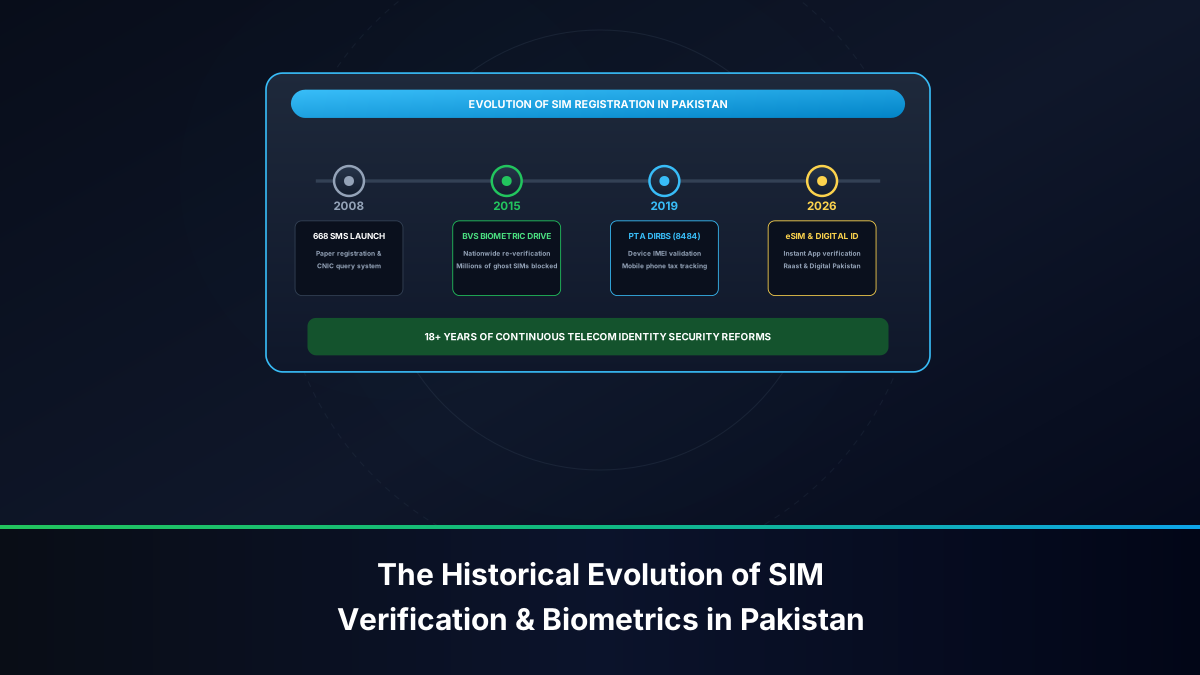
Comparative Historical Matrix: Major Telecom Eras in Pakistan
The following historical comparative table provides a multi-decade overview of how subscriber identity verification transitioned across technologies, regulatory mandates, and operational structures in Pakistan:
| Historical Era | Primary Verification Method | Governing Regulatory Mandate | Verification Latency | SIM Quota Per CNIC | Dominant Security Threat |
|---|---|---|---|---|---|
| 1994–2007 (Paper SAF) | Manual Paper Forms + Paper CNIC Photocopies | PTA Telecom Deregulation Framework 2003 | 2 to 4 Weeks (Physical couriers) | Unlimited (Unrestricted sales) | Stolen photocopies, anonymous burner SIMs, extortion |
| 2008–2013 (Digital 789/668) | 789 IVR Call Center Challenge Questions + SMS 668 | PTA 789 SOPs & National SIM Clearinghouse Directive | 15 to 30 Minutes | 10 SIMs per CNIC (Early quota) | Social engineering of mother's maiden name, call center collusion |
| 2014–2015 (BVS Revolution) | Single-Thumb Optical Biometric Matching (1:1 NADRA) | National Action Plan (NAP) 2015 BVS Directive | Instantaneous (15 to 45 Seconds) | Reduced to 5 Voice SIMs per CNIC | Unverified proxy lines, black-market bulk SIM distributions |
| 2016–2018 (PECA Era) | Biometric BVS + Legislative Criminal Sanctions | PECA Act 2016 (Sections 13, 14, 16, 17) | Instantaneous (< 20 Seconds) | 5 Voice + 3 MBB SIMs Maximum | Illegal international GSM gateways (SIM Boxes), grey traffic |
| 2018–2022 (DIRBS & MBVS) | Multi-Finger BVS (Randomized fingers) + DIRBS IMEI Binding | DIRBS Regulations 2018 & PTA MBVS Standard 2022 | Instantaneous (< 15 Seconds) | 5 Voice + 3 MBB SIMs Strictly Enforced | Smuggled handsets, cloned IMEIs, silicone fake thumbprints |
| 2023–2026+ (Contactless / eSIM) | Contactless Smartphone Camera Biometrics + GSMA eSIM RSP | PTA eSIM Guidelines & NADRA Rahbar Contactless API | Real-Time (< 5 Seconds) | 5 Voice + 3 MBB (Physical or eSIM) | Advanced mobile malware, SMS OTP interception trojans, social engineering |
Frequently Asked Questions
For more deep-dive insights regarding the historic milestones, regulatory decrees, and operational evolution of biometric verification in Pakistan, explore the dedicated FAQ answers provided above.