The 5G Paradigm Shift: Why Legacy 3G and 4G SIM Cards Cannot Simply 'Roam' into 5G
The commercial advent of Fifth-Generation (5G) New Radio (NR) mobile broadband in Pakistan marks a revolutionary technological leap that transcends mere raw download velocity. While consumer marketing frequently highlights gigabit-per-second throughput, the true engineering significance of 5G lies in ultra-reliable low-latency communications (URLLC), massive machine-type communications (mMTC), and dynamic network slicing. However, millions of mobile consumers operating handsets across Pakistan remain unaware of a fundamental hardware reality: a legacy 3G SIM card or an early-generation 4G LTE SIM cannot fully exploit the architectural security and radio spectrum advantages of 5G networks.
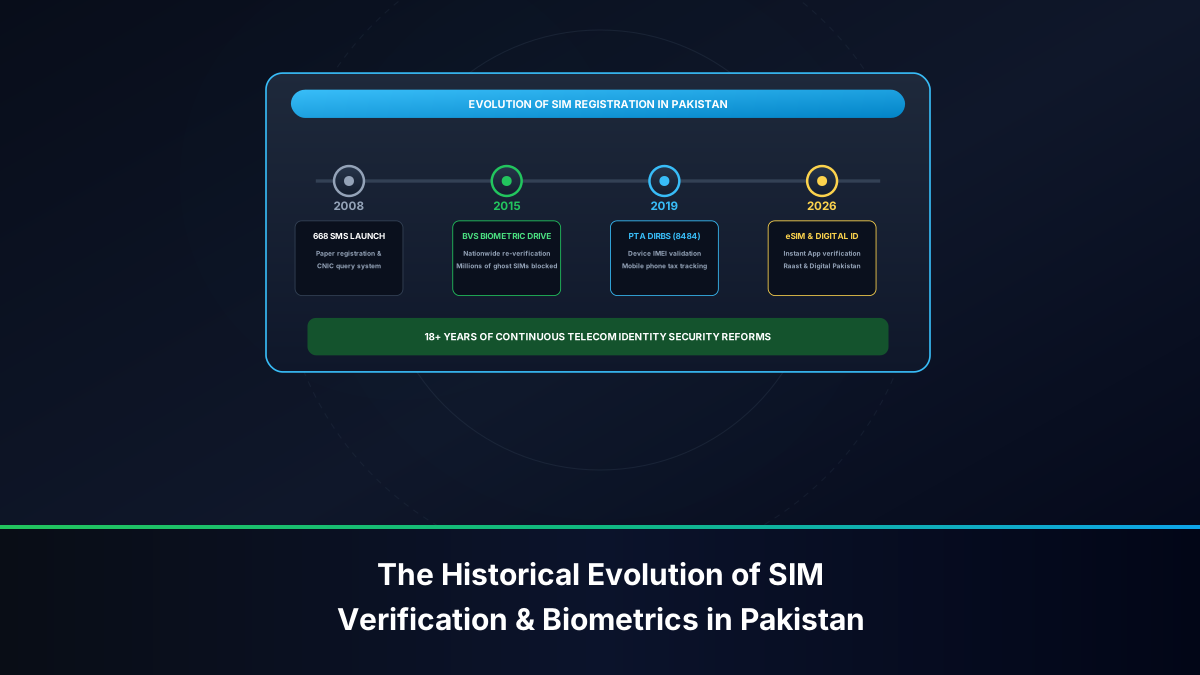
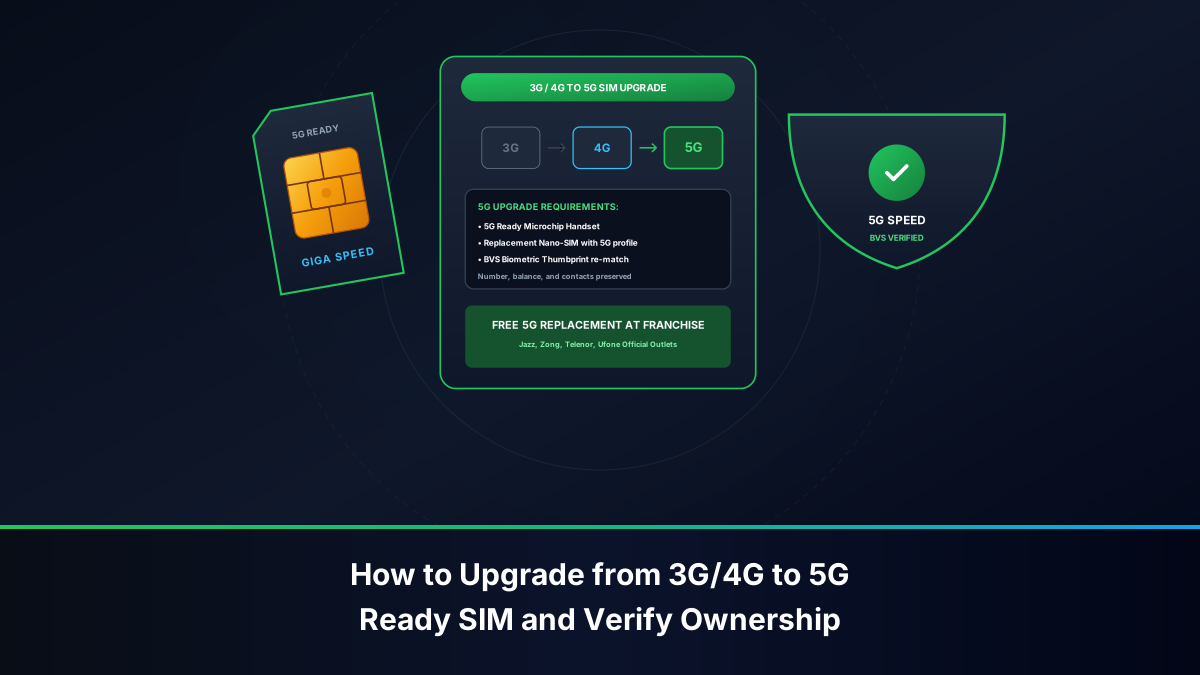
In Pakistan's mobile telecommunications sector—overseen by the Pakistan Telecommunication Authority (PTA) and anchored by cellular mobile operators (CMOs) Jazz (VEON), Zong (CMPak / China Mobile), Telenor Pakistan, and Ufone 4G (PTCL Group)—the migration to 5G entails a comprehensive hardware and identity overhaul. Transitioning to 5G is not merely an over-the-air firmware update. It necessitates upgrading the physical Universal Integrated Circuit Card (UICC), undergoing rigorous Biometric Verification System (BVS) re-authentication linked with the National Database and Registration Authority (NADRA), auditing subscriber identity card quotas, and verifying smartphone radio frequency band compliance via the Device Identification, Registration and Blocking System (DIRBS).
Under the Hood: Technical Differences Between SIM, USIM, and 5G ISIM
To understand why a hardware SIM card replacement is imperative, one must examine the evolution of smart card microprocessors utilized in mobile devices over the past three decades:
| Generation | Chip Standard | Cryptographic Algorithms | Identity Transmission Security | Network Core Capabilities |
|---|---|---|---|---|
| 2G (GSM) | Legacy SIM (Subscriber Identity Module) | COMP128-1/2/3, A5/1, A5/2 (Highly Vulnerable) | Plaintext IMSI broadcast over radio interface | Circuit-Switched Voice & low-speed GPRS/EDGE data |
| 3G (UMTS) | USIM (Universal SIM) Release 99 / R4 | Milenage, KASUMI, f1-f5 mutual authentication | Plaintext IMSI with temporary TMSI masking | Dual-domain core, UMTS Terrestrial Radio Access |
| 4G (LTE) | USIM (Release 8 through Release 14) | AES-128, SNOW 3G, ZUC, mutual network auth | Encrypted signaling, but IMSI still exposed during initial attach | All-IP Evolved Packet Core (EPC), VoLTE integration |
| 5G (NR) | 5G USIM / ISIM (3GPP Release 15/16/17+) | ECIES (Elliptic Curve Cryptography), SHA-256, Milenage | SUCI/SUPI: Zero plaintext IMSI exposure | 5G Core (5GC), Service-Based Architecture, Network Slicing |
The SUPI and SUCI Revolution: Defeating IMSI Catchers and Cellular Eavesdropping
The single most profound architectural security upgrade integrated into genuine 5G SIM hardware is the introduction of the Subscription Concealed Identifier (SUCI) and the Subscription Permanent Identifier (SUPI) defined under 3GPP Technical Specification 33.501. In all previous telecommunication generations (2G, 3G, and 4G LTE), whenever a mobile handset established its initial connection with a cell tower—such as after rebooting, emerging from an underground tunnel, or entering a new city—the SIM transmitted its permanent 15-digit International Mobile Subscriber Identity (IMSI) over unencrypted radio waves.
This critical vulnerability facilitated the proliferation of rogue base stations, colloquially known as IMSI Catchers or Stingrays. Illicit surveillance actors, cybercriminals, and intelligence operatives could position a portable transmitter near public gatherings, intercept plaintext IMSIs, triangulate citizen movements, and spoof cellular signaling. In genuine 5G smart cards, the raw permanent identifier (SUPI) never leaves the tamper-resistant hardware enclave of the chip. Instead, the SIM employs an asymmetric Elliptic Curve Integrated Encryption Scheme (ECIES), utilizing the public key of the home mobile operator to compute a globally unique, ephemeral, encrypted token: the SUCI.
Every single radio attachment generates a distinct mathematical SUCI payload. Eavesdroppers intercepting the radio transmission capture only meaningless cryptographic ciphertext. Only the operator's internal Authentication Credential Repository and Processing Function (ARPF) within the home 5G Core network possesses the corresponding private key capable of decrypting the SUCI back to the subscriber's SUPI. Achieving this privacy protection is physically impossible on legacy 3G and early 4G cards because their microprocessors lack the requisite mathematical coprocessors and memory space.
5G Non-Standalone (NSA) vs. Standalone (SA) Core Network Dependencies
In the rollout of 5G infrastructure across South Asia, mobile carriers deploy two distinct operational architectures:
- 5G Non-Standalone (Option 3x / NSA): In this interim deployment model, the carrier leverages existing 4G Evolved Packet Core (EPC) infrastructure paired with upgraded 5G New Radio cell towers. The control plane signaling (call setup, handover, session management) is anchored to 4G LTE anchor bands, while high-speed user payload data is routed over 5G NR carriers. Under NSA, older Release-11+ 4G USIM cards can technically connect to 5G radio frequencies, but they operate without 5G native security or network slicing capabilities.
- 5G Standalone (Option 2 / SA): The true architectural destination of 5G. SA features a completely dedicated, cloud-native 5G Core (5GC) independent of legacy 4G systems. In a 5G SA environment, legacy SIMs are completely rejected by the network switch during the initial registration attempt. Only devices carrying 5G Phase 2-certified UICC/eSIM chips equipped with ISIM (IP Multimedia Subsystem SIM) containers can register successfully.
Pre-Upgrade Ownership Audit: Verifying CNIC Title via PTA 668 Before Visiting Franchises
Before proceeding to a customer care center or retail franchise to request a physical SIM upgrade, subscribers must conduct an exhaustive ownership audit. Under strict regulations enforced by the Pakistan Telecommunication Authority, a SIM replacement cannot be executed if there is any ambiguity regarding the legal ownership of the MSISDN.
Resolving Registration Discrepancies and Family-Owned Numbers
A prevalent dilemma across Pakistan involves mobile numbers purchased a decade ago that remain legally registered under the Computerized National Identity Card (CNIC) of an elderly parent, an overseas relative, a deceased family member, or a former corporate employer. While a phone number may have been utilized by an individual for twelve consecutive years, telecom operators are legally prohibited from upgrading the SIM card unless the registered CNIC holder is physically present.
To verify the exact regulatory status of your cellular identity:
- Query PTA 668 via SMS: Compose a new text message containing your 13-digit CNIC (without hyphens or spaces, e.g.,
3520112345671) and transmit it to shortcode668(carrier charge: PKR 2.00 + tax). - Audit the Distribution Response: The PTA automated database returns an instant breakdown detailing the exact count of active voice and data connections registered to that CNIC across Jazz, Telenor, Zong, and Ufone.
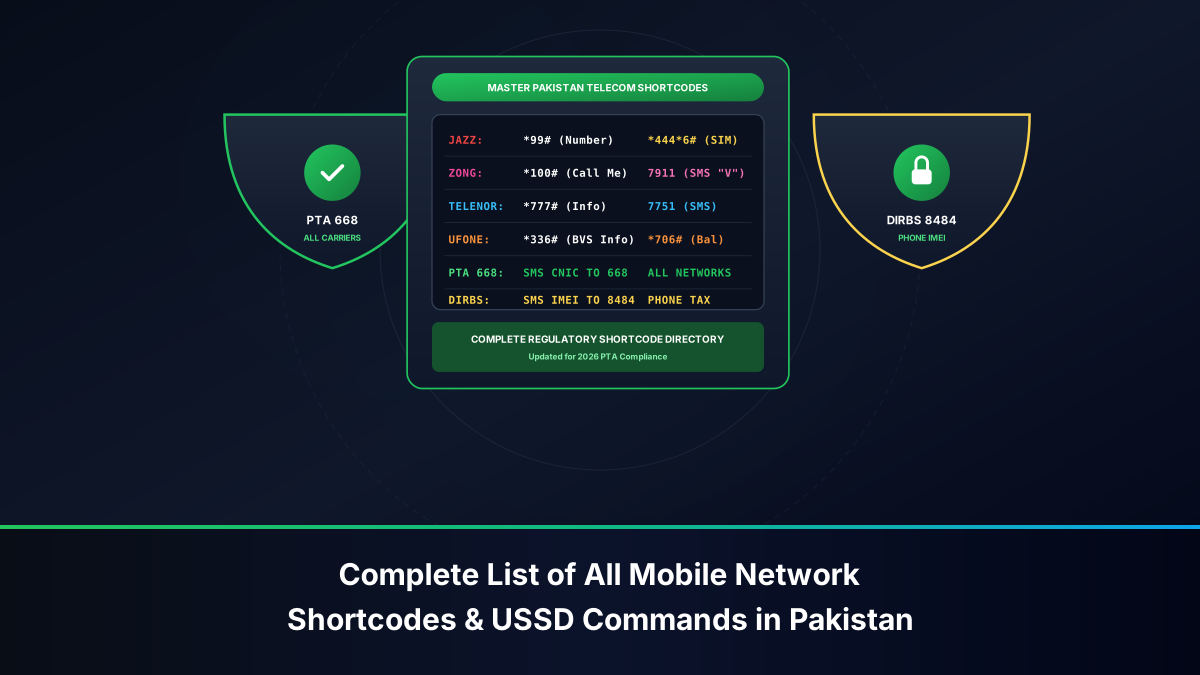
- Verify On-Device Ownership: From the specific handset holding the SIM, verify that the line matches your identity by dialing the respective carrier verification USSD shortcodes:
| Operator Network | On-Device Ownership USSD Code | Alternative Verification Channel |
|---|---|---|
| Jazz / Mobilink | Dial *444*6*1# |
Send blank SMS to 667 (returns registered Name & CNIC) |
| Zong (CMPak) | Dial *100# or *567# |
Send MNP to 667 via SMS |
| Telenor Pakistan | Dial *777# |
Send blank SMS to 667 or check My Telenor app profile |
| Ufone 4G | Dial *336*1# |
Send blank SMS to 667 |
If the verification response indicates that the line is registered to a different CNIC, you must execute a formal Biometric SIM Ownership Transfer. Both the current registered owner and the intended new owner must visit the franchise together with their original, unexpired Smart CNICs to undergo simultaneous BVS fingerprint verification before the 5G upgrade can proceed.
PTA Aggregate SIM Quotas: The 5-Voice and 3-Data Constraint
Under statutory PTA directives, every Pakistani citizen is capped at an aggregate maximum of 5 active voice SIMs and 3 active data-only SIMs (total ceiling: 8 SIM cards across all telecom licensees combined). When an existing voice SIM is upgraded from 4G to 5G, the transaction is processed as a technological replacement (SIM Swap); it does not decrement an additional slot from your 5-SIM ceiling. However, if your CNIC has already hit the hard cap of 5 voice SIMs and your records contain orphan or phantom SIM cards previously issued without your knowledge, carrier billing terminals will occasionally lock up and reject the upgrade workflow until surplus connections are permanently canceled.
Step-by-Step 5G SIM Upgrade Workflow Across Pakistani Mobile Networks
The physical procedure for replacing an obsolete SIM with a next-generation 5G smart card follows a rigorous standard operating procedure mandated by the PTA:
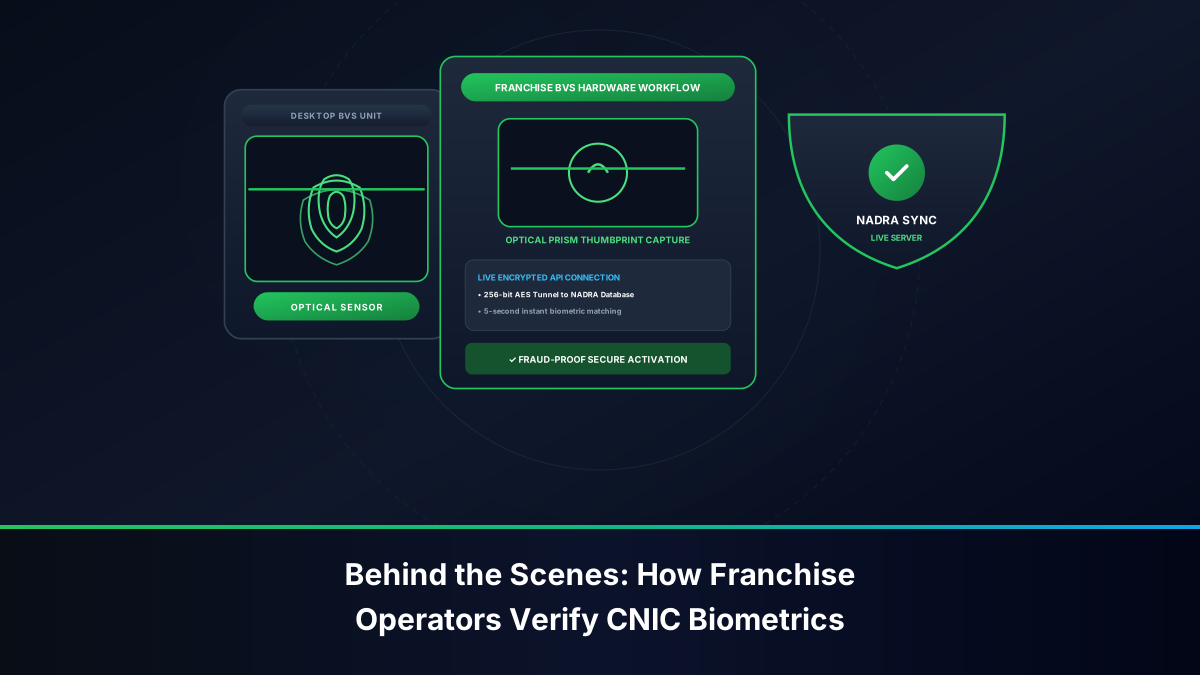
The Franchise BVS Handshake: Real-Time NADRA Verisys Authentication
- Franchise Visit: The subscriber visits an official Company-Owned Customer Service Center (CSC) or authorized flagship franchise of their mobile carrier. Avoid unverified third-party corner roadside kiosks, as 5G SIM inventory is restricted to secure franchise channels.
- Document Presentation: The subscriber presents their original physical Smart CNIC (with chip) or SNIC. Damaged, photocopied, expired, or manual laminated identity cards are strictly rejected under regulatory compliance rules.
- Biometric Fingerprint Acquisition: The franchise representative enters the subscriber's MSISDN into the secure telecom portal. The customer places their finger (selected randomly by the system, e.g., Right Index or Left Thumb) on an encrypted optical or capacitive biometric scanner.
- NADRA Verisys Handshake: The live biometric scan is encapsulated in an encrypted TLS tunnel and transmitted directly to NADRA's central identity verification gateway. If the mathematical minutiae vectors match NADRA's stored national fingerprint database within acceptable threshold parameters, NADRA dispatches an authenticated digital authorization token back to the operator switch.
Over-The-Air (OTA) Deactivation of the Legacy SIM Card and New ICCID Pairing
Once NADRA BVS approval is secured, the backend telecom switch executes an instantaneous state machine transition:
- The system generates a new 19- or 20-digit Integrated Circuit Card Identifier (ICCID) corresponding to the new physical 5G SIM card package.
- An automated
Cancel Locationand de-provisioning command is broadcast via SS7/Diameter signaling to the legacy SIM card currently residing in the customer's phone. - The legacy SIM immediately loses cellular radio signal and displays "SIM Inactive" or "No Service".
- The new 5G UICC chip is activated in the operator's Home Subscriber Server (HSS) and Unified Data Management (UDM) database. Within 5 to 15 minutes, the customer inserts the new 5G SIM card into their 5G handset, triggers a radio network scan, and completes the provisioning attach sequence.
Operator-Specific 5G Migration Policies: Jazz, Zong, Telenor, and Ufone
| Operator | Migration Program Name | Standard Replacement Fee | Self-Service Digital Upgrade Options | Post-Activation Cooling-Off Period |
|---|---|---|---|---|
| Jazz (Mobilink) | Jazz 5G Ready Upgrade | PKR 150 – 250 (Free for Postpaid / Gold) | Order via Jazz World app with doorstep BVS rider delivery | 24-hour financial SMS / bank OTP hold per SBP anti-theft rules |
| Zong 4G / 5G | Zong NextGen 5G Pioneer | PKR 200 – 300 | Home delivery booking through official Zong e-Store with biometric rider | 24-hour banking SMS freeze after fresh SIM swap |
| Telenor Pakistan | Telenor 5G Speed SIM | PKR 150 – 200 | Franchise walk-in or authorized e-Sahulat partner verification | 24-hour temporary hold on high-value outbound transactions |
| Ufone 4G (PTCL) | Ufone Super 5G Transition | PKR 200 – 250 | PTCL/Ufone joint service centers nationwide | Standard 24-hour SBP-mandated banking OTP suspension window |
Hardware Readiness: PTA DIRBS Approval, 5G NR Spectrum Bands, and Radio Modems
Acquiring a pristine 5G SIM card will yield zero performance improvements if your mobile hardware cannot communicate with Pakistan's allocated 5G radio frequency spectrum. Consumers must navigate device radio specifications and regulatory legality under the PTA DIRBS regime.
Key 5G Spectrum Bands in Pakistan: n78, n41, n28, and mmWave
The Pakistan Telecommunication Authority and the Frequency Allocation Board (FAB) have prioritized key radio spectrum bands for national 5G deployment:
- Band n78 (3.5 GHz C-Band): The universal global backbone for commercial 5G. Band n78 delivers the optimal balance between ultra-high capacity, multi-gigabit throughput, and moderate cell radius propagation. All genuine 5G smartphones sold in Pakistan must support Band n78.
- Band n41 (2.5 GHz Mid-Band): Primarily utilized by CMPak (Zong) and other carriers re-farming time-division duplex (TDD) spectrum to deliver deep suburban and urban capacity.
- Band n28 (700 MHz Low-Band): The premier coverage layer. Sub-1GHz 5G frequencies penetrate concrete buildings, dense urban residential blocks, and traverse long rural distances, providing reliable low-latency baselines.
- Millimeter Wave (mmWave - Bands n257 / n258 / n260 at 26–28 GHz): Reserved for high-density sports stadiums, industrial manufacturing complexes, and high-traffic metropolitan transport hubs, providing localized throughput exceeding 4 Gbps.
DIRBS Dual-IMEI Verification and Duty Clearance Requirements
Under PTA directives implemented through the Device Identification, Registration and Blocking System (DIRBS), every cellular modem slot operating in Pakistan must possess an authenticated, GSMA-compliant 15-digit International Mobile Equipment Identity (IMEI) registered with customs duty clearances.
For modern dual-SIM smartphones (including devices featuring one physical nano-SIM slot and one digital eSIM):
- Dial
*#06#on your handset dialer to display your hardware IMEI values (IMEI 1 and IMEI 2). - Transmit each IMEI independently via SMS to shortcode
8484or verify them throughdirbs.pta.gov.pk. - Ensure both slots return the status: "Compliant (PTA Approved)". If an imported international device was only registered on its physical slot while the second IMEI remained unpaid, inserting a 5G SIM or activating a 5G eSIM on the secondary slot will result in automated network blocking after 60 days.
The Digital Path: Migrating Directly to 5G eSIM on Flagship Smartphones
Rather than purchasing a physical plastic nano-SIM card, subscribers possessing modern flagship devices—including Apple iPhone 12 through 16 series, Samsung Galaxy S21 through S25 series, and Google Pixel 6 through 9 series—can upgrade directly to a 5G digital Embedded SIM (eSIM). The eSIM architecture permanently embeds an eUICC chip directly onto the device motherboard, eliminating physical wear, plastic waste, and tray extraction hassles.
To execute a 5G eSIM upgrade:
- Visit your carrier customer care center and request an eSIM migration for your active number.
- Undergo mandatory BVS fingerprint verification on the NADRA terminal.
- The representative generates an encrypted, single-use eSIM Activation QR Code containing your remote SIM provisioning profile strings (LPA - Local Profile Assistant address).
- Connect your smartphone to a stable Wi-Fi network. Navigate to
Settings > Mobile Data > Add eSIM / Add Mobile Plan. - Scan the physical QR code with your handset camera. The device downloads the carrier profile directly from the operator's SM-DP+ (Subscription Manager Data Preparation) server and installs the 5G profile within 60 seconds.
Comprehensive Troubleshooting Matrix: 5G Latency, Network Drops, and BVS Errors
| Identified Technical Problem | Root Cause Architecture | Definitive Remediation Protocol |
|---|---|---|
| BVS Fingerprint Rejection at Franchise | Dry skin, biological biometric erosion, or out-of-sync NADRA biometric record. | Hydrate hands with lotion. If failure persists across all 10 fingers, visit a NADRA Mega Center to renew Smart CNIC biometrics, or utilize authorized verification protocols for senior citizens. |
| Phone Stuck on 4G Despite 5G SIM | Network Mode configuration restricted or 5G Standalone toggle disabled. | Navigate to Settings > Cellular > Voice & Data. Select "5G Auto" or "5G On". On Android, navigate to Mobile Networks > Preferred Network Type > 5G/LTE/3G/2G (Auto). Toggle Airplane Mode on and off. |
| Bank OTPs / SMS Not Arriving Post-Upgrade | State Bank of Pakistan (SBP) mandatory 24-hour anti-SIM-swap cooling hold. | This is a statutory security feature, not a technical defect. Under SBP anti-fraud circulars, all financial one-time passwords and transaction alerts are automatically frozen for 24 hours following any SIM replacement to prevent unauthorized account takeovers. Service resumes automatically after 24 hours. |
| Severe Battery Drain in 5G Mode | Dual-Connectivity (EN-DC) hunting between weak 5G signals and 4G anchors. | In sectors with nascent 5G coverage, continuous radio polling rapidly expends battery power. Set network mode to "5G Auto" (Smart Data Mode), which reverts the device to 4G LTE when gigabit bandwidth is unnecessary. |
Legal Framework & Anti-Fraud Governance Under PECA 2016
Upgrading and managing telecommunication identities in Pakistan is strictly regulated by law. Under the Prevention of Electronic Crimes Act (PECA 2016), unauthorized acquisition, fraudulent replication, or identity substitution of subscriber SIM cards constitutes severe criminal fraud:
- Section 17 (Unauthorized Issuance of SIM Cards): Whosoever obtains, sells, possesses, or distributes cellular SIM cards through forged documentation or biometric impersonation faces rigorous imprisonment up to 3 years, punitive fines up to PKR 500,000, or both.
- Section 14 & 16 (Unauthorized Access to Critical Information System & Identity Information): Tampering with carrier HSS/HLR databases, executing unauthorized SIM swap fraud, or intercepting financial authentication vectors carries severe felony penalties extending up to 7 years incarceration.
Citizens must safeguard their biometric sovereignty: never authorize a fingerprint scan on a mobile POS machine without demanding to know the precise transactional reason, never lend SIM cards registered on your CNIC to third parties, and routinely monitor your registered line count via the official PTA 668 platform.
Frequently Asked Questions (FAQs)
Review the comprehensive FAQ section below for practical solutions to common inquiries regarding 5G SIM migrations, biometric re-verification workflows, and PTA regulatory guidelines.