Architectural Overview of the Telecom Subscriber Lifecycle in Pakistan
In Pakistan's telecommunications infrastructure, managed under the stringent regulatory framework of the Pakistan Telecommunication Authority (PTA) and the National Database and Registration Authority (NADRA), a mobile connection is not merely an unconstrained physical chip. A Subscriber Identity Module (SIM) represents a dynamic state machine provisioned inside an operator's core network. Every mobile number (MSISDN) traverses a series of clearly defined lifecycle states spanning initial biometric assignment, active operation, dormancy, regulatory suspension, administrative blocking, and eventual churn recycling.
The status of your SIM card directly governs your cellular privileges: whether your device can register with local radio cell towers, whether outbound voice and data sessions are authorized, whether incoming Application-to-Person (A2P) Short Message Service (SMS) One-Time Passwords (OTPs) from commercial banks can terminate on your handset, and whether your 13-digit Computerized National Identity Card (CNIC) remains tethered to that telephone number. Misunderstanding the technical boundaries between an Active, Inactive, Suspended, and Blocked SIM card often leads to catastrophic oversights—including sudden financial lockouts, missing court notifications, and the permanent loss of personal numbers to total strangers under the 180-day PTA recycling rule.
State 1: Active Connection – Technical Parameters & Network Heartbeats
An Active SIM is the standard, fully authorized state of a cellular subscriber in Pakistan. When a connection is active, the carrier's Home Location Register (HLR) and Home Subscriber Server (HSS) maintain an unrestricted profile for the subscriber's International Mobile Subscriber Identity (IMSI). The SIM's cryptographic security keys (Ki) negotiate seamless radio handshakes with base transceiver stations (BTS), allowing full bidirectional communication across 2G, 3G, 4G LTE, and emerging 5G spectrum bands.
To retain Active status under Pakistani telecom regulations, a connection must satisfy two foundational criteria:
- Biometric Verification System (BVS) Validation: The connection must be biometrically tied to an authenticated citizen profile within the Pakistan Mobile Database (PMD) clearinghouse, mapped to an unexpired 13-digit CNIC, NICOP, or Foreigner POC/Passport.
- Recent Revenue-Generating Activity: The subscriber must initiate at least one billable network interaction within any rolling 60-day window. Under PTA commercial guidelines, revenue-generating activity includes making an outgoing billable voice call, transmitting an outbound SMS, initiating an active packet data session, or recharging prepaid airtime balance via Easyload, scratch cards, or online banking gateways.
While in the Active state, subscribers enjoy complete access to emergency services (15, 1122), customer support helplines (111, 310, 345, 333), high-speed 4G data bundles, and real-time SMS delivery for two-factor authentication from banking institutions, the Federal Board of Revenue (FBR), and provincial Safe City traffic authorities.
State 2: Inactive & Dormant Status – The 60 to 90 Day Revenue Inactivity Threshold
When a subscriber places a SIM card into a desk drawer, switches to a secondary SIM card, or travels abroad without generating billable traffic, the network's billing mediation engine automatically flags the connection as Inactive (Dormant). Telecom operators in Pakistan (Jazz, Zong, Telenor, and Ufone) are commercially incentivized to monitor dormancy because spectrum allocations and active HLR database licenses incur recurring operational overhead.
Dormancy is not an instantaneous shutdown; it is a progressive, tiered restriction designed to notify the consumer while protecting network capacity:
Service Degradation Stages During SIM Inactivity
- Phase 1: Early Inactivity (Days 30 to 60): The subscriber receives automated warning SMS alerts reminding them to perform a balance recharge or generate billable usage. All core services (incoming calls, outgoing calls, data sessions, banking OTPs) remain fully functional.
- Phase 2: Outgoing Call Barring (Days 61 to 90): The core network initiates soft-barring. Outgoing voice calls and outbound SMS are blocked. If the subscriber attempts to place a phone call, an automated IVR recording intervenes: "Aapka balance na-kafi hai ya aapki service aarzi tor par muattal hai, barah-e-karam apna number recharge karein." However, incoming voice calls and incoming SMS OTPs continue to be received without impediment.
- Phase 3: Deep Dormancy & Complete Signaling Suspension (Days 91 to 179): Both outgoing and incoming voice and data services are severed. The handset will display signal bars, but incoming callers hear an automated prompt indicating that the dialed subscriber is temporarily unavailable. Crucially, banking OTPs and two-factor authentication messages will no longer terminate on the handset during this deep dormancy phase.
Reactivating a dormant SIM during Phases 1 and 2 is effortless: performing an Easyload of as little as PKR 50 to PKR 100 instantly resets the dormancy timer back to day zero and restores full bidirectional cellular connectivity within minutes.
State 3: Suspended Status – CNIC Expiration, PTA Notices & Incomplete Biometrics
A common misconception among smartphone users is equating an Inactive SIM with a Suspended SIM. While inactivity is driven entirely by commercial usage and balance recharges, Suspended Status is strictly regulatory and legal in nature. A suspended SIM may have thousands of rupees in prepaid balance or an active postpaid contract, yet find its radio transmission completely cut off by carrier compliance departments.
The primary catalysts for regulatory SIM suspension in Pakistan include:
- NADRA CNIC Expiration: When your Computerized National Identity Card crosses its official expiry date printed on the card, NADRA's civil database broadcasts an automated flag to the PTA PMD gateway. Under PTA directives, mobile operators must issue 15-day and 30-day compliance warning SMS messages. If the subscriber fails to renew their Smart CNIC and update their carrier profile, all SIM cards registered under that expired CNIC are placed into administrative suspension.
- Exceeding the 5-Voice SIM Limit: PTA regulations strictly enforce a cap of 5 voice SIMs and 3 broadband data SIMs per individual CNIC across all national operators combined. If a discrepancy or duplicate registration is identified during a national biometric database re-audit, excess connections are suspended pending customer rationalization.
- Biometric Fingerprint Mismatch Notices: If a connection was activated during legacy eras with ambiguous thumbprint scans or manual paperwork, PTA periodically flags the connection for mandatory BVS Biometric Re-verification. Non-compliance within the stipulated deadline results in immediate line suspension.
- Postpaid Bill Default: For postpaid subscribers, failure to settle monthly invoices beyond the credit grace period triggers administrative suspension of outgoing and incoming services.
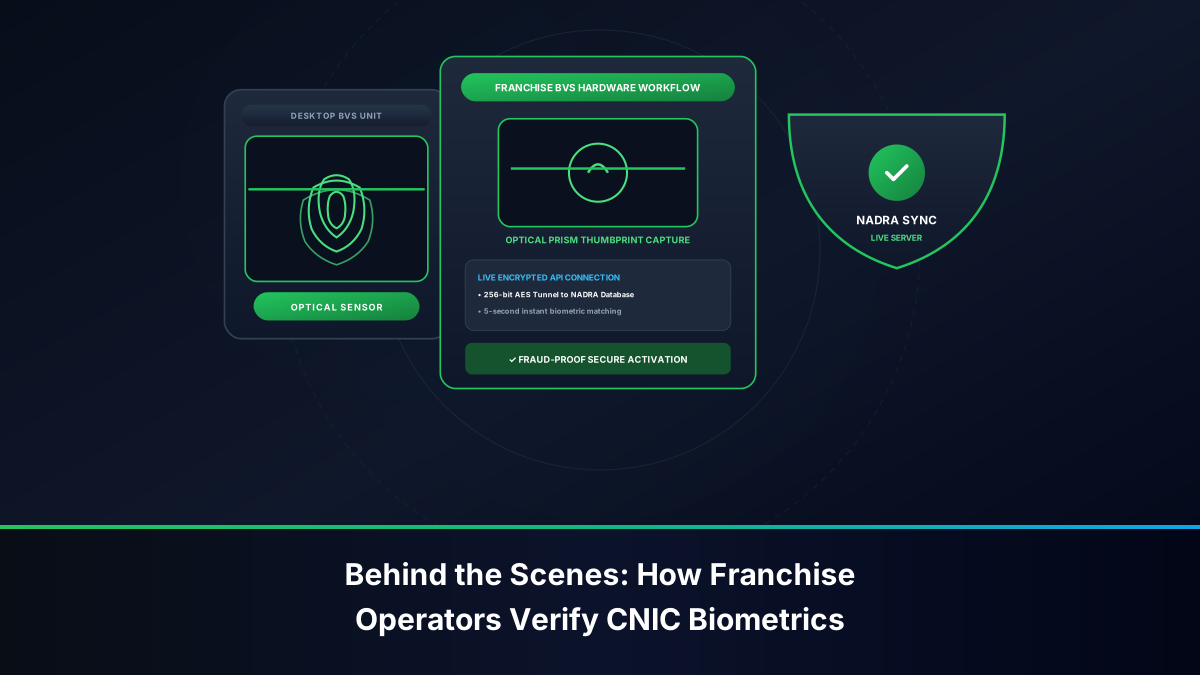
A suspended SIM card cannot be restored through simple balance recharges or helpline phone calls. The lawful owner must physically visit an official franchise or service center with their original, updated Smart CNIC and undergo live multi-finger BVS verification to clear the compliance flag on the PMD server.
State 4: Blocked & Blacklisted Status – Security Flags, Lost SIMs & PECA Orders
Blocked Status represents the most severe operational restriction applied to a cellular line before ultimate termination. In this state, the network switches reject all signaling requests from the SIM card. When inserted into a smartphone, the device will typically display "SIM Not Provisioned", "No Service", or "Emergency Calls Only".
SIM blocking is invoked under critical legal, criminal, or security protocols:
- Emergency Theft / Snatching Reports: Initiated directly by the subscriber via customer care helplines (111, 310, 345, 333) or web portals following street crime. The operator places an immediate temporary block on the IMSI to prevent cybercriminals from intercepting banking OTPs and hijacking WhatsApp accounts.
- PTA DIRBS Device Blacklisting: If a SIM is inserted into a counterfeit, stolen, or un-taxed non-PTA compliant mobile handset, the PTA Device Identification, Registration and Blocking System (DIRBS) may block the cellular pairing to prevent illegal device operation.
- Statutory Directives Under PECA 2016: If a telephone number is identified by the Federal Investigation Agency (FIA) Cyber Crime Wing, Intelligence Agencies, or Counter-Terrorism Departments (CTD) as being instrumentally involved in financial fraud, phishing scams (e.g., Benazir Income Support Program / lottery impersonation), hate speech, cyber harassment, or national security threats, a binding statutory order is dispatched to the PTA. PTA directs the operator to permanently blacklist the SIM and flag the underlying CNIC in the national compliance registry.
- Spam & Unsolicited Telemarketing Violations: Utilizing automated robotic dialers or bulk unsolicited commercial messaging without an official PTA commercial shortcode license leads to automated spam-blocking under the Protection from Spam, Unsolicited and Obnoxious Communication Regulations.
State 5: Recycled & Re-allocated Status – The Mandatory 180-Day PTA Churn Policy
Perhaps the most misunderstood and legally perilous dimension of Pakistan's telecom ecosystem is the 180-Day Number Recycling Rule. Telephone numbers in Pakistan are national public resources allocated by the PTA to mobile network operators in designated blocks (such as 0300 to Jazz, 0310 to Zong, 0340 to Telenor, and 0330 to Ufone). Because the national numbering plan has finite capacity, operators cannot permit dormant phone numbers to remain inactive indefinitely.
Under PTA Consumer Protection Regulations and Mobile Number Allocation SOPs, if a prepaid cellular connection experiences 180 consecutive days of complete revenue inactivity (zero outgoing calls, zero SMS, zero internet sessions, zero recharges), the operator is legally empowered to terminate the subscriber contract, purge the previous owner's CNIC registration from the HLR, and return the MSISDN to the company's unallocated inventory pool.
Following a mandatory 30-day quarantine cooling period in the operator's warehouse, the recycled mobile number is printed onto fresh blank SIM packaging, distributed to retail shops and franchises, and sold to an entirely unrelated member of the public via fresh biometric verification.
The Catastrophic Risks of Number Recycling: When your old number is recycled and assigned to a new stranger, profound security liabilities emerge:
- Financial Account Vulnerability: If you forgot to unlink that mobile number from your commercial bank accounts (HBL, Meezan, Alfalah), your Raast payment alias, or your credit card profiles, automated SMS alerts containing account balance updates and financial notices may begin arriving on the new subscriber's handset.
- WhatsApp & Social Media Hijacking: When the new buyer downloads WhatsApp and enters the newly acquired phone number, the SMS verification code delivers to their handset. Unless you had established a personal WhatsApp Two-Step Verification PIN with an email recovery address, the new owner can register your previous WhatsApp identity, view group memberships, and receive incoming personal messages intended for you.
- Safe City & Traffic E-Challans: Provincial excise and police databases will continue dispatching speed camera violation notices and unpaid traffic fines to the phone number until excise records are formally updated.
Comprehensive Technical Comparison Matrix of SIM States
To provide complete clarity across all operational dimensions, the following matrix contrasts the five primary SIM states recognized by Pakistani cellular networks:
| Feature / Privilege | Active Status | Inactive / Dormant (60-90 Days) | Suspended Status (PTA / BVS) | Blocked Status (Lost / PECA) | Recycled Status (180+ Days) |
|---|---|---|---|---|---|
| Cell Tower Signal Bars | Full Reception | Full Reception | Full / Intermittent | Emergency Only / No Service | No Service (Old SIM Dead) |
| Outgoing Calls & SMS | Allowed (Billable) | Barred by Network IVR | Completely Barred | Completely Barred | Barred (Line Terminated) |
| Incoming Calls & SMS | Allowed | Allowed (Days 60-90) | Restricted or Blocked | Completely Blocked | Rings on New Buyer's Phone |
| Banking OTP Receipt | Immediate Delivery | Delivered (Days 60-90) | Suspended | Completely Blocked | Delivered to New Buyer! |
| Mobile 4G/5G Internet | Full High-Speed | Suspended | Suspended | Suspended | Suspended |
| Prepaid Balance Status | Active & Deductible | Preserved (Valid) | Frozen | Frozen | Permanently Forfeited |
| Restoration Method | N/A (Operational) | Easyload Recharge / Call | Franchise BVS Biometrics | Franchise Duplicate BVS | Unrecoverable (Re-issued) |
Network-Specific Workflows: How to Reactivate Inactive or Suspended SIMs
If you discover that an important mobile number has slipped into dormancy or regulatory suspension, time is of the essence before the 180-day countdown expires. Follow these network-specific recovery procedures:
- Jazz (Prepaid & Postpaid):
- Inactive SIM Reactivation: Insert the SIM card into a phone. If signal bars appear, perform an instant online Easyload of at least PKR 100 via JazzCash, Easypaisa, or internet banking. Alternatively, dial
*551#to test eligibility for the "Jazz Sim Lagao Offer" (which frequently awards bonus minutes and gigabytes upon returning to the network). - Suspended / Blocked Line: Visit any Jazz Point or Customer Experience Center. Present your original Smart CNIC, verify thumbprints on the BVS terminal, and pay the duplicate SIM replacement fee (approx. PKR 100–250) if a fresh physical card is required.
- Inactive SIM Reactivation: Insert the SIM card into a phone. If signal bars appear, perform an instant online Easyload of at least PKR 100 via JazzCash, Easypaisa, or internet banking. Alternatively, dial
- Zong 4G (CMPak):
- Inactive SIM Reactivation: Insert the SIM and dial
*2244#or recharge balance online. Zong's "SIM Reconnection Scheme" will automatically provision the line back to Active status upon detecting fresh airtime credit. - Suspended SIM: If suspended due to CNIC expiry, renew your identity card with NADRA, then visit a Zong franchise for BVS biometrics. Alternatively, check status via the My Zong self-care web portal.
- Inactive SIM Reactivation: Insert the SIM and dial
- Telenor Pakistan:
- Inactive SIM Reactivation: Send an SMS typing
FREEto shortcode2222or call2222(charges may apply depending on tariff). Recharging PKR 100 instantly restores full data and call privileges. - Suspended SIM: Visit a Telenor franchise or designated Sahulat center with your physical CNIC for multi-finger BVS re-authentication.
- Inactive SIM Reactivation: Send an SMS typing
- Ufone 4G (PTML):
- Inactive SIM Reactivation: Dial
*5000#from your Ufone handset or recharge balance through the My Ufone application or banking channels. - Suspended / Blocked SIM: Visit a Ufone Service Center or PTCL Joint Shop. Complete biometric thumbprint scanning to reactivate dormant HLR entries.
- Inactive SIM Reactivation: Dial
Overseas Pakistanis & Roaming: Best Practices to Prevent Automatic SIM Termination
Non-Resident Pakistanis (NRPs) living in the United Arab Emirates, Saudi Arabia, the United Kingdom, the European Union, the United States, and Canada frequently suffer the sudden loss of critical Pakistani SIM cards. These numbers are vital for receiving Roshan Digital Account (RDA) OTPs, FBR tax verification codes, and managing family affairs in Pakistan.
To ensure your Pakistani mobile connection never enters dormancy or gets recycled while you are abroad, implement this robust maintenance regimen:
- Activate International Roaming (IR) Prior to Departure: Roaming must be pre-activated while your phone is still connected to domestic Pakistani cellular towers. Dial
*111#(Jazz),*1111#(Zong),345(Telenor), or333(Ufone) to enable prepaid international roaming. Without active roaming provisioning, the SIM will show "No Service" in foreign countries. - Receiving Incoming SMS is 100% Free: Across all Pakistani mobile networks, receiving incoming SMS (including banking OTPs and government alerts) while roaming on foreign networks is completely free of charge. You do not incur charges for incoming texts.
- Establish a Bi-Monthly Recharge Routine: Even though receiving SMS is free, the telecom billing engine tracks revenue-generating activity. To prevent the 60-day dormancy clock from ticking down, execute an online balance recharge of PKR 200–500 every two to three months via your Pakistani mobile banking app, JazzCash, Easypaisa, or international credit card.
- Send a Single Outbound SMS Every 60 Days: Transmitting one outbound roaming SMS back to a family member in Pakistan costs approximately PKR 10 to PKR 25. This minor expenditure registers as an active billable CDR event in the carrier's international mediation database, resetting the 180-day recycling timer completely.
- Utilize Long-Validity Annual Bundles: Several operators now offer dedicated "Overseas SIM Protection Bundles" or international roaming packs with extended validity (up to 12 months) specifically engineered to safeguard the subscriber's MSISDN against churn recycling.
Frequently Asked Questions: SIM Lifecycle States & PTA Regulations
Authoritative, verified answers addressing citizen questions regarding connection states, reactivation methods, and PTA consumer compliance in Pakistan.