When navigating Pakistan's telecommunications ecosystem, subscribers, enterprise administrators, and bank account holders frequently encounter three overlapping yet fundamentally distinct legal and operational terms: the SIM Owner Name, the CNIC Registration, and the Billing Account Title. In casual conversation, these terms are often used interchangeably as if they refer to the exact same concept. However, in the eyes of the Pakistan Telecommunication Authority (PTA), the State Bank of Pakistan (SBP), the National Database and Registration Authority (NADRA), and Pakistani criminal courts, they represent three completely independent tiers of governance.
A misunderstanding of these distinctions is the root cause behind tens of thousands of failed mobile banking registrations (Easypaisa, JazzCash, Raast, SadaPay, NayaPay), rejected Mobile Number Portability (MNP) requests, bitter intra-family ownership disputes, and unexpected legal liabilities under the Prevention of Electronic Crimes Act (PECA) 2016. For instance, an individual may have paid every monthly bill on a mobile connection for fifteen years, assuming they are the undisputed owner, only to find that because the SIM was biometrically registered under an uncle's or former employer's CNIC, they have zero legal claim to the phone number.
This exhaustive guide provides an authoritative analysis of the triad of telecom identity in Pakistan. We define each of the three layers, explain why and how discrepancies arise, examine the severe fintech and criminal law consequences of mismatched records, and provide clear step-by-step instructions on how to unify and reconcile your telecom identity into full compliance.
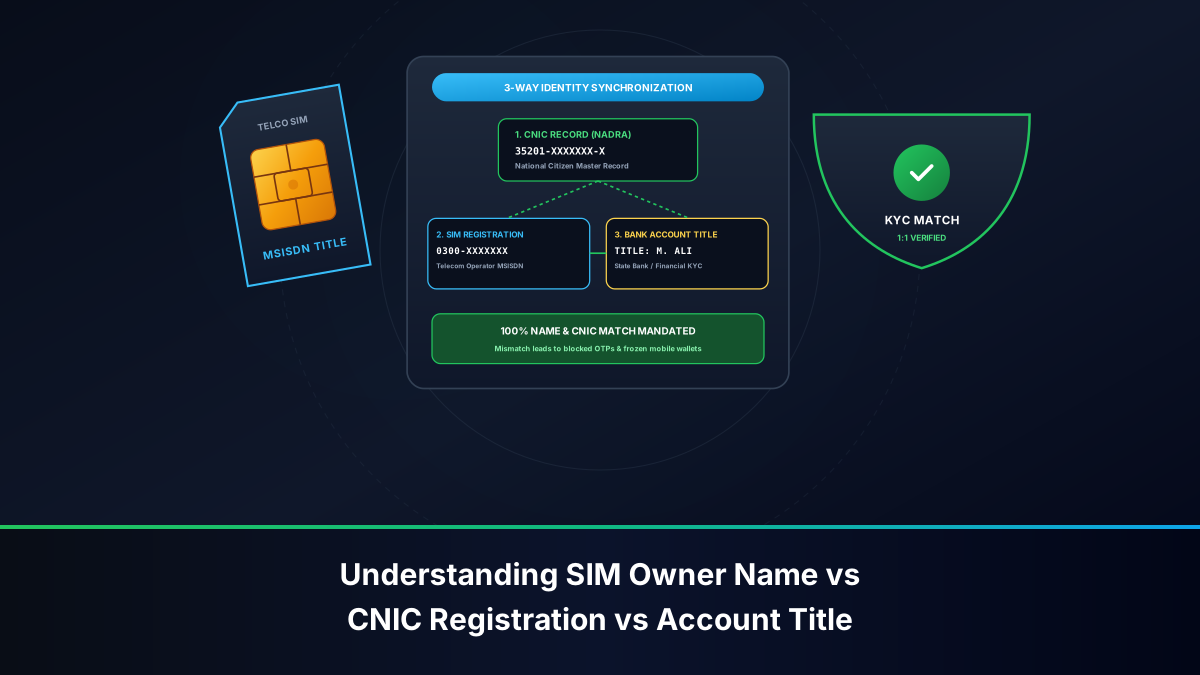
The Triad of Telecom Identity: Three Distinct Layers of Ownership
To navigate telecom regulations effectively, one must recognize that a cellular connection is not simply a piece of plastic; it is a multi-layered legal contract. Pakistani telecommunications architecture segregates subscriber identity into three functional strata:
- The Biological & Sovereign Layer (CNIC Registration): Anchored in NADRA's Centralized Biometric Verification System (CBVS), this is the unalterable 13-digit citizen identity that holds sovereign custody of the radio frequency allocation.
- The Civil Registry Layer (SIM Owner Name): The official legal spelling of the citizen's full name, father's/husband's name, and demographic record pulled directly from NADRA's National Data Warehouse.
- The Commercial & Billing Layer (Account Title): The commercial account entity created within the telecom operator's billing and customer relationship management (CRM) software (e.g., Ericsson, Huawei, or Amdocs platforms), which designates who receives invoices and pays the bill.
While in an ideal world all three layers align perfectly to the same human individual, millions of Pakistani mobile connections feature discrepancies across these layers. Understanding which layer takes precedence in different scenarios is vital.
Layer 1: CNIC Registration (The Absolute Sovereign Legal Anchor)
In Pakistan, the 13-digit Computerized National Identity Card (CNIC) Number (or NICOP / POC / Alien Registration number) is the single ultimate, non-negotiable legal anchor of a cellular SIM card. Under the PTA Cellular Mobile Network Regulations, ownership of a mobile phone number (MSISDN) is legally defined not by who holds the physical handset, not by who pays the monthly recharge, and not by whose contact card appears on Truecaller, but strictly by whose CNIC is biometrically linked to the SIM card in the PTA Centralized Biometric Verification System (CBVS).
The legal implications of CNIC Registration are absolute:
- Sovereign Power of Disposition: The individual whose CNIC is registered holds sole legal authority over the number. That person can walk into a customer care center at any moment and—without providing notice or justification—permanently cancel the SIM, suspend outgoing calls, request a duplicate SIM card, or demand Call Detail Records (CDRs).
- The 5-SIM Regulatory Cap: The PTA's national limit of 5 voice SIM cards and 3 broadband data SIMs is enforced entirely at the CNIC layer. An active connection consumes a slot on the registered CNIC holder's profile, regardless of who operates the phone.
- Subpoenas & Criminal Tracking: When law enforcement agencies (such as the FIA, Intelligence Bureau, or Provincial Counter-Terrorism Departments) trace a phone number involved in criminal activity, the search warrant and arrest orders are issued against the name and residential address registered to that specific 13-digit CNIC.
Layer 2: SIM Owner Name (The NADRA Master Record)
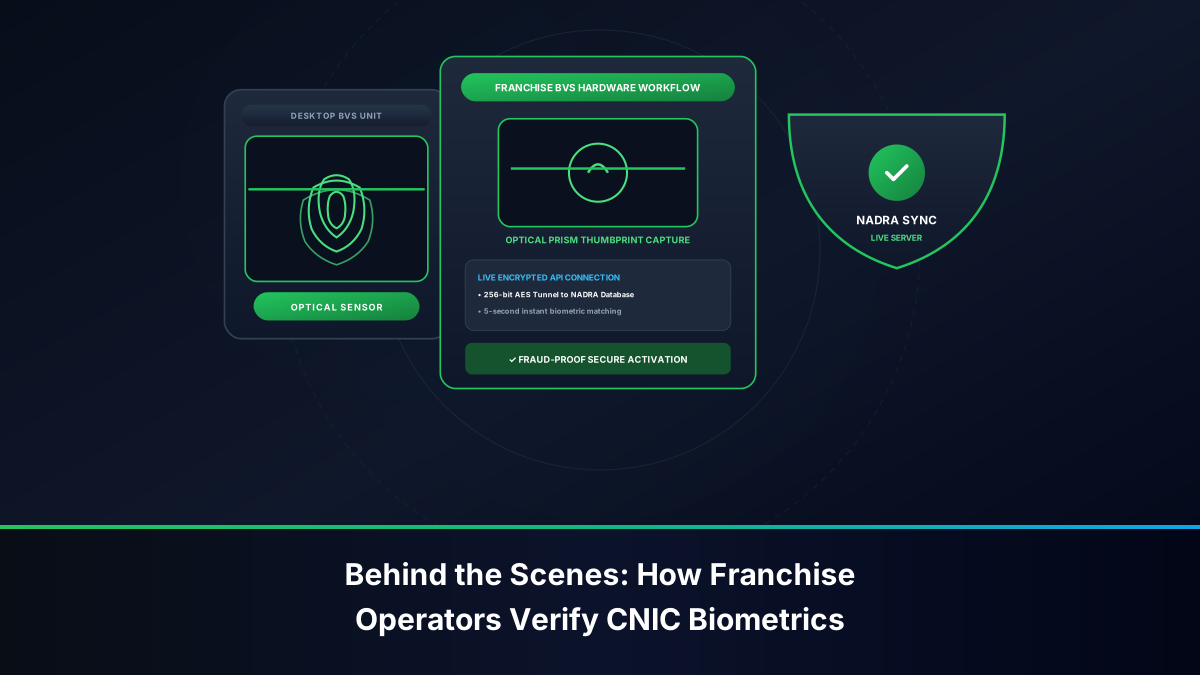
The SIM Owner Name is the official biographical string extracted directly from NADRA's central database during the biometric thumbprint handshake at the time of purchase or ownership transfer. Under modern BVS protocols, telecom operators are prohibited from manually typing a customer's name into their activation software; instead, the name field is auto-populated via an encrypted API feed from NADRA.
Key characteristics of the SIM Owner Name layer include:
- Exact Character-for-Character Matching: The SIM Owner Name mirrors your official government identity, including titles, middle names, and spelling (e.g., "MUHAMMAD BILAL HASSAN KHAN").
- Family Demographic Linkage: Behind the name string lies the citizen's family tree linkage (Father's Name or Husband's Name), which telecom operators and banks use as secondary verification factors during high-security transactions.
- Immunity to Informal Alteration: A subscriber cannot change the SIM Owner Name by presenting an affidavit, marriage certificate, or utility bill at a franchise. The only way the SIM Owner Name can ever change is if a formal Biometric Ownership Transfer (BVS Swap) is executed before a NADRA terminal, or if the individual legally changes their name at a NADRA Registration Center and syncs the updated Smart CNIC.
Layer 3: Billing Account Title (The Commercial & Invoicing Layer)
The Billing Account Title represents the commercial identity recorded on the mobile operator's monthly billing ledger. While on standard prepaid connections the account title is virtually synonymous with the SIM Owner Name, in postpaid and corporate enterprise telecommunications, the Account Title operates as an entirely independent commercial parameter.
Consider how the Account Title functions in practice:
1. Corporate & B2B Telephony Pools
In a corporate telecommunication agreement, an enterprise (e.g., "Engro Fertilizers Limited" or "Habib Bank Limited") purchases hundreds of lines under its corporate National Tax Number (NTN). The Account Title on the monthly master invoice is the registered corporate business name. However, the internal User Name on the company's asset tracking register may be the individual employee (e.g., "Tariq Mahmood"), while the sovereign CNIC Registration is linked to the company's designated corporate Authorized Signatory.
2. Postpaid Family Packages & Master Accounts
Many telecom operators offer postpaid "Family Plans" or shared-budget bundles where a household patriarch or matriarch pays a single consolidated monthly bill for four or five separate numbers used by their spouse and children. The Account Title for the entire billing cluster is in the parent's name, even if individual family members have their own CNICs biometrically linked to their respective lines.
3. Commercial Invoicing for Tax Withholding
For corporate income tax filers, the Account Title on telecom invoices is critical. Under Section 236 of the Income Tax Ordinance 2001, advance income tax is collected on cellular recharge and postpaid bills. To claim this withholding tax credit against corporate or personal FBR income tax returns, the Account Title and NTN/CNIC on the billing statement must match the taxpayer's official FBR registration.
Why Discrepancies Occur: Family Lines, Corporate Pools, & Name Changes
Discrepancies between the user of a SIM card and the registered CNIC owner are exceptionally common across Pakistan. Understanding how these misalignments develop is essential for resolving them:
The Four Most Common Discrepancy Scenarios
- 1The Family Gift Phenomenon: A parent or elder brother purchases a SIM card under their own CNIC and hands it to a teenage daughter, son, or sibling who does not yet possess an adult CNIC. Years later, the child grows up, begins using the number for banking and employment, but never executes a formal biometric transfer. The user assumes the number is "theirs", but legally it remains the property of the elder relative.
- 2Offboarding from Corporate Employment: When leaving a company, an employee is allowed to retain their company-assigned phone number. However, the company's admin department never issues a formal No Objection Certificate (NOC), or the employee never visits the franchise to complete the personal BVS transfer. The employee continues paying the bill, but the line remains legally anchored to the former employer's NTN.
- 3Marriage & Marital Name Transitions: A female subscriber marries and updates her CNIC at NADRA, adopting her husband's surname or altering her registered permanent address. Because telecom databases do not automatically sync with NADRA marital status changes, her legacy SIM records retain her maiden demographic profile.
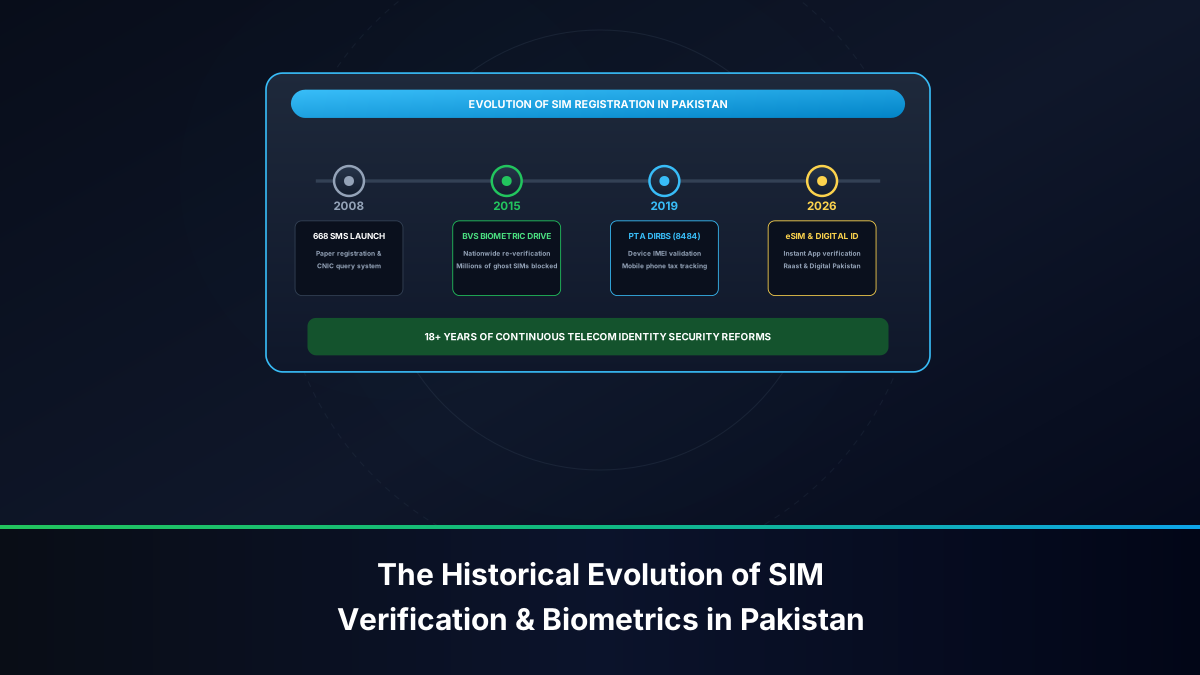
- 4Legacy Paper Pre-2015 Registrations: In rare cases involving senior citizens whose numbers were activated prior to the 2015 biometric re-verification drive, clerical spelling errors introduced by manual data entry clerks resulted in permanent typographical discrepancies between the paper subscriber form and the NADRA computerized identity card.
The Fintech Trap: How Name Mismatches Break Raast, Easypaisa, & Bank Apps
In contemporary Pakistan, the most painful consequence of a discrepancy between your SIM Owner Name and your personal CNIC occurs when attempting to access digital financial services. Under strict regulations enforced by the State Bank of Pakistan (SBP) and the Financial Action Task Force (FATF) anti-money laundering frameworks, mobile network operators and commercial banks operate integrated Automated KYC Verification Gateways.
When you attempt to register a branchless banking wallet (Easypaisa, JazzCash, SadaPay, NayaPay) or link your mobile number to Pakistan's instant payment system, Raast, the following automated validation protocol executes in milliseconds:
- 1You input your 13-digit CNIC into the digital banking app.
- 2The bank's backend system captures the active MSISDN (phone number) of the smartphone transmitting the request.
- 3The bank's API queries the mobile network operator's HLR database: "Does MSISDN 03XX-XXXXXXX belong to CNIC XXXXX-XXXXXXX-X?"
- 4The Instant Mismatch Rejection: If your SIM card is biometrically registered to your father, mother, brother, or former company, the operator returns a negative token (
Ownership Validation Failed). The banking app aborts onboarding immediately, displaying an error message stating: "This mobile number is not registered under your CNIC. Please register a SIM under your own CNIC to proceed."
No bank branch manager, helpline agent, or fintech executive has the administrative authority to override this automated SBP compliance check. If you want a mobile banking wallet or Raast ID on your primary number, the SIM card's CNIC registration must be transferred into your own name.
Legal & Criminal Liability Under PECA 2016: Who Goes to Court?
From a criminal jurisprudence standpoint, discrepancies between the functional user of a SIM card and the registered CNIC owner create grave legal hazards under the Prevention of Electronic Crimes Act (PECA) 2016 and the Pakistan Penal Code (PPC).
When a phone number is used in criminal activities—such as financial extortion, fake lottery fraud, harassment of women, or subversive communication—law enforcement agencies follow a strict evidentiary trail:
- The Primary Accused on Paper: Under the legal doctrine of prima facie ownership, the biometrically registered CNIC holder is named as the primary suspect in the initial police First Information Report (FIR). If you gave a SIM registered under your CNIC to a distant cousin, friend, or employee, and that person commits a crime, law enforcement will knock on your door, not theirs.
- Proving Lack of Custody: Once summoned by the Federal Investigation Agency (FIA) Cyber Crime Wing, the burden of proof rests heavily on the registered CNIC holder to demonstrate that they did not have physical possession of the SIM card when the offense took place. Establishing this defense requires exhaustive digital forensic examinations, cell tower triangulation, and witness testimony, resulting in immense financial and emotional distress.
- Strict Prohibition on SIM Lending: Under PTA regulations and Section 17 of PECA 2016, allowing unauthorized individuals to use cellular connections registered to your CNIC without formal transfer violates subscriber undertakings. If you hold extra lines that other people are using, you must demand that they transfer the connections to their own CNICs immediately, or you must permanently cancel the lines.
Step-by-Step Guide: How to Reconcile, Update, & Unify Mismatched Titles
If you discover that your active mobile phone number has a mismatched SIM Owner Name, CNIC Registration, or Billing Account Title, execute the following procedures to unify all three layers into perfect alignment:
Scenario A: Transferring a Personal SIM to Your Own CNIC
If your daily phone number is registered to a family member or friend, both parties must execute a formal Biometric Change of Ownership:
- 1Check Quota Availability: Send your CNIC to 668 to verify that you have not already reached your 5-voice SIM limit.
- 2Joint Franchise Visit: Both the current registered owner and the incoming recipient must visit an official customer care center of the operating network together.
- 3Dual Biometric Verification: The current owner scans their thumbprint to authorize line release; the incoming owner scans their thumbprint to accept legal ownership. The system rebinds the MSISDN to the recipient's CNIC in real time.
Scenario B: Transferring a Corporate Connection to a Personal CNIC
If you are retaining a corporate number upon leaving a job:
- 1Obtain an official No Objection Certificate (NOC) on company letterhead, signed and stamped by the designated Authorized Signatory, authorizing transfer to your specific CNIC.
- 2Clear all unbilled corporate usage or ensure the company's Key Account Manager detaches the line in the enterprise portal.
- 3Visit the operator's customer care center with the original NOC, company NTN copy, and your original CNIC to complete biometric transfer.
Scenario C: Updating Postpaid Billing Account Title
If your CNIC is already correct on a postpaid connection, but you want to update the printed Billing Account Title (e.g., adding your business name or tax NTN for withholding tax credits), visit the operator's franchise with your FBR Taxpayer Registration Certificate. The representative can update the commercial billing label in the CRM without altering the underlying sovereign CNIC registration.
Summary Comparison: Legal Standing, Source Authority, & Dispute Resolution
The table below provides an authoritative comparison of the three distinct layers of telecom identity in Pakistan:
| Dimension | CNIC Registration | SIM Owner Name | Billing Account Title |
|---|---|---|---|
| Primary Purpose | Sovereign legal ownership & security tracking | Civil identity verification & demographic KYC | Commercial invoicing & tax withholding filing |
| Source Database | NADRA Centralized BVS (CBVS) | NADRA Citizen Data Warehouse | Telecom Operator CRM / Billing Ledger |
| Legal Weight in Court | Supreme (Defines criminal/civil custody) | High (Corroborates identity) | Low (Restricted to commercial contract) |
| Fintech / Wallet Impact | Absolute (Must match wallet CNIC) | Matched during NADRA KYC check | Zero impact on mobile wallet creation |
| How to Check | SMS 668 / cnic.sims.pk | SMS MNP to 667 | Printed monthly postpaid invoice or app profile |
| Modification Method | In-person BVS biometric transfer | NADRA Smart CNIC renewal + BVS sync | Franchise request / FBR NTN submission |
Frequently Asked Questions About SIM Identity & Account Titles
Below are clear, expert answers to key operational questions regarding SIM ownership records and account titles in Pakistan.
Can I find out whose CNIC is registered to an unknown SIM card that is calling me?
No. Under the Pakistan Telecommunication Authority (PTA) Consumer Protection Regulations and Section 32 of PECA 2016, subscriber identity records and CNIC mappings are classified as strictly confidential data. Telecom operators and customer service agents are criminally barred from disclosing the CNIC or registered name of any phone number to third parties. If you are facing harassment or extortion, you must file an official complaint with the PTA CMS or FIA Cyber Crime Wing, who hold statutory legal authority to subpoena subscriber dossiers.
What is the 667 MNP inquiry and how does it help determine SIM ownership?
Sending the word MNP to shortcode 667 from any active SIM card queries the carrier's Home Location Register (HLR) directly. The network automatically generates an SMS reply displaying the exact Owner Name, CNIC Number, and original activation date registered to that specific physical card. It is the fastest, most reliable method to confirm whether a phone number in your hand is officially registered to your personal CNIC.
Can a deceased person's SIM card remain in use under their original CNIC registration?
No. When a citizen's death is formally registered with NADRA and a Family Registration Certificate (FRC) or Death Certificate is issued, NADRA flags the deceased citizen's CNIC as canceled. Under PTA regulations, family members have a grace period (typically 60 to 90 days) to legally transfer the deceased person's active mobile connections to legal heirs by presenting a succession certificate or FRC at an operator franchise. Failing to execute this transfer will result in automated, permanent termination of the lines.
By understanding the critical distinctions between SIM Owner Name, CNIC Registration, and Billing Account Title, Pakistani mobile users can protect themselves against identity theft, ensure seamless access to modern fintech wallets, and maintain complete legal compliance with Pakistan Telecommunication Authority regulations.