The Reverse Lookup Illusion: Public Curiosity vs Telecommunications Reality
In the digital age, receiving an unsolicited phone call, harassing SMS, or fraudulent WhatsApp notification from an unfamiliar Pakistani cellular number (e.g., a 030X, 031X, 032X, 033X, or 034X prefix) is an almost universal experience. Driven by curiosity, security concerns, or a desire for self-protection, millions of citizens turn to search engines with queries like "how to check SIM owner details by mobile number", "Pak SIM tracker online free", or "live mobile number locator with CNIC". This widespread public demand has fostered an entire digital underground of misleading claims, predatory web portals, and weaponized smartphone applications.
The objective truth of the Pakistani telecommunications regulatory architecture is unequivocal: there is no legitimate, authorized, or legal public mechanism for a private citizen to input an arbitrary mobile phone number and retrieve the registered owner's full name, Computerized National Identity Card (CNIC) number, or home residential address. Understanding the technical realities behind telecommunications confidentiality, the severe cybersecurity hazards of third-party "tracker" APKs, and the lawful pathways for reporting malicious communications is essential for protecting your own digital safety.
Debunking 5 Pervasive Myths Regarding SIM Owner Tracking in Pakistan
A web of myths and half-truths surrounds the concept of mobile number lookups in Pakistan. Let us dissect and debunk the five most prevalent fallacies:
Myth 1: "Public SIM Database Websites Provide Real-Time NADRA Data"
Scores of shady websites hosted on offshore domains claim to have direct, live integration with NADRA or PTA databases. This is technically and legally impossible. NADRA's citizen database is an air-gapped, state-sovereign cryptographic infrastructure. Telecommunications operators connect to NADRA via encrypted, dedicated VPN tunnels (IPSec) governed by hardware security modules (HSMs). No commercial API exists that allows public querying of citizen identities by telephone number. The data displayed on shady "Pakdata" websites consists of outdated, pirated SQL dumps originating from before the 2015 biometric verification campaign, or scraped phone directories. In over 80% of modern lookups, the data displayed is utterly false or reflects a subscriber who relinquished the number a decade ago.
Myth 2: "Truecaller Displays the CNIC-Verified Legal Name"
Many Pakistani smartphone users believe that caller ID applications like Truecaller, Whoscall, or Eyecon pull official records from the cellular operators. In reality, caller ID services operate through crowdsourced address book synchronization. When a user installs the application and grants permission to read their contacts, their entire phonebook is copied to the company's servers. If twenty individuals save an unknown number as "Plumber Aslam" or "Scam Lottery," that crowdsourced label is what appears on your screen. The name displayed has zero statutory or legal correlation with the actual CNIC registered to that physical USIM card.
Myth 3: "PTA 668 Can Tell Me Who Owns a Specific Number"
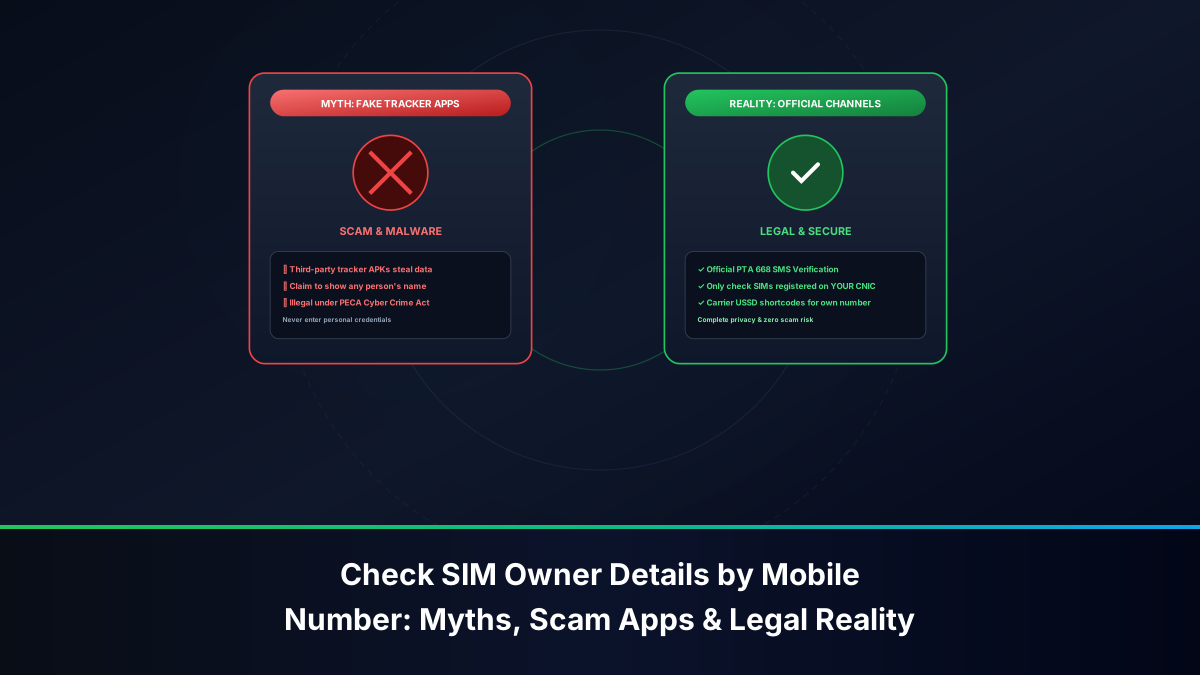
Citizens frequently confuse the functionality of the official PTA 668 system. The 668 SMS shortcode and its companion portal (cnic.sims.pk) function exclusively in one direction: CNIC-to-Count lookup. You submit your own 13-digit CNIC to verify how many SIM cards are registered in your name across Jazz, Zong, Telenor, and Ufone. The system does not accept a phone number to output an identity; entering a phone number into 668 generates a syntax error.
Myth 4: "Calling 111 or 310 Will Allow the Agent to Reveal the Caller's Identity"
Telecommunications customer service representatives are bound by strict non-disclosure legal covenants and PTA Consumer Protection Regulations. Carrier CRM software obscures sensitive subscriber demographic fields behind role-based access control (RBAC). A frontline helpline agent who attempts to look up an unrelated phone number and verbally disclose the owner's name or CNIC to an unauthenticated caller faces immediate employment termination, carrier disciplinary action, and criminal prosecution under PECA Section 16.
Myth 5: "Downloading a 'Pak SIM Tracker APK' is Safe If It Doesn't Ask for Money"
Free "tracker" apps distributed outside the Google Play Store on suspicious APK hosting websites or Telegram channels are not benevolent utilities. They are malicious lures engineered to compromise your smartphone. The operators of these tools monetize not through subscription fees, but through credential theft, ad fraud, and malware deployment.
The Threat Architecture: What 'SIM Tracker' & 'Live Tracker' APKs Actually Do
The cybersecurity landscape in Pakistan is inundated with weaponized Android application packages masquerading under names such as "Pak SIM Data 2026", "Live Tracker Pakistan", "CNIC Information Finder", and "Number Details APK". Security evaluations of these packages reveal dangerous threat architectures.
Android Trojan Vectors: Accessibility Abuse, Contact Theft & RAT Payloads
When an unsuspecting user sideloads these APKs and bypasses Google Play Protect warnings, the application typically requests invasive and hazardous permissions that no legitimate lookup utility would ever require:
- READ_SMS & RECEIVE_SMS Permissions: The application monitors incoming text messages in the background. When your bank (HBL, Meezan, Alfalah) or digital wallet (JazzCash, EasyPaisa, SadaPay) dispatches a One-Time Password (OTP), the trojan immediately exfiltrates the verification code to a Command & Control (C2) server, facilitating automated account takeovers.
- READ_CONTACTS Permission: The malware harvests your entire contact list, complete with names, numbers, email addresses, and home notes, uploading them to offshore data-harvesting syndicates to fuel further phishing campaigns.
- ACCESS_FINE_LOCATION: The application continuously tracks and records your precise GPS coordinates, selling real-time movement dossiers to grey-market advertisers and stalkers.
- BIND_ACCESSIBILITY_SERVICE Abuse: Advanced malicious variants request Android Accessibility permissions under the guise of "improving performance." Once granted, the malware can record on-screen keystrokes (keylogging), intercept passwords entered into banking applications, and execute unauthorized clicks without user knowledge.
The Truth Behind App Data: Outdated 2011 Leaks & Scraping Engines
When these rogue applications actually return an answer for an inquiry, where does that information come from? The reality exposes the fundamental deception of these tools:
| Data Source Used by Rogue Apps | Historical Context & Reliability | Accuracy on Modern SIMs (2026) |
|---|---|---|
| Pre-2015 Legacy Telecom Dumps | Unencrypted SQL database dumps stolen from local marketing agencies and billing aggregators prior to mandatory biometric verification. | <15% Accurate: Almost all numbers have churned, migrated networks via MNP, or re-verified under new owners. |
| Truecaller Scraped APIs | Automated bots querying crowdsourced phonebook directories via reverse-engineered private API keys. | Subjective: Displays informal nicknames, humorous titles, or erroneous tags assigned by strangers. |
| Synthetic Algorithmic Fabrication | Fictitious records generated by combining random Pakistani surnames with popular tehsils and towns to simulate real output. | 0% Accurate: Pure fabrication designed to entice users into clicking monetization ads. |
| Official NADRA / Telecom HLR | Direct real-time biological and subscriber registries managed under cryptographic hardware encryption. | 100% Inaccessible: Never exposed to public internet or rogue third-party tools. |
How Law Enforcement Agencies (LEAs) Actually Trace Mobile Numbers
While private citizens cannot look up SIM owners, Pakistani state institutions possess highly sophisticated, legally regulated mechanisms to trace mobile communications in criminal investigations:
- Statutory Subpoena & Warrant Requirement: Under the Code of Criminal Procedure (CrPC) and Section 31 of PECA 2016, an Investigating Officer (IO) of the rank of Inspector or above must obtain a formal judicial warrant or authorized agency clearance to request telecommunications subscriber data.
- Direct Carrier Liasion via PTA LIMS: Authorized agencies (FIA Cyber Crime Wing, Intelligence Bureau, Military Intelligence, Provincial Counter-Terrorism Departments) interface with telecom carriers through the Lawful Interception Management System (LIMS) and designated Regulatory Compliance Desks.
- Carrier Provision of Authoritative Metadata: Upon lawful request, the host operator's legal division provides an authenticated evidentiary packet containing:
- The verified 13-digit CNIC and full legal name of the subscriber from the BVS activation log.
- The exact timestamp, franchise POS ID, and BVS terminal serial number where the live fingerprint was recorded.
- Call Detail Records (CDRs) showing every inbound and outbound voice call, SMS timestamp, and IMEI handset mapping.
- Cell Tower Base Transceiver Station (BTS) sector azimuths and timing advance data, triangulating the handset's geographical movements at the time calls were placed.
Lawful Remedies: What Citizens Can Actually Do Against Harassment & Fraud
If you are being subjected to unsolicited sales spam, obscene phone calls, financial fraud attempts, or criminal intimidation, you do not need an illegal tracker app to defend yourself. Implement these official, lawful remedies:
- Report Spam & Unsolicited Marketing to PTA (9000 Shortcode): Forward the offending spam SMS along with the sender's mobile number to PTA's dedicated anti-spam shortcode: 9000. Format:
[Spam Number] [Space] [Spam Message Content]. PTA's automated enforcement system will issue warnings and blacklist the sender's MSISDN. - Activate the 'Do Not Call Register' (DNCR): If you receive excessive telemarketing calls, send an SMS with
REGto 3627 to add your mobile number to the national Do Not Call Register. Telemarketers who continue contacting registered numbers face heavy fines. - Lodge Formal Complaints for Harassment (PTA CMS): For persistent harassment, visit the PTA Consumer Complaint Management System at complaint.pta.gov.pk or dial 0800-55055. PTA coordinates with the host operator to bar the caller's IMEI and connection.
- File an Inquiry with the FIA Cyber Crime Wing: If the unknown caller is engaging in extortion, criminal blackmail, impersonation of state officials, or sharing non-consensual imagery, register an immediate inquiry via complaint.fia.gov.pk or visit your nearest regional FIA Cyber Crime Circle. The FIA has the forensic capability to apprehend the perpetrator within days through lawful BTS tower triangulation.
- Utilize Native Handset Call-Blocking: Modern iOS and Android operating systems feature sophisticated spam filters. On Android, enable "Caller ID & Spam Protection" in the Google Phone app; on iOS, activate "Silence Unknown Callers" in Settings.
Statutory Penalties: Criminal Liability Under PECA 2016 for Data Snooping
Attempting to harvest, purchase, trade, or distribute telecommunications subscriber data is not a victimless pursuit; it is a serious criminal offense under the laws of Pakistan:
- PECA Section 3 (Unauthorized Access to Information System): Gaining unauthorized access to any telecommunications database, server, or customer record carries imprisonment of up to three months, a fine of up to fifty thousand rupees, or both.
- PECA Section 4 (Unauthorized Copying or Transmission of Data): Unlawfully copying, downloading, or exfiltrating subscriber identity lists carries imprisonment of up to six months, a fine of up to one hundred thousand rupees, or both.
- PECA Section 16 (Unauthorized Use of Identity Information): Obtaining, maintaining, selling, or distributing another citizen's CNIC data, phone number registries, or biometric records without lawful authorization carries imprisonment of up to three years, a fine of up to five million rupees, or both.
- Operators of Tracker Websites: Individuals who host, administer, or monetize "Pak SIM Data" portals are routinely arrested during nationwide FIA Cyber Crime raids, facing asset confiscation and multiple concurrent felony indictments.
Digital Footprint Hardening: De-listing Your Number from Open-Source Harvesters
While criminals cannot access the live BVS database, they aggressively harvest Open Source Intelligence (OSINT) from public social media profiles, classified advertisement listings, and crowdsourced contact directories. To ensure that unknown callers and stalkers cannot discover your identity or associate your mobile number with your private personal life, implement these defensive cybersecurity steps:
- Delisting from Crowdsourced Directories: If your mobile number appears on caller ID applications like Truecaller, Whoscall, or Sync.me, visit their official web-based unlisting portals (e.g., truecaller.com/unlisting). Submit your mobile number in full international format (
+92300XXXXXXX) and request immediate removal from the public searchable directory. This strips your name from crowdsourced reverse-search queries across hundreds of millions of app installations. - Social Media Privacy Tightening: Ensure that your cellular phone number is decoupled from public visibility on Meta platforms (Facebook, Instagram), LinkedIn, and X (formerly Twitter). In WhatsApp privacy settings, configure "Profile Photo," "About," and "Last Seen" to "My Contacts" only, preventing strangers who merely save your number from viewing your portrait photo or personal status updates.
- Segregating Commercial and Personal Numbers: Never post your primary personal mobile number on public online marketplaces (such as OLX, PakWheels, or Facebook Marketplace) or physical property rental banners. Instead, maintain a dedicated secondary prepaid SIM solely for classified advertisements and public business transactions, keeping your private family and banking communications completely isolated.
- Device Sanitization After Installing Tracker Tools: If you previously downloaded an unauthorized APK claiming to track SIM owners, assume your device is compromised. Immediately uninstall the APK, revoke all runtime permissions under Settings > Apps, clear your browser caches, perform a full malware scan using Google Play Protect or a reputable mobile antivirus suite, and reset your mobile banking and email passwords.
Frequently Asked Questions: Checking SIM Owners by Mobile Number
Direct, regulatory-grounded answers addressing common misconceptions and legal avenues regarding phone number identification in Pakistan.