Across the Pakistani internet, millions of search queries every month revolve around the term "Live SIM Tracker". Users scouring search engines and online video tutorials are frequently led to believe that free public portals exist where anyone can punch in an 11-digit mobile number and instantly witness real-time GPS telemetry, live cell tower tracking, call logs, and active subscriber biographical dossiers. However, a profound divide exists between popular digital folklore and the hardened realities of telecommunications engineering, Pakistani statutory law, and the Pakistan Telecommunication Authority (PTA) regulatory framework.
While unauthorized real-time tracking of third-party mobile subscribers is an impossible fantasy perpetuated by online scam syndicates, real-time auditing and verification of your own cellular connections is an indispensable component of digital hygiene in Pakistan. Through official mechanisms like the PTA Subscriber Verification Management System (SVMS), the NADRA Centralized Biometric Verification System (CBVS), and designated regulatory shortcodes like BVS 6001 and 668, citizens have powerful, legal, and instant tools to monitor their telecommunication assets.
This technical whitepaper provides an exhaustive investigation into how live cellular telemetry operates, the structural mechanics of the PTA-NADRA biometric validation pipeline, the exact role of BVS Code 6001, why rogue tracker applications represent catastrophic cybersecurity hazards, and how to maintain an authoritative, real-time audit of your personal telecom identity.
The Phenomenon of 'Live SIM Trackers': Public Expectation vs Technical Reality
The explosive demand for live tracking software in Pakistan stems primarily from three distinct user motivations:
- Caller Identification and Threat Neutralization: Citizens receiving continuous unsolicited spam, financial fraud pitches, or threatening calls from unknown numbers who wish to confirm who is on the other end of the line before answering.
- Asset and Family Safety: Parents seeking to monitor the physical movements of children or individuals attempting to recover a lost or snatched high-end smartphone across major urban centers like Karachi, Lahore, or Rawalpindi.
- Curiosity and Malicious Voyeurism: Individuals attempting to snoop on the private interactions, physical locations, or personal relationships of third parties.
Public expectation assumes that telecommunication switches operate like open web servers, allowing any website with a sleek search bar to query live cellular coordinates. In reality, telecommunication networks are among the most heavily defended critical national infrastructure assets in the country. To understand why public tracking is impossible, one must inspect how cellular radio telemetry is generated and segregated.
Under the Hood: Cellular Network Telemetry and Tower Location Geometry
When a smartphone equipped with a SIM card from Jazz, Zong, Telenor, or Ufone connects to the Pakistani cellular network, it establishes a continuous, encrypted radio frequency dialogue with nearby Base Transceiver Stations (BTS). This radio dialogue generates internal operational telemetry, but this data is deeply isolated from public interfaces.
Cell Global Identity (CGI) and Timing Advance (TA)
Every cellular tower antenna in Pakistan possesses a unique globally standardized identifier known as a Cell Global Identity (CGI), consisting of:
- Mobile Country Code (MCC):
410for Pakistan. - Mobile Network Code (MNC): e.g.,
01for Mobilink/Jazz,04for Zong,06for Telenor,03for Ufone. - Location Area Code (LAC): A numerical designation representing a geographical cluster of towers (e.g., North Karachi or Islamabad Sector F-7).
- Cell Identity (CI): The individual radio transceiver sector antenna directing radio energy across a 120-degree arc.
To prevent radio interference, the network switch calculates the physical distance between the handset and the mast using Timing Advance (TA). Each Timing Advance step represents approximately 550 meters of radio signal propagation delay. By evaluating the TA value across multiple surrounding masts (radio triangulation), the network's internal Location Measurement Units (LMU) can calculate an approximate physical position.
However, this calculation happens entirely within the operator's internal Radio Access Network (RAN) and Base Station Controller (BSC). It is not broadcast to the open internet, it cannot be queried via standard HTTP/REST endpoints, and it is never exposed to third-party app developers.
Signaling Protocols (SS7 & Diameter) and Firewall Perimeters
In older legacy networks worldwide, vulnerabilities in the Signaling System 7 (SS7) protocol allowed sophisticated espionage groups to send illicit routing packets (such as SendRoutingInfoForSM) to locate mobile devices. In Pakistan, the PTA mandated comprehensive telecom security compliance standards over the past decade.
All Pakistani mobile operators deploy carrier-grade Signaling Firewalls (Diameter & SS7 Firewalls) at their international roaming gateway exchanges. These firewalls actively inspect, filter, and drop unauthorized location queries originating from outside the operator's trusted domestic core. Consequently, rogue websites claiming to offer "SS7 Live GPS Tracking" in Pakistan are peddling pure deception; their packets cannot penetrate carrier-grade border protection.
The Real-Time Authority: PTA SVMS and NADRA CBVS Architecture
While civilian live physical tracking is impossible, Pakistan operates one of the most technologically advanced real-time subscriber verification systems in the world: the synergy between the PTA Subscriber Verification Management System (SVMS) and the NADRA Centralized Biometric Verification System (CBVS).
Established under the PTA Cellular Mobile Network Regulations, this framework ensures that every cellular subscriber in Pakistan is cryptographically and biometrically anchored to a verified citizen identity record. Here is how real-time verification occurs inside the legitimate national pipeline:
- Biometric Acquisition: When an individual visits an authorized franchise, service center, or registered retailer to purchase a new SIM or execute a change of ownership, their physical fingerprint or iris pattern is captured using an optical biometric scanner.
- Encrypted API Handshake: The scanner software does not store the raw image. It creates a mathematical biometric template, encrypts it using high-grade cipher suites (AES-256 / RSA), and transmits the payload over an isolated, private APN (Access Point Name) directly to the PTA SVMS gateway.
- NADRA National Data Warehouse Validation: The SVMS routes the query to NADRA's automated fingerprint identification system (AFIS). NADRA cross-references the biometric hash against the citizen's master civil dossier.
- Regulatory Quota Enforcement: If the biometric hash matches, NADRA returns a success token along with the citizen's official legal name and father's/husband's name. Before authorizing activation, the PTA SVMS instantly tallies the citizen's active national SIM registrations across all four telcos. If the citizen already possesses 5 voice SIMs, the transaction is rejected on the spot.
- HLR Profile Provisioning: Only upon full regulatory clearance does the operator's Home Location Register (HLR) activate the IMSI and map the mobile number (MSISDN) to the subscriber's CNIC profile.
Deep Dive: Biometric Compliance Status via BVS Shortcode 6001
To enable citizens to verify that their active cellular connection is operating in full regulatory compliance, the PTA established the BVS 6001 verification framework. This service operates directly from the handset and provides instantaneous, authentic feedback regarding the line's biometric health.
How the 6001 Verification Query Interacts with Operator HLRs
When a subscriber interacts with shortcode 6001, the cellular handset sends a Signaling System message directly to the operator's Short Message Service Center (SMSC) or USSD gateway. Unlike third-party websites, the 6001 system executes a live internal database query:
- The network switch automatically extracts the sending device's MSISDN (Mobile Station International Subscriber Directory Number) and IMSI directly from the radio bearer channel. You cannot spoof the number you are querying from because the hardware identity is authenticated at the base station.
- The carrier's Subscriber Administration System checks the internal subscriber record to verify whether a valid, authenticated Biometric Verification System (BVS) confirmation timestamp exists for that connection.
- If the inquiry includes a 13-digit CNIC in the SMS body, the carrier's system performs a strict parity check between the inputted CNIC and the master CNIC recorded during the physical BVS scan.
Decoding 6001 SMS Responses and Status Classifications
When you send an inquiry to 6001, the carrier returns an official automated response. Understanding these standardized regulatory classifications is essential for maintaining line continuity:
Common BVS 6001 Status Classifications
-
✓
Verified / Compliant:
"Your connection [03XXXXXXXXX] is biometrically verified against CNIC [XXXXX-XXXXXXX-X]. No further action is required." This indicates full regulatory standing.
-
!
Re-Verification Required / Grace Window:
"Biometric re-verification is pending for this connection. Please visit your nearest franchise within 15 days with your original CNIC to avoid service disruption." This occurs when regulatory audits detect legacy pre-BVS records or flagged identity updates.
-
✕
Identity Mismatch / Suspended:
"The provided CNIC does not match the registered owner records for this mobile number." This confirms that the SIM is legally registered to another person's CNIC.
Deconstructing Rogue 'Live Tracker' Portals: What They Actually Do
If live cellular tracking is restricted to carrier cores and Law Enforcement Agencies, what is actually taking place behind the scenes of websites marketing themselves as "Pak Live SIM Tracker 2026", "SIM Data Online", or "Real-Time Number Locator"?
Mechanic 1: Repackaging Stale 2018–2021 Data Dumps
During the early rollout phases of computerized telecom databases over half a decade ago, compromised retailer credentials and unauthorized franchise exports resulted in localized data leaks. Rogue web administrators acquired these static SQL/CSV dumps and uploaded them to low-cost overseas offshore hosting servers.
When you query a phone number on these sites today, the software simply queries a static, frozen database dating back to 2018–2021. If the target subscriber has ported their number to another network via Mobile Number Portability (MNP), transferred ownership, changed residences, or activated the line recently, the displayed data is completely erroneous. These sites have zero connection to active HLR switches or NADRA servers.
Mechanic 2: Ad-Click Hijacking, Spyware, and Banking Droppers
The operational business model of these tracking portals relies on deceptive monetization and cybercrime syndicates:
- Forced Ad Redirects: Users clicking "Search" are bombarded with aggressive full-screen pop-unders, adult advertising networks, and deceptive notification prompts designed to infect browsers with push-notification spam.
- Malicious APK Droppers: Visitors on mobile browsers are frequently prompted with fake system alerts: "Your Android Tracker Driver is outdated. Download the latest APK to view live results." Installing this package infects the device with Remote Access Trojans (RATs) capable of exfiltrating banking credentials, photos, and WhatsApp databases.
- Advance Fee Extortion: After displaying a partially masked preview of the target's operator and province, the portal redirects to a WhatsApp or Telegram handle demanding PKR 1,500 to PKR 5,000 via Easypaisa or JazzCash to "decrypt the full dossier." The moment funds are remitted, the victim is permanently blocked.
Technical Matrix: Real Core Infrastructure vs Rogue Tracker Websites
To provide a clear, unambiguous overview of capabilities, the table below contrasts legitimate national telecom infrastructure with fraudulent tracker websites:
| Capability / Feature | Rogue "Live Tracker" Portals | Official PTA SVMS / Operator Core |
|---|---|---|
| Data Source | Stale 5-year-old stolen text dumps or fake random generators | Live NADRA National Data Warehouse & Carrier HLR |
| Live Tower Telemetry | None. Inability to communicate with Base Station Controllers | Real-time BTS Timing Advance & CGI; accessible only under court warrant |
| BVS Compliance Status | Cannot verify biometric validity or compliance records | Instant verification via BVS 6001 and operator CRM terminals |
| Legal Compliance | Illegal under PECA 2016 Sections 3, 4, 13, and 17 | Fully licensed under Pakistan Telecommunication Reorganization Act 1996 |
| Device Security Impact | Severe: High probability of keylogger infection, OTP theft, and RATs | Zero risk: Direct encrypted USSD/SMS signaling channels |
| Query Cost | Phishing traps, malware distribution, or advance payment fraud | Free or standard nominal regulatory SMS tariffs |
Establishing an Authoritative Personal SIM Monitoring Routine
Rather than seeking dangerous third-party tools, every Pakistani citizen and resident should establish a routine personal security audit to ensure that their identity has not been compromised and that all active connections are compliant.
Step 1: The Bi-Weekly 668 CNIC SIM Count Audit
The foundation of cellular security in Pakistan is auditing your national SIM quota:
- Via SMS: Open your smartphone messaging app, compose a new message containing your 13-digit CNIC number without hyphens or spaces (e.g.,
4210112345671), and dispatch it to shortcode668. - Via Web: Alternatively, visit the official PTA SIM Information System portal at
cnic.sims.pk. Enter your CNIC and solve the human verification CAPTCHA. - Audit the Breakdown: Review the count of active voice and broadband SIMs across Jazz, Telenor, Zong, and Ufone. If the portal displays connections on a network you have never subscribed to, an unauthorized activation has occurred.
Step 2: In-Hand SIM Identity Verification via MNP 667
While 668 tells you the aggregate number of SIMs registered to your CNIC, it does not reveal the 11-digit phone numbers themselves due to privacy safeguards. To verify the ownership of the specific SIM card inside your physical handset:
- Send an SMS with the uppercase word
MNPto shortcode667. - The carrier switch will immediately return an automated diagnostic receipt containing:
Owner Name: MUHAMMAD ALI KHAN
CNIC: 35202-XXXXXXX-X
Activation Date: 14-MAR-2022
Network: Jazz (PMCL)
IMSI: 41001XXXXXXXXXX
Confirm that the CNIC and Owner Name printed in this system receipt match your personal identity credentials exactly.
Step 3: Auditing Raast, Easypaisa, and Banking Account Bindings
In Pakistan's modern financial ecosystem, mobile numbers serve as sovereign digital payment addresses. Ensure that your telecom identity matches your banking profiles:
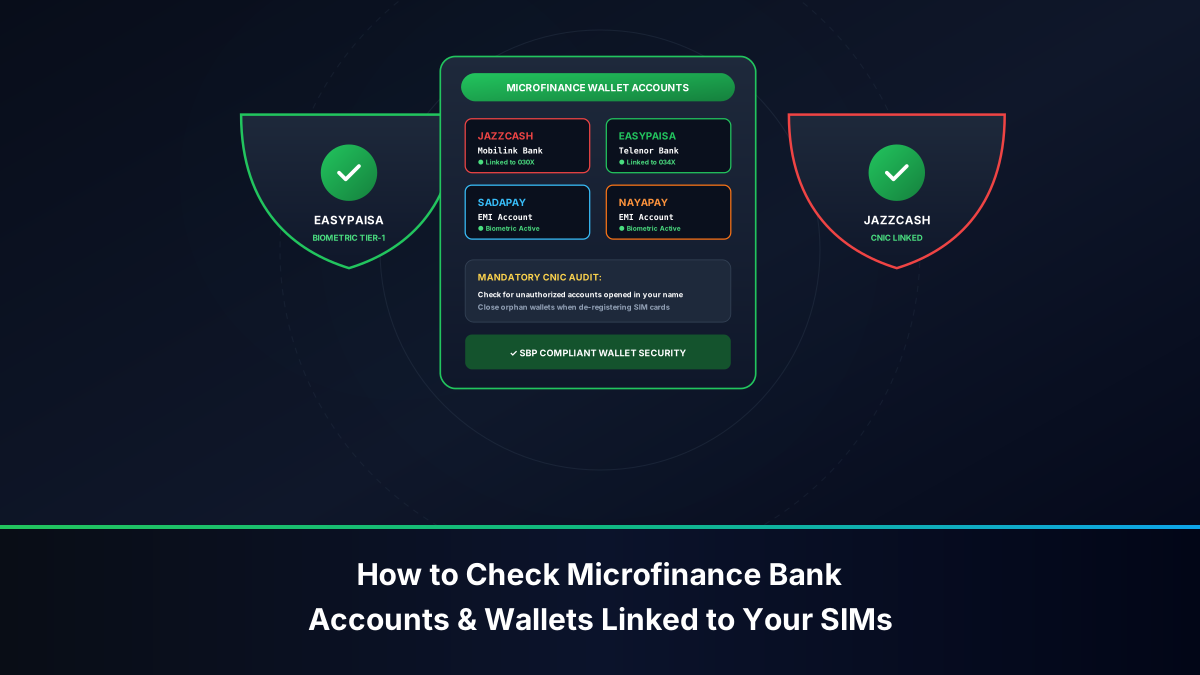
- Under State Bank of Pakistan (SBP) regulations, branchless banking wallets (Easypaisa, JazzCash, SadaPay, NayaPay) and Raast Instant Payment IDs can only be created if the cellular MSISDN is biometrically registered under the exact same CNIC as the bank account.
- If your daily phone number is registered under a family member's CNIC, your mobile wallet accounts are vulnerable to sudden regulatory suspension, and you cannot link your personal Raast ID.
- Verify that your bank has your personal CNIC recorded and that the SMS alert number matches your personal biometric SIM card.
How to Remediate Ghost SIMs and Unauthorized CNIC Activations
If your 668 audit reveals that unauthorized SIM cards have been biometrically registered under your CNIC without your knowledge (a phenomenon historically linked to rogue retail agents manipulating BVS thumbprint silicone moulds), immediate corrective action is legally mandatory.
Franchise Physical Surrender and Biometric Deactivation Protocol
You cannot cancel another person's cellular connection over the phone or through an online app; telecom operators require physical biometric authentication to prevent malicious cancellations:
- Identify the Offending Network: Note which cellular network hosts the unauthorized connection from your 668 summary (e.g., two unknown SIMs on Zong and one on Ufone).
- Visit the Operator Customer Care Center: Locate the official company-operated customer care center or flagship franchise (avoid third-party corner shops or roadside kiosks).
- Request a CNIC SIM Disownment / Deactivation: Inform the representative that you are auditing your CNIC and wish to permanently cancel all unauthorized mobile numbers registered under your profile.
- Execute Biometric Surrender Scan: Place your thumb or index finger on the NADRA BVS terminal to authenticate your identity. The representative will pull up the list of MSISDNs linked to your CNIC, mark the unauthorized lines for immediate deactivation, and issue a stamped regulatory receipt.
- Verification Check: Within 24 to 48 hours, query
668again. The unauthorized SIM count will decrement to zero.
Lodging Regulatory Grievances via PTA CMS and DIRBS
If an operator franchise hesitates or refuses to disconnect unauthorized numbers registered to your identity, escalate the matter immediately to the regulatory authority:
- Dial PTA Consumer Helpline: Call 0800-55055 to lodge a formal non-compliance report.
- PTA CMS Online Portal: Navigate to
complaint.pta.gov.pk, register an account, and select SIM Related Issues > Unauthorized SIMs Registered Against CNIC. - Document Submission: Attach a copy of your Smart CNIC and the 668 screenshot showing the unauthorized allocations. PTA's Enforcement Directorate will issue a direct regulatory notice to the telecom operator, compelling them to purge the rogue registrations and inspect the franchise agent who authorized the fraudulent issuance under Section 17 of PECA 2016.
Frequently Asked Questions About Live SIM Tracking and 6001
Below are authoritative, expert answers to key technical and operational questions regarding real-time SIM verification, telecom telemetry, and security protocols in Pakistan.
Can someone locate my physical position just by sending me a WhatsApp message or calling my SIM?
No. Simply receiving a standard cellular phone call or WhatsApp message does not transmit your physical GPS coordinates or cell tower location to the other party. WhatsApp uses end-to-end encryption for voice and messaging payloads. Unless you manually share your live location within a chat or click on a malicious, deceptive external tracking link (IP logger) sent by the attacker, your geographical location remains completely private.
What is the official difference between dialing *99# and sending SMS to 6001?
Dialing *99# is an operator-specific USSD shortcode (primarily on Jazz) that queries the local device profile to instantly display the active 11-digit mobile number (MSISDN) on your screen free of charge. In contrast, sending an SMS to 6001 queries the centralized regulatory Biometric Verification System (BVS) to verify whether the SIM card has completed valid biometric registration against your CNIC under PTA compliance mandates.
What should I do if a lost or stolen phone with my SIM card is still active?
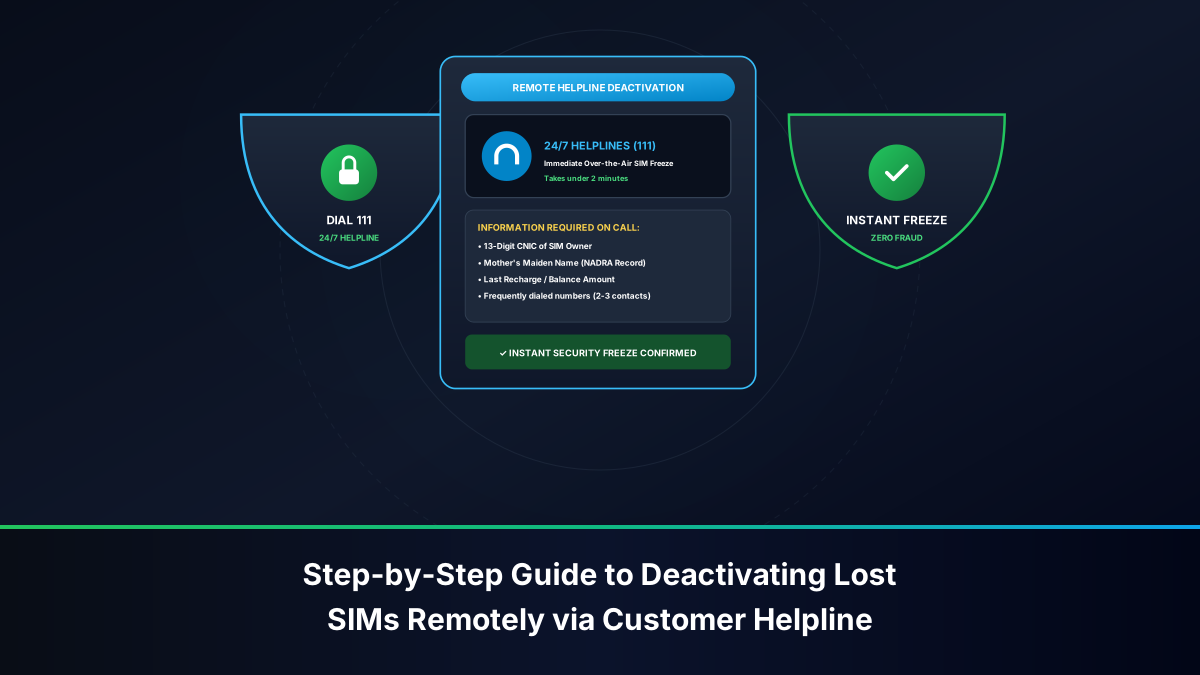
If your mobile phone is lost or stolen, immediately execute a two-step lockdown: first, call your telecom operator's helpline (Jazz: 111, Zong: 310, Telenor: 345, Ufone: 333) to suspend outgoing calls and block the SIM card instantly. Second, contact the PTA DIRBS Helpline at 0800-25625 or visit dirbs.pta.gov.pk to report your phone's 15-digit IMEI number. PTA will instantly blacklist the device hardware across all Pakistani networks, preventing thieves from utilizing the phone even if they insert a new SIM card.
By relying on established regulatory systems like 668, 667, and 6001, Pakistani citizens can ensure total sovereignty over their telecommunications identity while remaining completely immune to the deceptive world of rogue tracker scams.