The Rise of Digital Telcos in Pakistan: Understanding ONIC
In 2023, the Pakistani telecommunications industry entered a new era of digital innovation with the commercial launch of ONIC. Positioned as Pakistan's first digital-native mobile virtual operator (MVNO-style digital sub-brand), ONIC was conceived to cater to the lifestyle expectations of Gen-Z consumers, digital nomads, remote freelancers, and tech-savvy urban professionals who prefer app-driven self-service over visiting crowded physical franchises.
Unlike legacy cellular carriers—such as Jazz, Zong, Telenor, and parent operator Ufone—which rely heavily on physical scratch cards, retail franchise queues, and complex USSD codes, ONIC operates entirely through an integrated digital mobile application. From onboarding and number selection to eSIM provisioning, recurring package renewals, and customer support, every interaction occurs within a sleek smartphone interface.
However, despite its digital operating model, ONIC is fully regulated under the statutory oversight of the Pakistan Telecommunication Authority (PTA) and the National Database and Registration Authority (NADRA). Every ONIC SIM—whether delivered as a physical SIM card or downloaded as a digital eSIM—is strictly bound to a citizen's 13-digit Computerized National Identity Card (CNIC) through mandatory biometric authentication.
Regulatory Compliance Standard: Under the Pakistan Telecommunication Act 1996 and the Prevention of Electronic Crimes Act (PECA 2016), cellular subscribers are legally presumed accountable for all activity originating from their registered SIM cards. Only verify and audit SIM cards registered under your personal legal identity.
Network Infrastructure: The PTML / Ufone Spectrum Relationship
A frequent technical question among consumers is: "Whose network towers does ONIC utilize, and what is its coverage footprint?"
Technically and legally, ONIC operates as a specialized digital brand under Pakistan Telecom Mobile Limited (PTML)—the cellular division of PTCL Group and e& (Etisalat). Therefore:
- Unified Radio Access Network (RAN): ONIC does not construct independent cellular towers. It broadcasts over Ufone's nationwide 4G LTE cellular infrastructure, utilizing PTML's licensed 900 MHz, 1800 MHz, and 2100 MHz spectrum bands.
- Core Network Integration: All signaling, call routing, and data sessions are provisioned through PTML's central Home Subscriber Server (HSS) and Unified Data Management (UDM) core network.
- Coverage Parity: Wherever Ufone 4G LTE coverage is accessible across Pakistan, ONIC subscribers experience identical radio frequency reception, VoLTE voice clarity, and broadband download speeds.
The App-Centric Architecture: Why ONIC Has No Legacy USSD Codes
If you insert an active ONIC SIM into a mobile phone and attempt to dial legacy codes such as *1#, *99#, or *336#, the handset will return an error stating "Service Not Supported" or "Invalid MMI Code". This is not a network failure; it is by deliberate architectural design.
ONIC completely eliminated the legacy USSD layer in favor of an API-driven smartphone app ecosystem:
- Elimination of Balance Inquiries: Instead of dialing shortcodes to check remaining credit, opening the ONIC mobile app immediately displays remaining data gigabytes, calling minutes, and SMS counts on a dynamic real-time progress circle.
- Direct Digital Payments: Balance top-ups and plan purchases do not use physical scratch cards or retailer Easyloads; they are executed seamlessly via credit/debit cards, JazzCash, Easypaisa, or 1Link banking transfers.
- Zero Unwanted VAS Deductions: By removing interactive USSD subscription menus, ONIC eliminates the accidental activation of costly third-party ringtones or daily horoscope services that plague legacy networks.
Method 1: Checking ONIC Owner Details Inside the ONIC Mobile App
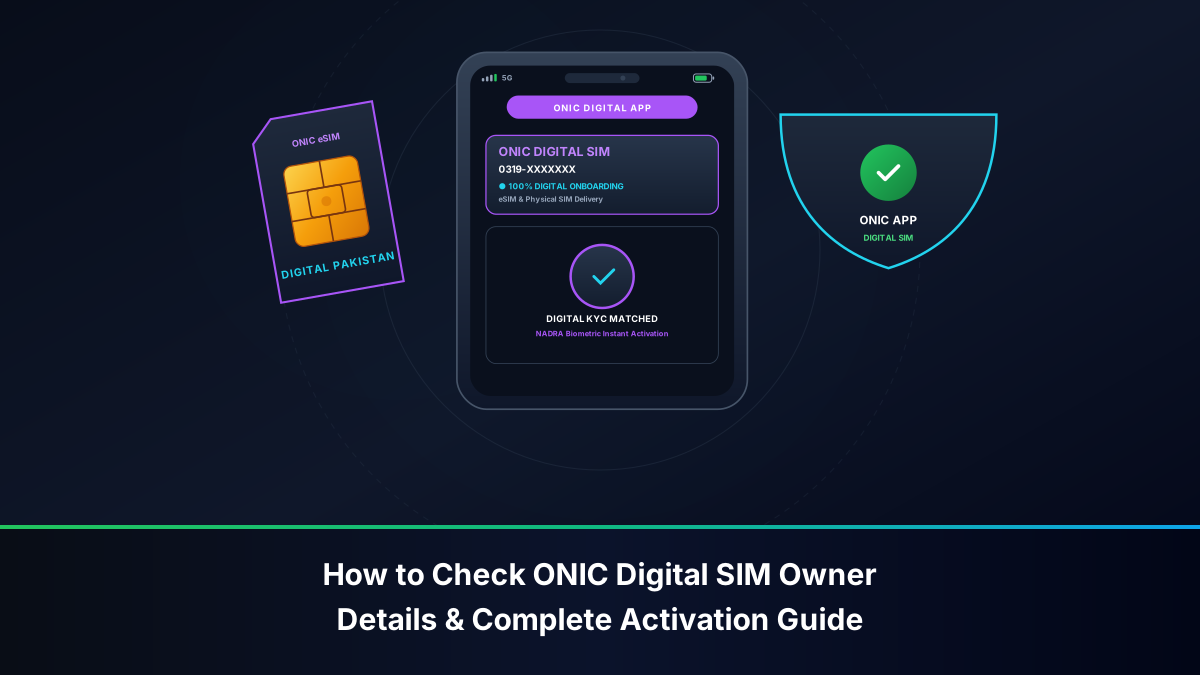
For active ONIC subscribers, the official ONIC App (available on Google Play Store and Apple App Store) is the primary gateway for inspecting account ownership credentials.
Navigating the Profile & Account Dashboard
- Launch the ONIC App on your smartphone.
- Authenticate your session using your registered email address and biometric fingerprint / Face ID login.
- Tap the Profile / Account tab located on the bottom navigation menu.
- The screen displays your registered personal credentials:
- Full Registered Name: Matches your NADRA citizen identity record.
- Masked CNIC Digits: Displays your 13-digit national identity card number.
- Active ONIC MSISDN: Your 11-digit mobile number (formatted as
0339-XXXXXXXor ported prefix). - Account Status: Displays "Active & Biometrically Verified".
Reviewing Active Data, Voice, and Digital Add-ons
Within the main dashboard, subscribers can audit their active plan allowances (such as the Epic, Iconic, or Legendary data tiers), view rollover data balances, and review transaction invoices with digital receipts.
Method 2: Extracting Legal Registration Credentials via SMS 667 (MNP)
Although ONIC does not support carrier-specific USSD menus, it remains legally bound to the national Mobile Number Portability (MNP) shortcode 667 mandated by the Pakistan Telecommunication Authority:
- Open the native SMS application on the smartphone housing your active ONIC SIM or eSIM.
- Create a new outgoing text message addressed to shortcode 667.
- Type MNP in capital letters in the text field.
- Dispatch the message.
Within seconds, PTML's centralized clearinghouse transmits an automated regulatory reply formatted as follows:
Subscriber Name: ZEESHAN ALI
CNIC: 35201XXXXXXXX
IMSI: 41003XXXXXXXXXX
SIM Connection Date: 19-SEP-2023
Connection Type: PREPAID (ONIC)
Diagnostic Utility: This SMS provides irrefutable documentary confirmation of the legal ownership registered on the PTML switch. If the displayed CNIC does not match your identity, the SIM cannot be managed or transferred in your name.
Step-by-Step ONIC SIM Activation: Physical SIM vs. eSIM
ONIC pioneered streamlined onboarding workflows in Pakistan, allowing consumers to acquire numbers without stepping foot inside a brick-and-mortar telecom franchise.
Physical SIM Doorstep Delivery & Biometric Handshake
- App Order: Download the ONIC app, select "Buy New SIM", browse and pick your preferred phone number from the digital inventory.
- Enter CNIC Information: Input your 13-digit CNIC and delivery address.
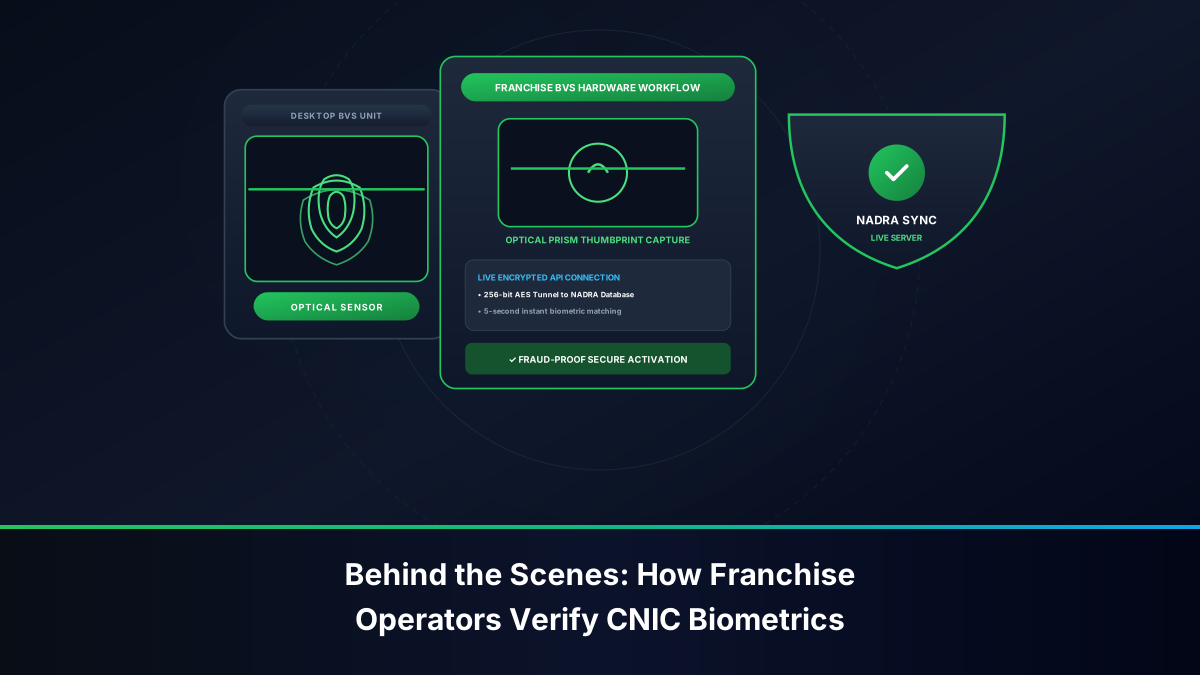
- Doorstep Courier Delivery: An authorized delivery agent arrives at your residence with a handheld BVS terminal.
- Live Biometric Authentication: Present your original physical CNIC and scan your thumbprint on the courier's optical scanner.
- Instant Activation: Upon successful 1:1 match with NADRA records, the physical SIM chip is handed over and activates within 5 to 15 minutes of insertion into your device.
Instant eSIM QR Code Provisioning & Activation
For users possessing eSIM-compatible hardware (iPhone 11 or newer, Samsung Galaxy S20 or newer, Google Pixel series):
- In the app, select "eSIM" during the onboarding stage.
- Complete digital identity verification and submit your order.
- Following required biometric clearance, an encrypted single-use eSIM QR Code is generated directly within the app and transmitted to your registered email address.
- Navigate to your smartphone's Settings > Cellular > Add eSIM.
- Scan the QR code. The cellular profile downloads from the PTML remote SIM provisioning server, activating cellular 4G connectivity without requiring physical card delivery.
PTA Quota Integration: How ONIC Impacts Your 5-Voice Limit
Because ONIC is marketed as an independent, trendy digital brand, some consumers mistakenly assume it possesses a separate quota allocation outside of the national ceiling. This assumption is legally incorrect.
The Shared PTML Operator Ceiling
PTA enforces subscriber caps based on underlying telecommunication operator licenses, not commercial sub-brands:
- Both standard Ufone 4G and ONIC operate under the single license of Pakistan Telecom Mobile Limited (PTML).
- Every active ONIC voice SIM consumes 1 slot from your national allocation of 5 voice SIMs per CNIC.
- If you currently hold 2 Jazz SIMs, 1 Zong SIM, and 1 Ufone SIM, you have 1 remaining voice allocation. Purchasing an ONIC SIM will completely exhaust your national voice quota of 5.
Visibility on the PTA 668 Clearinghouse (cnic.sims.pk)
When you query your CNIC via SMS 668 or the official portal at cnic.sims.pk, ONIC SIM cards are registered and itemized under the Ufone (PTML) column. They do not appear under a separate "ONIC" heading on the clearinghouse matrix.
Porting to and from ONIC: Mobile Number Portability Protocol
Consumers have full statutory rights under PTA MNP regulations to port existing numbers to ONIC or migrate from ONIC to another network:
- Porting an Existing Number to ONIC: Open the ONIC app, select "Switch to ONIC", input your existing mobile number (Jazz, Zong, or Telenor), send
MNPto667, and enter the verification token in the app. Biometric verification is completed during delivery, transferring your number seamlessly within 24 to 48 hours. - Porting Out from ONIC: Send
MNPto667from your active ONIC connection. Forward the resulting SMS payload to your desired new carrier's shortcode (e.g., 76333 for Jazz, 76310 for Zong, or 76345 for Telenor) and complete BVS authentication at their customer center. - 60-Day Tenure Restriction: In compliance with PTA anti-churn directives, any number ported to ONIC must remain active on the network for at least 60 calendar days before becoming eligible for another porting transaction.
Emergency Procedure: Suspending Lost or Stolen ONIC Connections
If your mobile phone containing an active ONIC physical SIM or eSIM profile is lost or stolen, execute immediate suspension to protect your linked accounts:
- In-App Line Suspension: Log into the ONIC app from a secondary smartphone, family member's device, or computer browser at https://onic.pk. Navigate to Manage Line > Security > Suspend Line. The connection is barred from the network switch instantly.
- Live Chat Support: If you cannot access the app, open the ONIC website and initiate an emergency session with the 24/7 Live Chat support desk. Provide your registered CNIC, mother's maiden name, and primary email address to authenticate identity and demand immediate MSISDN barring.
- Order Replacement Profile: Through the app or web portal, order a duplicate physical SIM or new eSIM QR voucher. Once the replacement is biometrically authenticated, the stolen SIM is permanently revoked.
Troubleshooting Common ONIC Activation Errors & Biometric Failures
Users occasionally encounter roadblocks during onboarding or usage. Below are verified resolutions:
- Error: "Biometric Authentication Failed at Doorstep": Ensure the physical CNIC presented matches the exact ID entered during order placement. In cases of worn fingerprints, request the courier to use index or middle fingers, or clean the optical scanner glass.
- Error: eSIM QR Code "Unable to Activate": Verify that your smartphone is connected to a reliable, unmetered Wi-Fi connection during profile download. Ensure your handset is carrier-unlocked and supports Pakistani LTE bands (Band 3 / Band 8).
- Cannot Send SMS to 667: Confirm that your ONIC account maintains active outgoing SMS allowances in your active bundle plan.
Security Architecture: OTPs, WhatsApp & Account Recovery on ONIC
A mobile number is the anchor identity for most of a Pakistani user's digital life: banking OTPs, WhatsApp registration, Raast addressing, and social logins all terminate on the SIM. ONIC's digital-first model changes both the attack surface and the recovery process compared with legacy carriers.
- Banking OTP Delivery: All commercial banks and branchless wallets (JazzCash, Easypaisa, UPaisa) deliver one-time passwords to whatever SIM is inserted in your device, regardless of brand. An ONIC line receives OTPs normally over PTML's network, provided the line stays active and within coverage.
- WhatsApp on ONIC: WhatsApp verifies against the number, not the brand. You can register, re-register, or port a number to ONIC and keep the same WhatsApp identity. However, anyone who briefly controls the SIM can hijack the WhatsApp session, so enable two-step verification (Settings > Account > Two-step verification) with a PIN and a recovery email.
- App-Based Recovery Advantage: Because the line is suspended and replaced from the ONIC app or website rather than through a franchise queue, a stolen-phone victim can bar the SIM within minutes from any other device — substantially faster than the legacy path of calling a helpline and visiting a service center the next morning.
- Phishing Resistance: ONIC's removal of USSD menus eliminates a classic scam vector in which fraudsters talk victims into dialing shortcodes that trigger forwarding or VAS subscriptions. On ONIC there is simply no USSD layer for a social engineer to abuse.
Security Notice: Never share the one-time password sent to your ONIC number during eSIM profile download or re-registration. Possession of that code is equivalent to possession of your line.
Digital Payments, Wallets & Recharge Discipline
ONIC's billing model assumes universal digital payment access, which works well for urban users but deserves deliberate planning for everyone else:
- In-App Card Payments: Debit and credit cards from all major Pakistani banks (and international Visa/Mastercard) can be tokenized in the ONIC app for one-tap renewals of monthly bundles.
- Wallet Top-Ups: JazzCash, Easypaisa, and other SBP-regulated wallets can fund ONIC balances through their own apps — useful when you prefer not to store card credentials inside a telco app.
- 1Link Bank Transfers: Direct account-to-account transfers via Raast or IBFT settle into the ONIC balance, making it feasible to top up a parent's or child's line remotely from your own banking app.
- Load-Shedding and Outage Planning: Because there are no scratch cards for ONIC, a user in an area with prolonged power or internet outages should keep at least one backup payment method active — for example, a small balance on a legacy-network second SIM for emergencies when neither mobile data nor Wi-Fi is available.
Subscribers who convert from legacy carriers should also understand that recharge-based bonuses do not exist on ONIC: there is no retailer Easyload commission chain, no scratch-card promotions, and no per-recharge loyalty tiers. The trade-off is transparent pricing and no unauthorized VAS deductions, but it removes the informal flexibility of paying cash at the corner shop.
Dormancy, Expiry & Number Retention on a Digital Telco
PTA dormancy and recycling regulations apply to ONIC exactly as they apply to every licensed operator, because the line lives inside PTML's HSS/HSS-UDM provisioning system:
- 90-Day Activity Window: A line with zero billable activity (no outgoing call, SMS, or data session) enters a warning state after roughly 90 days, with incoming service progressively restricted.
- 180-Day Recycling Threshold: After 180 consecutive inactive days, the MSISDN becomes eligible for deactivation and eventual reissue to a new subscriber. On a digital telco, where the primary usage pattern is a large monthly data bundle, forgetting to renew once can silently start this clock.
- Auto-Renew Protection: Enabling auto-renew on your monthly plan with a tokenized card is the most reliable dormancy defense: the renewal transaction itself counts as billable activity and resets the inactivity timer every cycle.
- Deliberate Retirement: If you no longer want an ONIC number, do not simply let it die. Use the app to request formal closure, then run a 668 audit to confirm the line has disappeared from your CNIC — an abandoned-but-registered line is a standing invitation to identity misuse.
Who Should (and Should Not) Use an ONIC Connection
ONIC's strengths are real but situational. The following profiles map cleanly onto the platform's design:
- Ideal fit — urban professionals and students: eSIM-capable handsets, reliable card or wallet access, and a preference for transparent bundle pricing over scratch-card promotions.
- Ideal fit — overseas visitors and short-stay residents: App-based onboarding with doorstep biometric delivery removes the need to hunt for a franchise, and eSIM QR provisioning can be completed before leaving the airport Wi-Fi.
- Workable fit — small households: One ONIC line as a data-forward secondary SIM while keeping a legacy-network line for cash recharges and universal retail top-up access.
- Poor fit — cash-dependent users: If your entire recharge habit is cash at a neighborhood shop, ONIC's digital-only payments will feel like a tax on your routine.
- Poor fit — rural edge-of-coverage users: ONIC inherits Ufone 4G's footprint. Where PTML's LTE coverage is thin, a digital-only brand with no physical service centers compounds the inconvenience.
- Poor fit — users needing in-person resolution: Disputes, ownership corrections, and complex MNP cases resolve faster face-to-face; ONIC's channel is chat support, which is responsive but not a substitute for a stamped franchise receipt.
For most subscribers the practical answer is coexistence: keep a legacy voice SIM as your financial and family anchor, and add ONIC as the flexible, app-managed data line — respecting the shared PTML quota ceiling described above.
Comparison: ONIC Digital SIM vs. Traditional Telecom Operators
The following table outlines the operational differences between ONIC and conventional legacy carriers:
| Feature | ONIC Digital SIM | Traditional Carriers (Jazz, Zong, Telenor, Ufone) |
|---|---|---|
| Service Management | 100% Smartphone App Only | USSD Codes, Web, Retail Franchises, Apps |
| USSD Code Support (*99#, *1#) | No (Not Supported) | Yes (Full Support) |
| Scratch Card / Easyload Top-ups | No (Digital Payments Only) | Yes (Everywhere in Retail) |
| Physical Franchises | No (Digital Delivery / Online Chat) | Extensive Nationwide Franchise Network |
| eSIM Ordering Process | Direct In-App Delivery | In-Person Franchise Visit Mandatory |
| PTA SIM Quota Impact | Counts under PTML Voice Quota | Counts under Respective Operator Quota |