Until the mid-2010s, Pakistan's telecommunications landscape struggled with outdated legislative tools. Law enforcement authorities prosecuting modern cyber fraud, identity theft, electronic extortion, and mobile network sabotage were forced to rely on the antiquated Telegraph Act of 1885 and generic provisions of the Pakistan Penal Code (PPC) of 1860—statutes written more than a century before the advent of the internet, GSM cellular base stations, and digital encryption. Recognizing this critical gap, the Parliament of Pakistan enacted the Prevention of Electronic Crimes Act (PECA) 2016.
PECA 2016 represents Pakistan's foundational penal code for the digital age. It established sweeping, modern criminal definitions for unauthorized access, data interception, electronic forgery, identity spoofing, cyberstalking, and the illicit proliferation of electronic communication equipment. In the cellular telecommunications sector, PECA 2016 serves as the primary legal weapon utilized by the Pakistan Telecommunication Authority (PTA) and the Federal Investigation Agency (FIA) Cyber Crime Wing to dismantle counterfeit SIM networks, prosecute corrupt telecom retail agents, smash illegal grey-trafficking gateways, and hold perpetrators accountable.
This comprehensive legal guide provides an exhaustive analysis of PECA 2016 as it applies to cellular SIM ownership and mobile communications in Pakistan. We explore the substantive penal sections of the Act, examine the mechanics of illegal SIM operations, detail the stringent criminal penalties and fines imposed by Special Cyber Courts, analyze the critical doctrine of vicarious liability for ordinary citizens, and provide legal strategies to safeguard your identity.
The Statutory Architecture of PECA 2016 in Pakistan's Telecom Sector
The Prevention of Electronic Crimes Act (PECA) was enacted to create a comprehensive legal framework covering every dimension of electronic data, information systems, cyber devices, and telecommunication infrastructure. Under Section 2 of the Act, statutory definitions are explicitly expanded to encompass modern telecom realities:
- "Information System": Defined broadly as an electronic, magnetic, optical, or high-speed data processing device—including cellular smartphones, cellular base transceiver stations (BTS), mobile switching centers (MSC), and biometric verification terminals.
- "Access to Data": Interrogating, transmitting, manipulating, or reading cellular network signals, Call Detail Records (CDRs), or subscriber identity databases without lawful authorization.
- "Critical Information Infrastructure": Systems whose disruption or destruction would have a debilitating impact on national security, the economy, public health, or safety. National telecom backbones and NADRA biometric verification gateways are formally classified as critical information infrastructure, triggering enhanced penal penalties under Section 6 and Section 7.
By establishing these statutory anchors, PECA eliminated jurisdictional loopholes that previously allowed cybercriminals, illegal SIM merchants, and grey-traffickers to escape conviction on technical grounds.
Critical PECA Sections Governing SIM Fraud, Forgery, & Identity Theft
While PECA contains numerous provisions addressing cyber terrorism and hate speech, several specific substantive sections form the core legal artillery used to prosecute illicit SIM card activities:
Section 13: Electronic Forgery
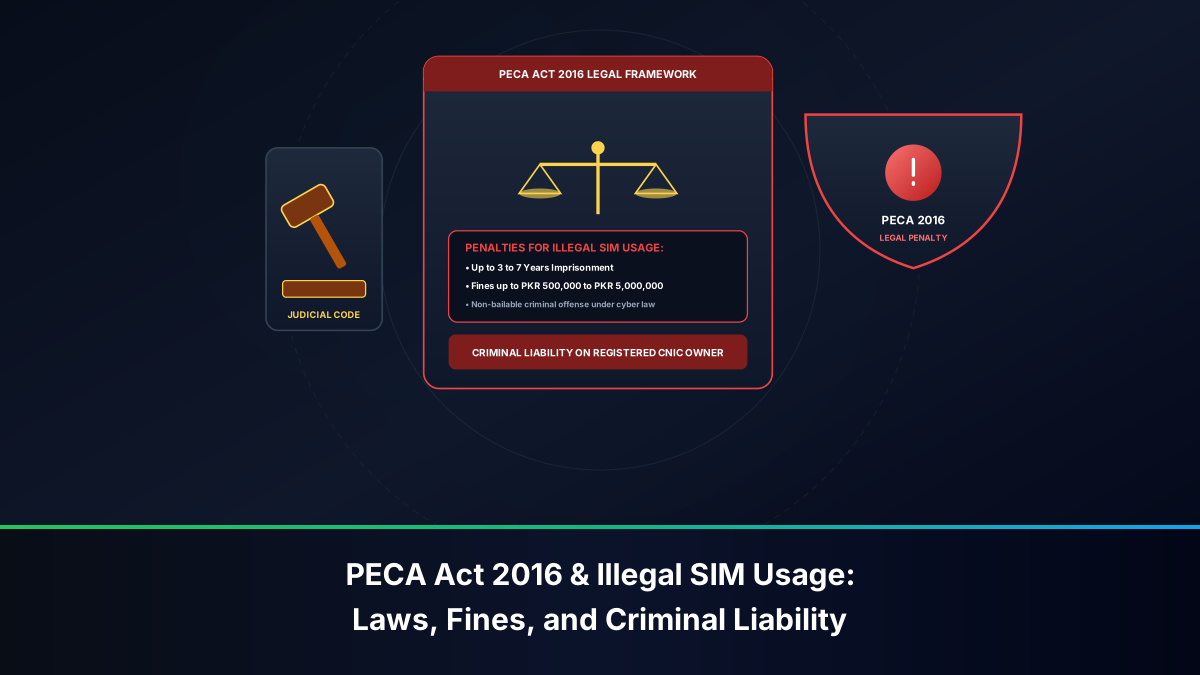
Section 13 penalizes anyone who, with fraudulent or dishonest intent, creates, alters, or manipulates any electronic data, device, or identity token to make it appear authentic when it is not. In the telecom sector, this covers the creation of counterfeit biometric fingerprint templates, tampering with carrier SIM provisioning files, and generating fake electronic subscriber profiles. Conviction carries imprisonment of up to 7 years, a fine of up to PKR 5 million, or both.
Section 14: Electronic Fraud
Section 14 targets anyone who, for wrongful gain or to cause wrongful loss to another person, uses an information system or cellular network to deceive, defraud, or impersonate an institution or individual. This covers social engineering scams, fake lottery prize calls, counterfeit BISP allocations, fraudulent mobile banking OTP exfiltration, and phishing attacks. Conviction carries imprisonment of up to 4 years, a fine of up to PKR 5 million, or both.
Section 16: Unauthorized Use of Identity Information (Identity Theft)
Section 16 is the single most frequently charged offense in illegal SIM investigations. It criminalizes obtaining, selling, possessing, transmitting, or using another citizen's identity information (including their CNIC number, photograph, biometric minutiae, or mother's maiden name) without lawful authorization. Anyone caught possessing illicit CNIC scans or using another citizen's identity to register a SIM card faces imprisonment of up to 3 years, a fine of up to PKR 5 million, or both.
Section 17: Unauthorized Issuance of SIM Cards
Specifically crafted to address telecom retail malpractices, Section 17 directly penalizes telecom franchise agents, roadside retailers, and employees who issue, sell, or activate a SIM card in violation of PTA biometric regulations (such as using pre-captured prints or failing to verify the physical customer). Conviction carries imprisonment of up to 3 years, a fine of up to PKR 500,000, or both.
How Illegal SIMs Are Created: Silicone Prints, BVS Spoofing, & Retail Collusion
Understanding the severe legal penalties of PECA requires analyzing how illicit SIM syndicates operate in Pakistan. Prior to biometric verification, illegal SIMs were mass-registered using discarded CNIC photocopies. After the PTA introduced mandatory Biometric Verification Systems (BVS) in 2015, criminal networks evolved sophisticated, high-tech evasion methods:
1. Artificial Silicone & Gelatin Fingerprint Moulds
In notorious joint raids conducted by the FIA Cyber Crime Wing and PTA enforcement directorates, investigators have seized hundreds of thousands of artificial silicone, wax, and gelatin finger moulds. Corrupt retail agents obtain high-resolution latent fingerprint impressions from citizens who unknowingly touch wax sheets or compromised scanners during routine retail transactions (such as purchasing subsidized flour, utility subsidies, or micro-finance loans). These moulds are subsequently pressed onto BVS scanners late at night to activate batches of ghost SIM cards.
2. The "Biometric Failed" Dual-Activation Scam
Another common fraudulent technique occurs at rogue retail counters. When an unsuspecting citizen attempts to purchase a legitimate SIM card, the dishonest shopkeeper secretly captures the citizen's biometric scan, displays a fake error message on the terminal ("Biometric match failed, please scan another finger"), and uses the second successful scan to activate a completely separate, unauthorized SIM card that is quietly diverted to the black market.
3. The Afghan Refugee & Foreigner Quota Abuse
Syndicates exploit legal documentation loopholes by harvesting identity copies of Afghan Citizen Card (ACC) holders, Proof of Registration (PoR) cardholders, or foreign laborers departing the country, activating maximum SIM quotas before the individual crosses international borders.
Under PECA Section 13 (Forgery) and Section 16 (Identity Theft), every party involved in this pipeline—the person who manufactures the silicone mould, the retail agent who submits the false scan, the wholesale SIM broker, and the ultimate buyer of the unregistered line—is prosecuted as co-conspirators under the joint criminal enterprise doctrine.
Grey Trafficking & Unauthorized VoIP Bypass: Massive Financial Penalties
In telecommunications law, Grey Trafficking refers to the illegal termination of international incoming calls into Pakistan by bypassing authorized International Clearing House (ICH) gateways. Legitimate international carriers pay regulated termination tariffs and taxes to the Government of Pakistan. Grey traffickers use satellite downlinks, internet VoIP lines, and massive racks of local GSM SIM cards (known as SIM Boxes) to route international calls over local mobile networks, making a call from London or New York appear as an ordinary local 0300 or 0321 number on the recipient's screen.
Grey trafficking creates immense national security and economic dangers:
- Total Surveillance Evasion: Calls bypassed through illegal gateways circumvent statutory lawful interception monitors maintained by intelligence authorities, creating blind spots for counter-terrorism operations.
- Billion-Rupee Treasury Loss: Millions of dollars in foreign exchange terminating charges and federal withholding taxes are diverted directly into underground money laundering and Hawala/Hundi networks.
- SIM Depletion: A single commercial SIM box can house 64 to 256 active SIM cards simultaneously, burning through tens of thousands of illicitly obtained Pakistani SIMs every month to avoid automated carrier algorithmic blocking.
Penalties for Grey Trafficking
Under Section 31 of the Pakistan Telecommunication (Re-organization) Act 1996, read with PECA Sections 3, 4, and 14, operating an unauthorized telecom gateway carries rigorous imprisonment of up to 10 years, mandatory fines of up to PKR 500 million, and immediate judicial forfeiture of all seized telecom apparatus, servers, and real estate premises housing the illegal exchange.
Statutory Sentencing Matrix: Imprisonment Terms, Heavy Fines, & Asset Confiscation
Pakistani courts impose non-negotiable statutory penalties across different classes of cyber telecommunication offenses. Sentences can be ordered to run consecutively (one after the other) rather than concurrently, resulting in massive cumulative prison terms for organized syndicates.
| Offense Category | Governing Law | Maximum Prison Sentence | Statutory Fine |
|---|---|---|---|
| Unauthorized SIM Issuance (Retail Agent) | PECA 2016, Sec 17 | Up to 3 Years | Up to PKR 500,000 |
| Unauthorized Identity Theft (CNIC Misuse) | PECA 2016, Sec 16 | Up to 3 Years | Up to PKR 5,000,000 |
| Electronic Fraud (OTP Scams, BISP Frauds) | PECA 2016, Sec 14 | Up to 4 Years | Up to PKR 5,000,000 |
| Electronic Forgery (Silicone Finger Moulds) | PECA 2016, Sec 13 | Up to 7 Years | Up to PKR 5,000,000 |
| Cyber Terrorism / Critical Infrastructure Attack | PECA 2016, Sec 10 | Up to 14 Years | Up to PKR 50,000,000 |
| Grey Trafficking / Illegal VoIP Gateways | PTA Act, Sec 31 | Up to 10 Years | Up to PKR 500,000,000 |
Vicarious Criminal Liability: What Happens When Your CNIC Is Misused?
The most alarming question confronting law-abiding citizens is: "If a criminal commits a robbery, extortion, or cybercrime using a SIM card fraudulently registered on my CNIC, can I be hanged, jailed, or prosecuted?"
In jurisprudence, Vicarious Criminal Liability refers to holding one person legally responsible for the actions of another. In telecommunications:
- The Presumption of Ownership: Under administrative regulations, the individual whose CNIC is biometrically linked to an MSISDN in the PTA database is presumed to be the lawful custodian of that connection. If that number sends a bomb hoax, threatens a judge, or blackmails a student, the police first raid the residential address registered on that CNIC.
- The Mens Rea Requirement: Under Anglo-Saxon common law adopted by Pakistan's superior judiciary, a criminal conviction requires both Actus Reus (the guilty physical act) and Mens Rea (a guilty mind/intent). If you had zero knowledge that the SIM existed, never had physical custody of the plastic SIM card, and received no financial benefit from the crime, you cannot be lawfully convicted of the underlying criminal offense.
- The Danger of Negligence: However, if an individual voluntarily loaned their SIM card to a friend, sold their registered connection for quick cash, or ignored explicit warning notifications from the PTA, courts can hold the citizen liable for criminal negligence or aiding and abetting under Section 109 of the Pakistan Penal Code.
The Anatomy of a Cybercrime Trial: Special Courts, Bail, & Digital Forensics
When an illegal SIM investigation transitions from an administrative inquiry into a formal criminal case, it follows strict statutory procedures governed by the Code of Criminal Procedure (CrPC) 1898 and PECA 2016:
- 1Registration of First Information Report (FIR): Following preliminary forensic inquiries and verification from the PTA, the FIA Cyber Crime Reporting Centre (CCRC) registers a formal criminal FIR naming the primary suspects and invoking relevant PECA sections.
- 2Arrest and Physical Remand: Suspects are apprehended and produced within 24 hours before a designated Judicial Magistrate to secure physical remand for forensic extraction of smartphones, laptops, and biometric equipment.
- 3Digital Forensic Examination: Seized devices are submitted to the FIA's ISO-certified National Digital Forensic Laboratory (NDFL). Forensic analysts extract raw disk images, decode deleted WhatsApp databases, retrieve call recordings, and match physical hardware IMEIs against carrier logs.
- 4Submission of Challan (Final Charge Sheet): The investigating officer submits the formal final report under Section 173 CrPC before the Special Cyber Court.
- 5Trial and Sentencing: The Special Cyber Court examines official witness testimony from telecom network engineers, NADRA forensic officers, and victims before handing down binding penal sentences and asset confiscation orders.
Proactive Legal Defenses: Establishing Absence of Mens Rea & Audit Trails
If you discover an unauthorized SIM registered under your CNIC or receive an inquiry notice from law enforcement, taking immediate, documented legal countermeasures is essential to establish complete personal innocence:
1. The 668 Audit Trail Defense
Query the PTA 668 SMS shortcode every 3 months and capture timestamped screenshots of the response. If an unauthorized line appears, immediately file an official complaint via the PTA CMS Portal (cms.pta.gov.pk). The existence of a prior, timestamped complaint lodged by you before any crime was committed provides airtight judicial proof that you were a victim of identity theft, completely neutralizing allegations of complicity.
2. The Lost CNIC Police Diary (Roznamcha)
If you lose your physical CNIC, never simply apply for a replacement without reporting the loss. Always visit the nearest local police station and file an official loss report in the police daily diary (Roznamcha). Obtain a certified, stamped copy of the entry. If a syndicate later exploits your lost card, the police diary entry proves that you were not in possession of your physical credentials when the illicit SIM was issued.
3. Formal Affidavit & Franchise De-Registration
Immediately visit an official carrier Customer Care Center (not a third-party retailer) and submit a formal written demand for permanent line disconnection under Section 17 of PECA. Require the franchise representative to provide an official stamped SIM Surrender Receipt confirming that the connection has been deactivated due to unauthorized biometric registration.
Comprehensive Reference Table: PECA Sections, Offenses, & Exact Penalties
The table below outlines the full statutory spectrum of cyber offenses related to mobile phones, SIM cards, and electronic identity under Pakistani law:
| PECA Section | Legal Classification | Bail Status | Maximum Sentence | Maximum Fine |
|---|---|---|---|---|
| Section 3 | Unauthorized Access to Information System | Bailable | Up to 3 Months | PKR 50,000 |
| Section 4 | Unauthorized Copying / Transmission of Data | Bailable | Up to 6 Months | PKR 100,000 |
| Section 10 | Cyber Terrorism | Non-Bailable | Up to 14 Years | PKR 50,000,000 |
| Section 13 | Electronic Forgery (Minutiae & BVS Tampering) | Non-Bailable | Up to 7 Years | PKR 5,000,000 |
| Section 14 | Electronic Fraud (Financial Scams via SIM) | Non-Bailable | Up to 4 Years | PKR 5,000,000 |
| Section 16 | Unauthorized Identity Information (CNIC Theft) | Bailable | Up to 3 Years | PKR 5,000,000 |
| Section 17 | Unauthorized Issuance of SIM Cards | Bailable | Up to 3 Years | PKR 500,000 |
| Section 21 | Cyber Stalking & Obscene Calls | Bailable | Up to 3 Years | PKR 1,000,000 |
Frequently Asked Questions About PECA 2016 & Cellular Telecom Offenses
Below are clear, authoritative answers to essential legal questions regarding cybercrime laws and cellular subscriber rights in Pakistan.
Can telecom retail agents be prosecuted if their employees sell illegal SIMs?
Yes. Under the corporate governance rules of PECA and the PTA Code of Commercial Conduct, telecom franchise owners and licensed retail concessionaires operate under strict vicarious liability. If a franchise owner fails to implement reasonable internal supervision and their sales agents issue counterfeit SIM cards using silicone moulds, both the employee and the franchise owner can be prosecuted as co-accused for criminal negligence, resulting in the cancellation of their commercial telecom license and asset forfeiture.
Does the FIA have the authority to tap or record phone calls during a PECA investigation?
No, the FIA cannot arbitrarily tap phone calls. Under Section 33 and Section 34 of PECA 2016, lawful real-time collection or interception of electronic communications requires a formal judicial warrant issued by a Court of Sessions upon demonstration of probable cause involving serious national security threats or heinous criminal offenses. Warrantless interception is strictly illegal and inadmissible in trial.
What should I do if an FIA officer summons me regarding a SIM registered on my CNIC?
If you receive a formal inquiry notice from the FIA Cyber Crime Wing, do not ignore it or attempt to abscond. Cooperate fully with the inquiry. Bring your original CNIC, your primary mobile phone showing your genuine personal numbers, proof of prior 668 inquiries, and any police reports or PTA complaints regarding stolen credentials. You have the constitutional right to be represented by a licensed advocate (legal counsel) during official statements to ensure your rights under the law are protected.
By understanding the rigorous statutory provisions of PECA 2016, actively auditing your registered SIM counts through official 668 channels, refusing to share biometric authentication tokens with unverified vendors, and taking immediate legal countermeasures when identity theft is detected, Pakistani citizens can insulate themselves from criminal liability and contribute to a safer national cyberspace.