SIM Card Expiry Rules: Inactive & Recycled Numbers
In Pakistan's regulated telecommunications ecosystem, a mobile telephone number is categorized as a finite national sovereign resource managed by the Pakistan Telecommunication Authority (PTA). Mobile subscribers do not permanently own their assigned phone numbers; rather, they lease the right of operational access tied directly to an active, validated Computerized National Identity Card (CNIC) through the National Database and Registration Authority (NADRA) Biometric Verification System (BVS). When an assigned SIM card remains dormant without performing billable network activity—such as placing an outbound voice call, sending an SMS, charging a mobile data bundle, or performing a balance recharge—it enters a strictly enforced regulatory lifecycle governed by the PTA Standard Operating Procedures (SOPs) on Inactive SIMs and Number Recycling.
Understanding these expiry and deactivation protocols is crucial for individual consumers, overseas Pakistanis who maintain local SIMs while abroad, and enterprises utilizing cellular telemetry. When a SIM lapses beyond its active grace window, cellular operators—including PMCL (Jazz), CMPak (Zong), Telenor Pakistan, and PTCL/Ufone—are legally bound to initiate Home Location Register (HLR) deactivation, severing cellular signaling, wiping stored mobile account tokens, and ultimately transitioning the MSISDN (Mobile Station International Subscriber Directory Number) into a mandatory cooling-off quarantine before releasing it back into public circulation for new customer acquisition.
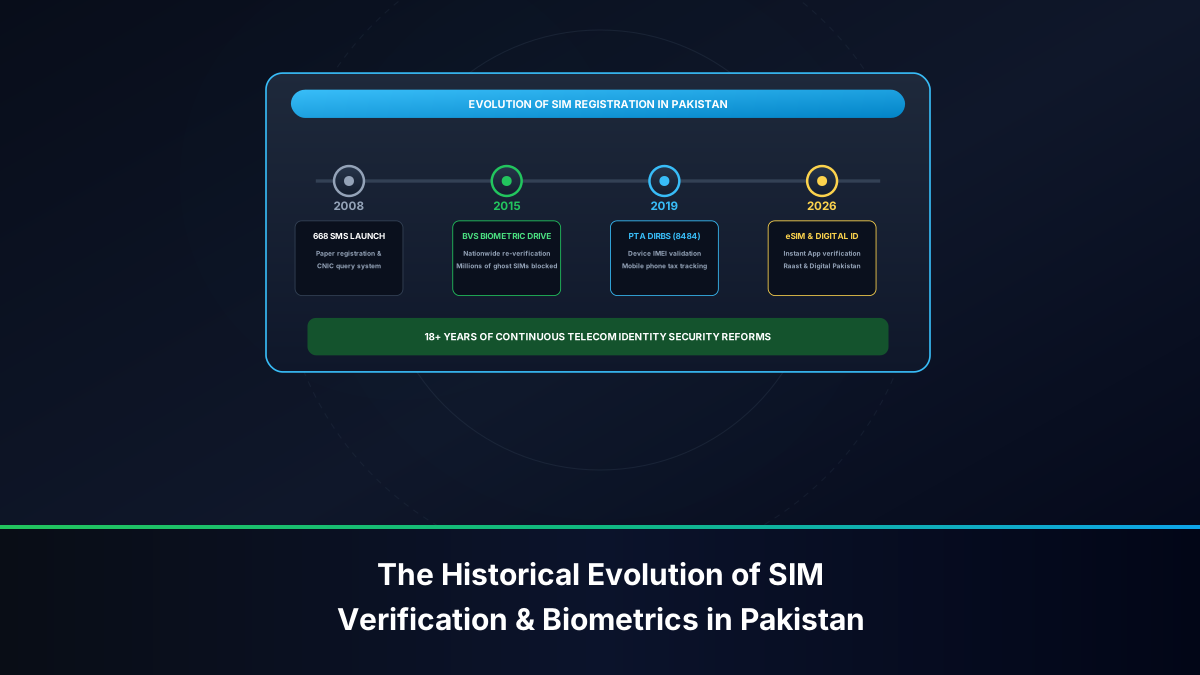
This website provides official regulatory procedures for verifying SIM ownership on your own CNIC. Viewing unauthorized third-party personal records is strictly prohibited under the Prevention of Electronic Crimes Act (PECA 2016).
The Standard PTA SIM Expiry Timeline and Activity Cycles
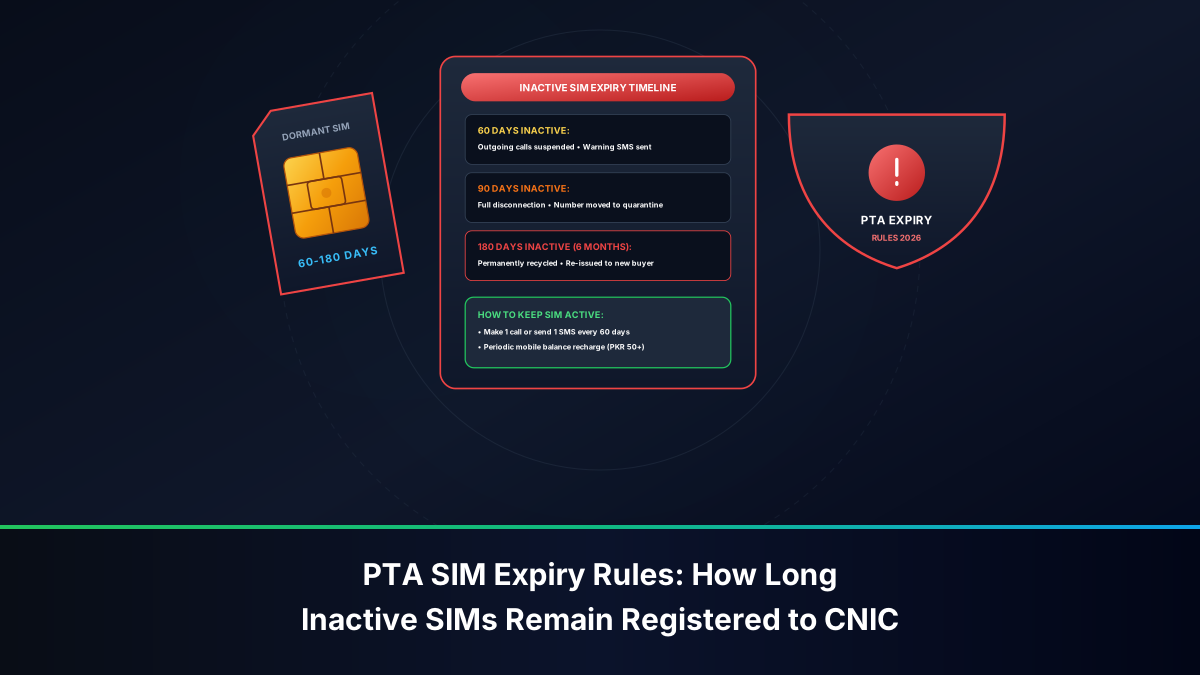
The transition of an operational SIM from an active status to permanent recycling follows a four-phase regulatory continuum established by the Pakistan Telecommunication Authority to balance consumer protection against spectrum utilization efficiency.
Phase 1: The Active Lifecycle (Days 1 to 90)
During everyday usage, any billable activity executed across the cellular network resets the subscriber activity countdown timer within the Mobile Switching Centre (MSC) and Billing Support System (BSS). Billable activities recognized by PTA and cellular networks include:
- Placing a standard outbound cellular voice call that connects for at least one billable pulse (typically 1 second or 60 seconds depending on tariff).
- Sending an outbound SMS message to a domestic or international destination.
- Consuming billable packet-switched mobile data over 2G, 3G, 4G LTE, or 5G testbeds.
- Performing a financial top-up, scratch card load, JazzCash/EasyPaisa electronic airtime recharge, or postpaid billing settlement.
- Subscribing to an active value-added service (VAS) or recurring hybrid bundle.
If ninety consecutive days elapse without a single billable event or airtime recharge recorded in the operator's CDR (Call Detail Record) mediation engine, the SIM is officially flagged as dormant, transitioning into Phase 2.
Phase 2: Administrative Suspension and Outgoing Barring (Days 91 to 150)
Upon reaching the 90-day threshold of total inactivity, the telecommunication operator executes an automated administrative barring of outgoing services. At this junction, the subscriber experiences the following behavioral profile:
- Outgoing Call & SMS Barring: The subscriber cannot originate voice calls, send text messages, or initiate USSD service strings (except emergency services like 1122 and 15, and the operator's automated balance recharge IVR).
- Incoming Service Allowance: Incoming cellular voice calls and incoming SMS messages (including critical two-factor authentication OTPs from banking institutions) remain operational for an auxiliary grace period, typically lasting an additional 30 to 60 days.
- Warning Broadcasts: Regulatory compliance obligates the carrier to transmit automated warning SMS notifications to the handset, advising the subscriber that the line will face permanent disconnection unless a qualifying recharge or call is executed immediately.
Phase 3: Total Disconnection and HLR Deactivation (Days 151 to 180)
If the subscriber fails to execute a balance top-up or billable transaction during administrative barring, the carrier initiates complete service cessation. At Day 180 (or Day 90 under certain accelerated prepaid contracts sanctioned by PTA tariff approvals), both outgoing and incoming communication streams are severed. The subscriber's SIM card loses network registration, displaying 'No Service', 'Emergency Calls Only', or 'SIM Card Registration Failed' on the mobile handset display.
At this moment, the subscriber profile within the operator's active core network is frozen, initiating core database purging procedures.
Phase 4: The Mandatory 180-Day Cooling-Off Quarantine (Days 181 to 360)
Under historic telecom practices, disconnected numbers were frequently reissued almost immediately, causing severe privacy and security risks where subsequent buyers received personal calls, bank notifications, and WhatsApp recovery messages intended for the prior owner. To remedy this security flaw, the Pakistan Telecommunication Authority enacted mandatory cooling-off directives.
Under current PTA regulations, once an MSISDN is completely disconnected from an inactive subscriber's CNIC, it cannot be immediately sold or reissued. The cellular operator must place the MSISDN into a strict cooling-off quarantine period lasting a minimum of 180 days (6 months). During this quarantine window:
- The number cannot be searched, reserved, or purchased through franchises, retailers, or online golden number portals.
- The previous subscriber retains a conditional final window of opportunity to visit an official company-owned customer service center (Franchise or CSC), undergo NADRA Biometric Verification System (BVS) verification, settle any outstanding dues or reactivation fees, and retrieve the number.
- Third-party digital platforms (such as financial switches, Raast, and over-the-top messaging databases) have an operational buffer period during which automated unlinking or token invalidations occur.
Deep Dive: HLR Deactivation and Core Network Purging
To grasp why an expired SIM cannot simply be 'turned back on' over the phone without visiting a physical franchise, one must analyze the telecommunications architecture underpinning GSM, UMTS, and LTE networks.
Every cellular carrier operates a centralized relational database known as the Home Location Register (HLR), accompanied in modern 4G/5G architectures by the Home Subscriber Server (HSS) and Unified Data Management (UDM). The HLR/HSS stores comprehensive master profile records for every SIM issued by the operator, including:
- IMSI (International Mobile Subscriber Identity): The unique 15-digit hardware sequence burnt into the physical silicon SIM or embedded eSIM chip.
- MSISDN: The telephone number dialing string recognized by public telephone exchanges (e.g., 0300-1234567).
- Ki (Authentication Key): A 128-bit or 256-bit cryptographic secret key shared exclusively between the physical SIM card's crypto-coprocessor and the operator's Authentication Centre (AuC).
- Subscriber Service Profile: Authorized Quality of Service (QoS), APN data routing pathways, roaming permissions, and prepaid balance flags.
- VLR (Visitor Location Register) Pointer: Dynamic records tracking the geographical location area identity (LAI) and cell tower currently serving the handset.
When an inactive SIM reaches Phase 3 deactivation, the operator's automated provisioning pipeline issues an administrative de-provision command to the HLR/HSS. The physical SIM's IMSI is permanently decoupled from the MSISDN phone number. The cryptographic state mapping between the physical SIM's Ki and the AuC is erased from the active routing registry. Consequently, the physical piece of plastic resting in the subscriber's phone becomes functionally inert. Even if the subscriber powers on the device, the base station rejects the SIM's location update request (`Location Updating Reject: Cause 7 - EPS services not allowed to this SIM`), rendering it incapable of attaching to the cellular signaling plane ever again.
The Formal Reactivation Process for Inactive SIMs
If your mobile number has been deactivated due to dormancy but has not yet exited the 180-day cooling-off window or been sold to a third party, you can restore ownership by following the statutory PTA reactivation procedure.
Step 1: Status and Ownership Pre-Check
Before traveling to an operator franchise, confirm whether the inactive SIM is still registered in your name or if it has already been stripped from your CNIC record:
- From any other active SIM registered on your CNIC, transmit your 13-digit CNIC (without dashes) via SMS to 668.
- Alternatively, navigate to the official web portal at
https://cnic.sims.pkand enter your CNIC. - Examine the returned SIM count for your specific carrier. If the count indicates the number is still assigned under your operator tally, your MSISDN is still in the revocable suspension phase. If the count has decreased, the number has been unlinked and purged into the cooling-off inventory pool.
Step 2: Visiting an Official Operator Service Center or Authorized Franchise
Reactivation of an expired, HLR-deactivated SIM cannot be performed via customer care telephone helplines (such as 111, 310, or 345), online portals, or roadside third-party reload vendors. You must physically appear at a designated location:
- Authorized Locations: Company-Owned Customer Support Centres (COCO) or primary licensed franchises equipped with biometric data terminals.
- Mandatory Documentation:
- Original, physical Computerized National Identity Card (CNIC) or Smart National Identity Card (SNIC) issued by NADRA. Digital photos or photocopies are legally unacceptable.
- If you are an overseas Pakistani, bring your original National Identity Card for Overseas Pakistanis (NICOP) and original Pakistani passport.
- If you are an Afghan citizen residing in Pakistan, bring your original Proof of Registration (PoR) card or Afghan Citizen Card (ACC).
- The dormant physical SIM card (if still in your possession), which assists customer service representatives in scanning the 19-digit ICCID printed on the card back.
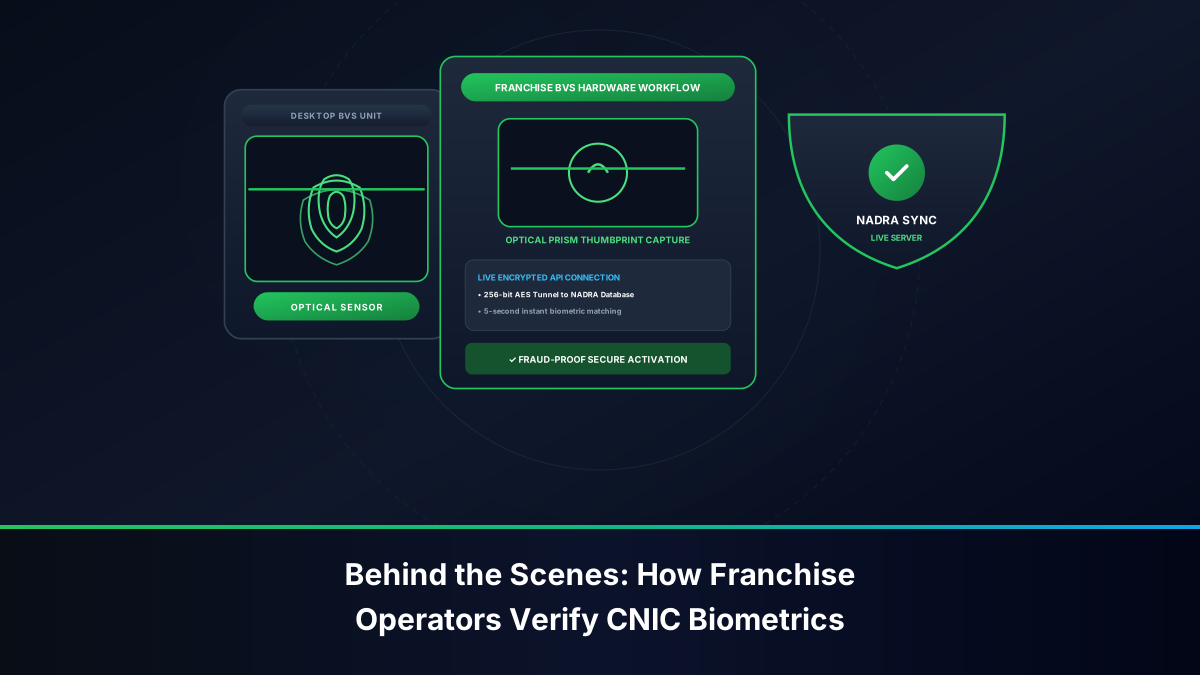
Step 3: NADRA Biometric Re-Verification (BVS)
Under PTA directives, restoring a suspended or dormant MSISDN requires mandatory live biometric re-verification against NADRA databases:
- The franchise agent inputs your CNIC and the target inactive MSISDN into the secure telecom portal.
- You place your primary thumb or index finger on the NADRA-certified optical fingerprint scanner.
- The encrypted biometric payload travels over a private VPN tunnel to NADRA's centralized Automated Fingerprint Identification System (AFIS).
- Upon successful match authentication (`BVS Status: Verified`), the operator's CRM system unlocks the reactivation provisioning workflow.
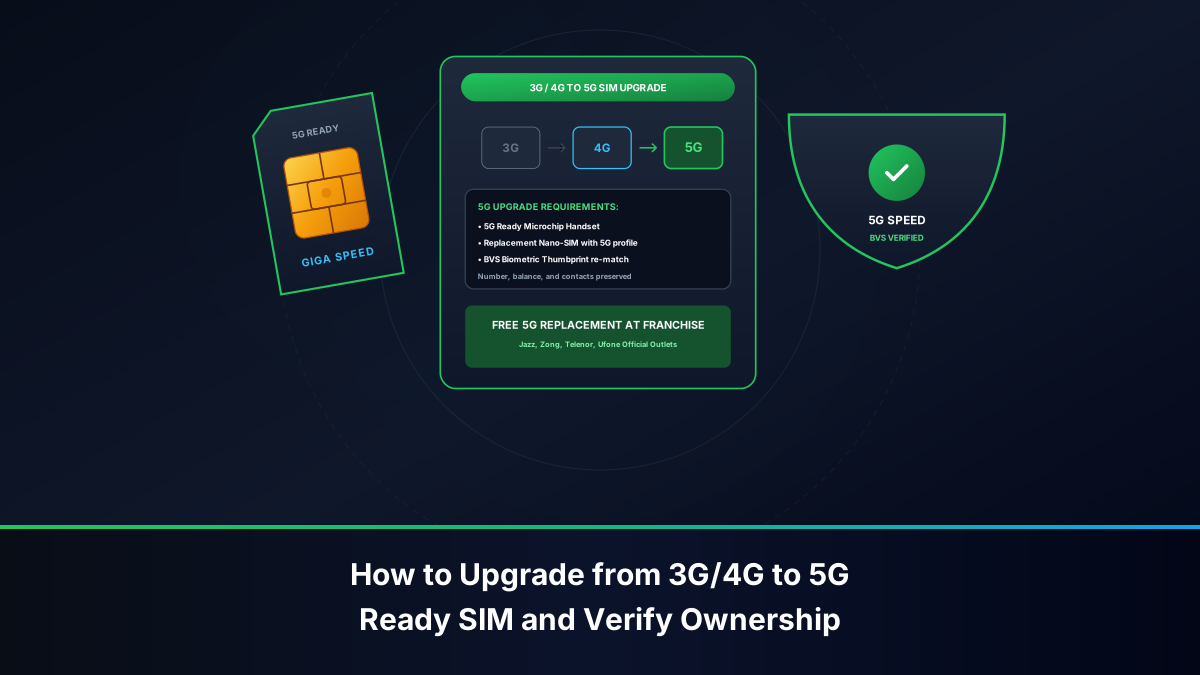
Step 4: Issuance of a Replacement 4G/5G SIM (SIM Swap)
Because the original physical SIM card's cryptographic linkage in the HLR was permanently deleted during core purging, the old physical SIM card cannot be resurrected. The franchise representative must issue a brand-new physical 64K/128K triple-cut SIM card or configure a new digital eSIM profile QR voucher. The new SIM card features a new serial number (ICCID) and a new IMSI, which is dynamically mapped in the HLR back to your original, reclaimed MSISDN.
Reactivation Fees, Tariffs, and Regulatory Taxes
Telecom operators impose administrative and physical replacement charges sanctioned by the PTA for reactivating lapsed cellular numbers:
| Service / Action | Average Standard Cost (PKR) | Tax & Regulatory Notes |
|---|---|---|
| Pre-cooling Phase Reactivation (Dormant <90 days) | PKR 0 - PKR 50 | Simply executing an airtime recharge of PKR 100+ reactivates the line without physical SIM swap. |
| Standard Physical SIM Replacement (SIM Swap) | PKR 250 - PKR 500 | Subject to provincial sales tax (PST 19.5% in Punjab, KP, Balochistan; 19% in Sindh). Covers card hardware. |
| eSIM Activation Voucher | PKR 1,000 - PKR 2,500 | One-time digital profile generation fee; varies by operator tier (Jazz, Zong, Telenor, Ufone). |
| HLR Restoration Surcharge (Post-quarantine reclamation) | PKR 500 - PKR 1,500 | Applied when retrieving a number in advanced cooling-off quarantine before public lottery re-listing. |
| Postpaid Outstanding Arrears Settlement | Variable by subscriber | All accumulated billing line items, Late Payment Surcharges (LPS), and line rent must be cleared 100%. |
Key Regulatory Provisions Governing SIM Disconnection & Recycling
The operational framework enforced by PTA is anchored in precise legal and statutory directives designed to safeguard national security, curb grey telephony, and regulate spectrum usage:
- 5 Voice SIM Cap per CNIC: Under PTA regulations, a Pakistani citizen is permitted a maximum of 5 active voice-enabled cellular SIM cards across all telecom operators combined. When an inactive SIM is purged from the HLR, its slot is freed up on your CNIC tally, allowing you to purchase or activate a new SIM without exceeding the regulatory threshold.
- 3 Data SIM Allowance: In addition to the 5 voice SIM limit, subscribers can hold up to 3 dedicated mobile broadband data SIMs (used in 4G Wi-Fi dongles and routers), bringing the total maximum cellular connections to 8 SIMs per CNIC.
- DIRBS Compliance (Device Identification, Registration & Blocking System): Inserting a reactivated SIM card into an unapproved, non-tax-paid mobile phone will trigger automatic network suspension by the DIRBS system within 60 days. Always ensure the device IMEI is fully PTA-approved via the
*#06#and 8484 SMS shortcode verification tools. - Section 17 of Telecom Reorganization Act (1996): Empowers PTA to manage national telephone numbering plans and reallocate dormant numbering blocks to prevent artificial spectrum exhaustion.
- Section 31 of PECA 2016 (Prevention of Electronic Crimes Act): Criminalizes the unauthorized acquisition, tampering, or fraudulent resale of cellular identity profiles, subjecting offenders to heavy fines and imprisonment.
Official Channels to Monitor and Verify Your SIM Status
Subscribers should systematically audit the active cellular connections registered against their identification credentials to detect dormant or unauthorized numbers before they face unexpected deactivation or recycling:
- PTA 668 SMS Gateway: Dispatch an SMS containing your 13-digit CNIC (without hyphens or spaces) to shortcode 668. You will receive an automated dispatch detailing the aggregate count of active connections distributed among Jazz, Zong, Telenor, and Ufone.
- PTA Online SIM Verification Portal: Access
https://cnic.sims.pkfrom any desktop or mobile browser. Input your CNIC number, solve the reCAPTCHA security verification challenge, and review the operator-wise breakdown table. - Carrier Self-Care Mobile Applications: Install official operator apps (Jazz World, My Zong, My Telenor, My Ufone). These applications feature real-time dashboards indicating your SIM registration status, exact CNIC association, airtime expiry dates, and remaining bundle allowances.
- PTA Complaint Management System (CMS): If a carrier has improperly deactivated a number without adhering to the 90-day warning window, or if an inactive number has been fraudulently transferred, lodge an expedited complaint at
https://cms.pta.gov.pkor dial the PTA Consumer Protection Helpline at 0800-55055. - NADRA e-Sahulat Franchises: Physical kiosks across Pakistan providing assisted citizen verification services and biometric identity diagnostics.
Step-by-Step Action Plan: How to Keep Numbers Active and Avoid Expiry
To ensure that critical cellular numbers—especially those bound to primary bank accounts, WhatsApp, and family networks—are never forfeited to the HLR deactivation engine, implement the following operational routines:
- Establish a 60-Day Calendar Trigger: Set a recurring reminder on your smartphone every 60 days to perform a billable event on secondary or emergency SIM cards.
- Execute a Single Billable Pulse: Dial an outbound voice call to any local number and let it connect for 5 to 10 seconds. Alternatively, transmit a simple SMS text message (`BAL` or `INFO` to an official operator inquiry shortcode).
- Maintain a Minimum Account Balance: Always retain at least PKR 10 to PKR 50 on the prepaid SIM account balance. Prepaid lines with zero balance face accelerated dormancy flagging by automated revenue assurance engines.
- Utilize Long-Validity or Auto-Renewing Subscriptions: Multiple Pakistani networks offer 30-day, 90-day, or annual bundle subscriptions that automatically deduct recurring charges from your account balance, thereby generating continuous billable CDR records that prevent dormancy.
- Activate International Roaming Prior to Traveling Abroad: If departing Pakistan for an extended overseas deployment, activate International Roaming (IR) via your network app or dial the carrier helpline before departing. While roaming overseas, receiving SMS messages is typically free of charge, but executing an occasional outbound SMS or roaming data ping ensures the HLR keeps your profile actively registered.
Crucial Security Warnings: The Threat of Recycled Numbers
The recycling of dormant mobile phone numbers presents one of the most critical digital security vulnerabilities in modern personal computing. Because telecom operators re-release recycled MSISDNs into the commercial retail market after the 180-day cooling-off window, the new purchaser inherits the exact phone number formerly owned by someone else.
If you fail to preserve an inactive number and let it get recycled, the subsequent owner can inadvertently or maliciously exploit your identity if you have not cleaned up your digital footprint:
- Banking and Financial Fraud: In Pakistan, State Bank of Pakistan (SBP) commercial banks, microfinance institutions, JazzCash, EasyPaisa, and Nayapay rely heavily on SMS OTPs for account verification and transaction authorization. If your old number is recycled, the new recipient might receive transaction alerts or attempt OTP-based account takeovers if your CNIC linkage is not decoupled.
- WhatsApp and Social Media Takeover: WhatsApp associates accounts strictly with phone numbers. When a new SIM owner registers the newly bought recycled number on WhatsApp, WhatsApp's SMS verification grants them access to incoming messages directed to that number, immediately ejecting you from active family, professional, and community chat groups.
- Preventative Unlinking Protocol: If you intentionally decide to surrender or abandon a mobile phone number, immediately update your registered mobile phone number across all banking apps, digital wallets, Google Account 2FA, Apple ID, WhatsApp (`Settings > Account > Change Number`), social media profiles, and government portals (FBR Iris, SECP, NADRA Pak-ID) before the SIM enters dormancy.
Legal Disclaimer
This technical guide is compiled exclusively for educational, public advisory, and regulatory compliance awareness purposes based on the published frameworks of the Pakistan Telecommunication Authority (PTA), the National Database and Registration Authority (NADRA), and the Ministry of Information Technology and Telecommunication (MoITT). We are not affiliated with the PTA or any commercial cellular mobile operator. We do not provide unauthorized access to subscriber records, private call logs, or third-party HLR databases. Users are cautioned that attempting to impersonate another individual, forge biometric credentials, or fraudulently seize recycled telephone numbers constitutes a serious federal offense punishable under the Pakistan Penal Code (PPC) and the Prevention of Electronic Crimes Act (PECA 2016).