The Convergence of Telecommunications and Digital Banking in Pakistan
Over the past decade, Pakistan has undergone a profound financial technology transformation. The traditional banking model—reliant on brick-and-mortar branches, paper checks, physical debit cards, and manual signatures—has been largely superseded by an agile, smartphone-first digital economy. Central to this digital transformation is the complete convergence of telecommunications infrastructure and financial technology.
With more than 195 million active cellular subscriptions registered with the Pakistan Telecommunication Authority (PTA) and tens of millions of digital accounts across Raast, 1Link, JazzCash, Easypaisa, UPaisa, SadaPay, and NayaPay, your mobile phone number is no longer merely a communication utility. In 2026, your 11-digit Mobile Station International Subscriber Directory Number (MSISDN) serves as your primary sovereign digital identifier, your financial routing alias, and your cryptographic authentication anchor for multi-factor authorization.
To preserve the security of this interconnected financial grid, the State Bank of Pakistan (SBP) enforces strict statutory regulations mandating an absolute 1:1 match between the citizen identity on record with the banking institution and the biometric subscriber identity registered on the telecommunications network. Understanding these regulatory mandates, how Raast identity resolution operates, and how to resolve CNIC-SIM discrepancies is essential for every digital account holder in Pakistan.
The State Bank of Pakistan (SBP) Digital Identity & KYC Framework
Financial identity verification in Pakistan is anchored to the sovereign citizen database managed by the National Database and Registration Authority (NADRA). Under the legal framework established by the Payment Systems and Electronic Fund Transfers Act 2007 and comprehensive operational circulars issued by the SBP's Payment Systems Department (PSD) and Banking Policy & Regulations Department (BPRD), financial institutions are legally prohibited from onboarding or maintaining accounts tied to mismatched identity credentials.
Statutory Directives: BPRD & PSD Regulations on MSISDN Binding
Key regulatory frameworks enacted by the State Bank of Pakistan include:
- Mandatory 1-to-1 CNIC-to-MSISDN Binding: Under branchless banking and Electronic Money Institution (EMI) licensing conditions, every digital wallet account must be provisioned against a mobile number that is biometrically registered under the exact same 13-digit Computerized National Identity Card (CNIC) or National Identity Card for Overseas Pakistanis (NICOP).
- Zero Third-Party Proxy Policy: Using a cellular connection registered in the name of a parent, spouse, sibling, child, employer, or commercial vendor to operate a personal digital bank account is classified as an unauthorized proxy, violating Anti-Money Laundering (AML) and Countering the Financing of Terrorism (CFT) compliance guidelines.
- Continuous Automated Audits: Financial institutions do not merely inspect telecom records at the moment of account opening. They execute scheduled periodic batch reconciliations against telecom clearinghouse records. Any subsequent discrepancy triggers automatic account tier downgrades or complete transaction freezing.
The Real-Time NADRA Biometric Handshake in Financial Apps
Modern banking and fintech onboarding in Pakistan utilizes advanced smartphone camera contactless biometric scanning or optical fingerprint sensors at authorized banking agents. The operational workflow is highly sophisticated:
- CNIC Metadata Capture: The applicant inputs their 13-digit CNIC number alongside the date of issuance and mother's maiden name.
- Contactless Biometric Verification: The smartphone camera captures live images of the applicant's four fingers, extracting minutiae ridges and pore patterns through specialized biometric SDKs approved by NADRA.
- Encrypted API Query: The minutiae payload is encrypted using AES-256 and transmitted to NADRA's centralized identity engine.
- Telecom Gateway Validation: Simultaneously, the bank's core banking system queries the PTA Subscriber Verification Management System (SVMS) to confirm that the MSISDN provided by the customer is active and legally assigned to that verified CNIC.
- Account Provisioning: If both the biological identity and telecommunications identity produce a 100% cryptographic match, the account or wallet is provisioned instantly.
How Raast Instant Payment System Links CNIC Directly to MSISDN
Developed by the State Bank of Pakistan in partnership with 1Link and international digital payment consortia, Raast is Pakistan's state-of-the-art instant retail payment system. Raast allows real-time, zero-fee fund transfers between individual consumers, corporate merchants, and government entities.
The Central Alias Directory & ISO 20022 Messaging Protocol
Traditional interbank fund transfers (IBFT) require the sender to know the recipient's lengthy 24-character International Bank Account Number (IBAN) or select the correct bank branch from a cumbersome dropdown menu. Raast completely revolutionizes this process through its Central Alias Management System (CAMS):
- The Mobile Number as IBAN Alias: When you activate Raast in your mobile banking app (such as HBL Mobile, Meezan Bank, UBL Digital, Alfalah, Bank Alfalah, SadaPay, or NayaPay), your 11-digit mobile number (e.g.,
03001234567) is registered in the SBP central directory as your unique financial alias. - ISO 20022 Financial Messaging: Raast operates on the global ISO 20022 financial messaging standard. When funds are sent to your phone number, the initiating switch sends an instantaneous PACS.008 payment message to the SBP central switch.
- Cryptographic Identity Verification: The central switch resolves your mobile number against the CAMS directory, extracts the associated IBAN and legal title of account, and prompts the sender to confirm the recipient's name before executing settlement.
End-to-End P2P Payment Routing Workflow
The complete end-to-end execution of a Raast Person-to-Person (P2P) transaction occurs in less than two seconds across four automated steps:
- Initiation: Sender enters recipient's mobile number (
03XXXXXXXXX) and transfer amount in their banking application. - Directory Lookup: Sender's bank queries the central SBP Raast switch → The switch maps the phone number to the recipient's verified IBAN and returns the verified account holder title.
- Authentication & Settlement: Sender confirms the recipient's title and enters their Transaction PIN / Biometric ID → Funds are debited immediately and settled through the SBP Real-Time Gross Settlement (RTGS) core.
- Instant Credit & Notification: Recipient's bank credits the beneficiary account in sub-second latency and dispatches an automated confirmation SMS and push notification.
Because this entire infrastructure depends on the mobile number alias, any discrepancy in SIM card ownership breaks the chain of trust and compromises financial settlement integrity.
Consequences of CNIC-SIM Mismatches: Suspensions, Freezes, and Lockouts
Thousands of smartphone users in Pakistan unwittingly operate mobile connections registered in the names of third parties. Many young professionals and students use SIM cards originally purchased by a parent during their teenage years, while others use connections registered to a friend or former employer. While regular voice calls and internet bundles continue to operate normally, attempting to conduct digital banking on a mismatched SIM triggers severe consequences:
- Immediate Registration Block: When attempting to create a new digital wallet (Easypaisa, JazzCash, SadaPay, NayaPay), the application queries the NADRA BVS gateway. If the SIM owner's CNIC does not match the CNIC scanned on the national identity card, registration terminates instantly with an unmaskable error: "Mobile number registration does not match CNIC".
- Suspension of Existing Wallets: Under SBP periodic re-verification mandates, financial institutions conduct regular background audits. If your previously registered account is found to operate on a SIM whose ownership was altered or re-assigned, your wallet is downgraded to a restricted freeze state where debit transactions and cash withdrawals are prohibited.
- De-linking of Raast ID: The central Raast switch automatically invalidates mobile aliases when an operator reports a change in subscriber registration or when a donor operator confirms an unlinked MNP event. Incoming funds sent to your phone number bounce back to the sender.
- Blocked Banking OTPs and 3D Secure Verification: E-commerce transactions, credit card verifications, and high-value interbank transfers require dynamic One-Time Passwords (OTPs). If an account is flagged for ownership discrepancy, automated fraud filters may suspend OTP transmissions, paralyzing your digital purchasing capacity.
Master Compliance Matrix: Digital Wallets, EMIs & Commercial Banks
The table below summarizes the mandatory identity verification rules, biometric methods, and mismatch triggers across Pakistan's major financial institutions:
| Institution / Platform | Regulatory Category | Mandatory 1:1 CNIC Match | Biometric Onboarding Method | Raast ID Support | Consequence of Ownership Mismatch |
|---|---|---|---|---|---|
| JazzCash | Branchless Banking (MMBL) | Strict Mandatory | In-App Contactless / BVS Agent | Full P2P & Merchant | Immediate Account Freeze & Wallet Lock |
| Easypaisa | Branchless Banking (TMB) | Strict Mandatory | In-App Camera / BVS Retailer | Full P2P & Merchant | Registration Abort / Transaction Barring |
| UPaisa | Branchless Banking (U Bank) | Strict Mandatory | Franchise BVS / In-App | Full P2P Supported | Account Suspension Pending Franchise Visit |
| SadaPay | Electronic Money Inst. (EMI) | Strict Mandatory | In-App NADRA Facial & Fingerprint | Full P2P Supported | Instant Registration Failure |
| NayaPay | Electronic Money Inst. (EMI) | Strict Mandatory | In-App Contactless Fingerprint | Full P2P Supported | KYC Tier-1 Rejection |
| HBL / UBL / Meezan | Commercial Conventional / Islamic | Mandatory for Raast | NADRA BVS Bio-Metric Terminal | Full Raast Integration | Raast Registration Barred / In-Branch KYC |
Step-by-Step Protocol: Resolving CNIC-SIM Ownership Mismatches
If your current mobile number is registered under someone else's identity, you must legally transfer the connection into your own name before setting up digital banking or Raast. Follow this verified three-phase protocol:
Phase 1: Legal Biometric SIM Transfer at Operator Franchise
Under PTA regulations, transferring the ownership title of a cellular connection cannot be executed online; it requires physical biometric verification by both parties:
- Coordinate with Current Registered Owner: Contact the individual whose CNIC currently holds the connection (e.g., your parent, sibling, or relative) and arrange an in-person visit to an authorized telecom customer care center.
- Visit an Official Company Center: Proceed together to an official customer service center or corporate flagship franchise of the mobile operator (Jazz, Zong, Telenor, or Ufone). Avoid non-franchise corner retailers.
- Present Original Smart CNICs: Both the current registered owner (transferor) and the intended new owner (transferee) must present their original, valid physical Smart CNICs. Photocopies and digital phone pictures are legally unacceptable.
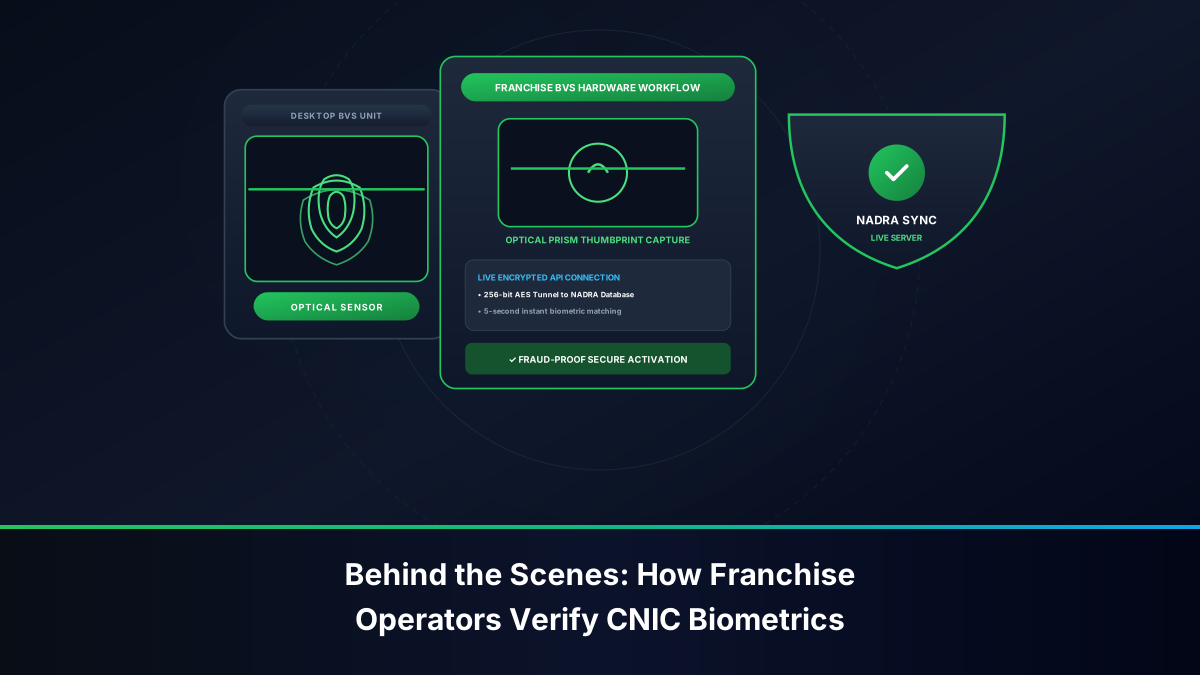
- Execute Transferor Biometric Verification: The customer service representative initiates the transfer on the NADRA BVS terminal. The current owner places their thumbprint on the optical scanner to authorize voluntary surrender of the MSISDN.
- Execute Transferee Biometric Acceptance: The new owner places their thumbprint on the scanner to accept legal liability and bind the connection to their 13-digit CNIC.
- Verify Quota Availability: The system verifies that the transferee has not reached their maximum 5-voice SIM ceiling. If compliant, the ownership transfer is cleared, and a new physical SIM card is issued.
- Obtain Transaction Slip: Retain the printed ownership transfer receipt indicating the timestamp, MSISDN, and updated CNIC registration.
Phase 2: PTA SVMS Clearinghouse Sync & Propagation
While the new SIM card connects to the local cellular tower within minutes, central clearinghouse synchronization follows standard batch intervals:
- Core Network HLR/HSS Update: 15 – 30 Minutes.
- PTA SVMS Central Clearinghouse Ledger Sync: 24 – 48 Hours.
- Verification Query: After 24 hours, confirm successful synchronization by sending an SMS with keyword
MNPto667from the newly transferred SIM. Verify that the returned name and CNIC match your credentials precisely.
Phase 3: Updating Banking KYC & Re-Linking Raast ID
Once your SIM ownership is confirmed via 667, update your financial applications:
- Launch Mobile Banking / Wallet App: Open your banking application (e.g., SadaPay, Meezan Digital, JazzCash).
- Navigate to Profile & KYC Settings: Select Account Information > Update Registered Mobile Number or re-initiate biometric upgrade.
- Perform In-App Biometric Re-Verification: Complete the contactless fingerprint scan using your smartphone camera. The bank's system queries NADRA and the newly synchronized PTA clearinghouse, successfully confirming that the phone number and CNIC are 100% identical.
- Link Raast ID: Navigate to the Raast management submenu and tap Link Raast ID. The SBP central directory registers your mobile number alias to your verified IBAN in under two seconds.
SIM-Swap Fraud & Account Takeover: How SBP Safeguards Protect Citizens
A sophisticated cyber threat targeting financial consumers worldwide is the SIM-Swap Attack. In this scheme, cybercriminals use forged identity documents, corrupt retail agents, or social engineering to obtain a duplicate SIM card of a victim's phone number. Once the duplicate SIM activates, the victim's legitimate SIM loses cellular reception, allowing the fraudster to intercept banking SMS OTPs and drain savings accounts.
To decisively counteract SIM-swap fraud, the State Bank of Pakistan and PTA enacted aggressive technical safeguards:
- Mandatory 24-Hour Digital Banking Cooling-Off Period: Whenever a mobile operator issues a duplicate SIM card or processes a SIM replacement, the carrier's gateway automatically broadcasts an alert flag to the national banking switch. Financial institutions instantly impose a 24-hour cooling-off restriction during which all digital outbound fund transfers, password resets, and Raast activations are frozen.
- Automated IMSI Change Detection: Advanced banking applications monitor the SIM card's unique International Mobile Subscriber Identity (IMSI) serial number. If an app detects that the IMSI hardware identifier changed while the phone number remained the same, it immediately invalidates current login sessions and mandates in-person biometric re-authentication.
- Multi-Factor Facial Liveness Checks: High-risk financial operations increasingly pair SMS OTPs with AI-powered biometric facial liveness scanning to ensure the physical identity holder is present.
Troubleshooting Common Banking & Raast Verification Errors
When connecting your cellular line to digital banking infrastructure, users frequently encounter standard operational errors. Here is how to diagnose and resolve them:
Error: 'Mobile Number Already Linked to Another CNIC'
This error occurs when you purchase a recycled SIM card that previously belonged to an individual who registered it with a digital wallet:
- Root Cause: Under telecom recycling guidelines, numbers dormant for over 180 days are reissued. However, the previous owner's branchless banking account may remain dormant on the financial institution's internal database.
- Resolution: Call the financial institution's official helpline (e.g., 4444 for JazzCash, 3737 for Easypaisa). Provide your active CNIC, your PTA 667 ownership SMS, and your franchise transfer receipt. Request a "Dormant Account Purge & Mobile Number De-link". Customer support will release the number within 3 to 5 business days.
Resolving Delayed or Undelivered Banking SMS OTPs
If you fail to receive vital banking authorization codes:
- Check Spam Protection: Open your smartphone SMS app → Settings > Spam Protection. Operating systems frequently flag automated banking shortcodes (e.g., 8558, 8888, 8181) as promotional broadcasts.
- Shortcode Whitelisting: Dial your mobile operator helpline (111, 310, 345, or 333) and verify that regulatory "Promotional & Transactional Shortcode Blocking" is disabled on your line.
- Clear Handset Memory: Stale SIM memory or full local SMS storage can prevent incoming high-priority carrier alerts. Delete outdated SMS threads and reboot your phone.
Routing Failures After Number Portability (MNP)
If you recently switched carriers (e.g., Telenor to Jazz) and your Raast payments fail to arrive:
- Cause: The central 1Link / SBP routing table or banking SMS aggregator may still reflect your former donor network.
- Fix: Open your mobile banking app, navigate to Raast Settings, tap De-link Raast ID, wait 10 minutes, and tap Re-link Raast ID. This forces the central switch to query the live Pakistan Mobile Database (PMD) clearinghouse and update the telecom routing node.
Legal Liabilities Under PECA 2016 & AML Regulations
Operating financial accounts on unauthorized telecommunications identities entails severe legal exposure under Pakistani federal law:
- Anti-Money Laundering Act (AMLA 2010 / Amendments): Structuring financial transactions through proxies or utilizing accounts registered under third-party identities constitutes a non-bailable financial crime, exposing violators to asset freezing, confiscation of funds, and custodial sentences of up to 10 years.
- Prevention of Electronic Crimes Act (PECA 2016 - Section 16): Unauthorized access to identity information and obtaining financial services under false biometric pretenses carries statutory prison terms of up to 3 years and fines of up to PKR 5 million.
Ensuring that your SIM card is biometrically verified under your own 13-digit CNIC is not merely a convenience for hassle-free mobile banking—it is a vital legal duty that safeguards your finances and guarantees uninterrupted access to Pakistan's sovereign digital economy.