The South Asian Telecom Identity Landscape: Biometric Sovereignty vs. Roaming Freedom
Across South Asia—encompassing Pakistan, India, Bangladesh, Sri Lanka, and Nepal—telecommunications regulation is fundamentally intertwined with national security, counter-terrorism doctrines, and the digital transformation of public finance. Unlike Western jurisdictions where prepaid SIM cards can occasionally still be procured over-the-counter with minimal identity auditing, South Asian nations have pioneered some of the most rigorous, biometrically anchored subscriber verification ecosystems on earth. Mobile numbers (MSISDNs) in this region are not mere communication conduits; they function as primary national legal identifiers, legally coupled with central state citizen databases such as Pakistan's National Database and Registration Authority (NADRA), India's Unique Identification Authority of India (UIDAI / Aadhaar), and Bangladesh's Election Commission National Identity (NID) wing.
For the tens of millions of citizens comprising the South Asian diaspora—including Non-Resident Pakistanis (NRPs), Non-Resident Indians (NRIs), and Bangladeshi expatriates spread throughout the Gulf Cooperation Council (GCC), the United Kingdom, Europe, and North America—maintaining active domestic cellular connectivity while situated thousands of kilometers abroad is a critical financial imperative. Modern digital banking architectures, including the Roshan Digital Account (RDA), Raast instant payments, State Bank of Pakistan (SBP) two-factor authentication (2FA) mandates, Indian UPI international integrations, and property registration portals, strictly require inbound one-time passwords (OTPs) dispatched exclusively to domestic cellular numbers. Navigating international roaming mechanisms, avoiding punitive financial forfeiture, and understanding the complex legal frameworks governing cross-border telecom identity requires an exhaustive understanding of regional administrative and technical standards.
Comparative Regulatory Frameworks Across South Asian Jurisdictions
Each sovereign territory within South Asia administers cellular subscriber lifecycle management through dedicated regulatory authorities operating under distinct statutory powers. The operational differences between these regimes govern how SIM cards are procured, biometrically authenticated, limited per citizen, and maintained while roaming across national borders.
| Jurisdiction | Statutory Regulator | Identity Anchor Database | Biometric Verification Mandate | Maximum Voice SIM Cap per Citizen | Foreign Tourist SIM Rules |
|---|---|---|---|---|---|
| Pakistan | Pakistan Telecommunication Authority (PTA) | NADRA (Smart CNIC / NICOP / POC) | Mandatory Live Biometric Verification System (BVS) via fingerprint/iris | Strict cap of 5 voice SIMs per CNIC (plus 3 dedicated data-only SIMs) | Passport + valid visa; validity tied to visa duration (max 90 days, extendable) |
| India | Department of Telecommunications (DoT) / TRAI | UIDAI (Aadhaar 12-digit UID) | Mandatory Aadhaar e-KYC or Digital KYC with live geotagged photo capture | Maximum 9 SIMs nationally (restricted to 6 in J&K, Assam, and North East circles) | Passport, visa, local reference, proof of stay; validity linked strictly to visa |
| Bangladesh | Bangladesh Telecommunication Regulatory Commission (BTRC) | National Identity (NID) Database | Centralized Biometric BVS matching national electoral fingerprint registry | Maximum 15 SIM cards total across all operational cellular carriers | Passport + visa verification at airport telco desks; valid for duration of stay |
| Sri Lanka | Telecommunications Regulatory Commission of Sri Lanka (TRCSL) | Department for Registration of Persons (NIC) | Physical photo verification, NIC documentation, moving toward digital e-NIC | No strict numeric cap, but mandatory centralized registry auditing per NIC | Passport copy verification at Bandaranaike International Airport booths |
| Nepal | Nepal Telecommunications Authority (NTA) | National Identity Card / Citizenship Certificate | Fingerprint scanning and physical citizenship certificate cross-referencing | Maximum 2 SIM cards per individual carrier without special corporate clearance | Passport, tourist visa, and two physical passport-sized photographs |
Pakistan: PTA, NADRA BVS, and the Five-SIM Constraint
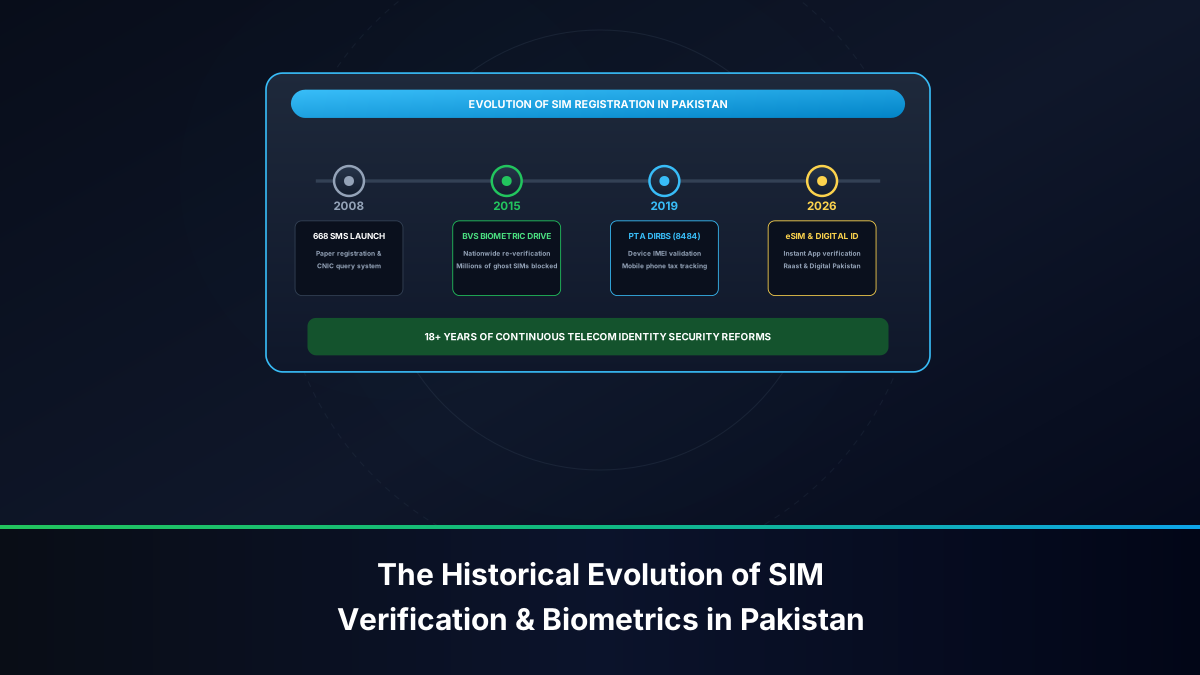
Under the statutory oversight of the Pakistan Telecommunication Authority (PTA) and section 17 of the Prevention of Electronic Crimes Act (PECA 2016), telecommunications issuance in Pakistan is bound to the national identity card framework. In 2015, following the National Action Plan, Pakistan became one of the first countries in the world to retroactively re-verify its entire cellular subscriber base—exceeding 100 million connections—via real-time automated fingerprint biometrics linked directly to the NADRA database. Under modern PTA regulations, no cellular subscriber can operate more than 5 active voice SIMs across all licensed operators (Jazz, Telenor Pakistan, Zong / CMPak, and Ufone / PTCL). An additional allowance of up to 3 data-only SIMs is permitted for mobile broadband routers (dongles, MiFi devices, and tablets).
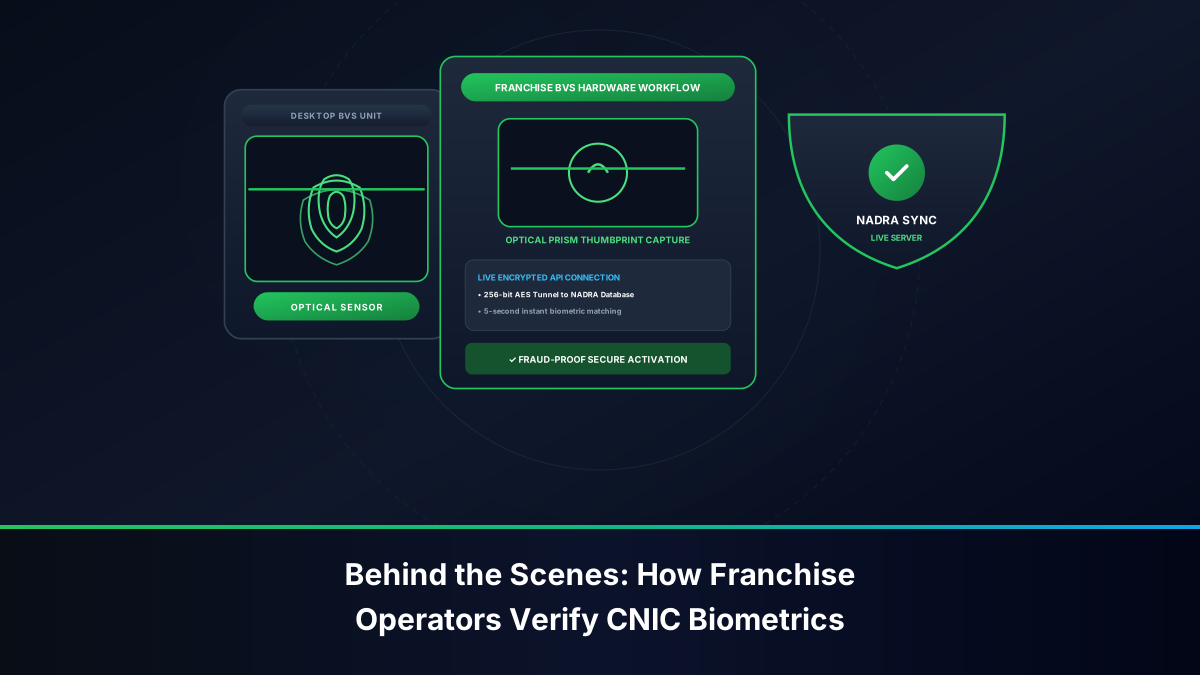
The system enforces live BVS authentication: every retail franchise, authorized retailer, and customer support kiosk is equipped with an encrypted biometric scanner that transmits live fingerprint templates to NADRA's Verisys / e-Sahulat backend engine. A single biometric mismatch terminates the issuance workflow immediately, preventing identity theft and unauthorized SIM duplication.
India: DoT Mandates, Aadhaar e-KYC, and Nine-SIM Thresholds
In India, the Department of Telecommunications (DoT) regulates cellular distribution under the Indian Telegraph Act, 1885, and the modern Telecommunications Act, 2023. Subscriber identity acquisition primarily utilizes the Aadhaar e-KYC protocol operated by UIDAI. Prospective subscribers provide their 12-digit Aadhaar number and undergo live biometric authentication (fingerprint or iris scanning) or OTP-based authentication linked to the primary Aadhaar mobile registry. The DoT enforces a strict aggregate ceiling of 9 mobile connections across all licensed Telecom Service Providers (TSPs) nationally, with a reduced ceiling of 6 connections enforced in security-sensitive circles such as Jammu & Kashmir, Assam, and the North East telecom circles.
The DoT also operates the TAFCOP (Telecom Analytics for Fraud Management and Consumer Protection) portal, a centralized consumer utility analogous to Pakistan's PTA 668 service, allowing Indian citizens to audit the aggregate quantity of cellular numbers registered under their unique government identity document and initiate termination requests for unauthorized lines.
Bangladesh: BTRC Biometric Centralization and 15-SIM Upper Ceiling
The Bangladesh Telecommunication Regulatory Commission (BTRC) mandated full biometric verification for all mobile subscribers in December 2015. Operating across mobile operators Grameenphone, Robi Axiata, Banglalink, and state-owned Teletalk, the BTRC system synchronizes directly with the national electoral database managed by the Bangladesh Election Commission. A central biometric verification server checks citizen fingerprints in real time against national identity (NID) data. In 2017, the BTRC instituted a strict cap of 15 SIM cards per NID across all networks combined, dramatically reducing corporate hoarding, grey market VOIP termination gateways, and illicit SIM reselling across border districts.
Sri Lanka & Nepal: TRCSL & NTA Emerging Identity Verification Schemes
In Sri Lanka, the Telecommunications Regulatory Commission of Sri Lanka (TRCSL) oversees mobile operators Dialog Axiata, Mobitel, Airtel Lanka, and Hutchison. While historical subscriber acquisition relied heavily on physical National Identity Card (NIC) photocopies and manual customer application forms (CAF), TRCSL has systematically introduced central verification protocols linking telecom databases with the Department for Registration of Persons to combat SIM card spoofing and financial cybercrime. In Nepal, the Nepal Telecommunications Authority (NTA) regulates Nepal Telecom, Ncell, and Smart Telecom, requiring physical citizen certificates, voter identification, or official passport documentation alongside mandatory thumbprint records, while capping personal ownership at two active connections per provider without exceptional enterprise justifications.
Cross-Border Spillover, Geo-Fencing, and Border Signal Controls
Geographical proximity along the extensive land borders dividing South Asian nations—most notably the 3,323 km India-Pakistan border (comprising the International Border and the Line of Control) and the 4,096 km India-Bangladesh border—presents severe regulatory and technical challenges regarding cellular signal propagation. Radio frequency (RF) transmissions emitted by high-power cell towers (Base Transceiver Stations / BTS) do not respect sovereign cartographic lines, leading to potential RF spillover where handsets in border villages connect inadvertently to foreign towers.
To eliminate unauthorized cross-border communications, national security directives enforced by both the PTA and India's DoT mandate strict physical and technical buffer zones:
- Power Attenuation and Down-Tilting: Mobile network operators in border districts (such as Lahore, Sialkot, Kasur, and Narowal in Pakistan, and Amritsar, Gurdaspur, and Ferozepur in India) are legally compelled to mechanically and electrically down-tilt directional cellular antenna panels away from the international border. Transmission power must be attenuated so that usable signal strength degrades below threshold limits prior to traversing the zero line.
- Buffer Zones & Exclusion Corridors: Regulatory mandates prohibit the installation of commercial BTS towers within designated exclusion corridors (typically ranging between 500 meters and 2 kilometers) from international boundary lines unless granted explicit security clearance.
- Illegal Cross-Border SIM Operation: Possessing or operating an active foreign SIM card without authorized international roaming registration in border military zones is classified as a severe penal offense under PECA, the Indian Telegraph Act, and national border security regulations. Inadvertent latching onto foreign towers without roaming activation triggers automated cell-ID rejection codes on the visited network.
Technical Roaming Architecture: How South Asian SIMs Function Transnationally
When a Pakistani subscriber travels abroad to the United Arab Emirates, Saudi Arabia, the United Kingdom, or the United States, seamless cellular functionality relies on complex transnational signaling architectures governed by the GSM Association (GSMA) standards. Roaming is not a single switch; it is a distributed, real-time negotiation between the subscriber's Home Public Land Mobile Network (HPLMN) (e.g., Jazz Pakistan) and the Visited Public Land Mobile Network (VPLMN) (e.g., STC Saudi Arabia or EE United Kingdom).
The HLR, VLR, and Diameter/SS7 MAP Registration Protocol
The sequence that occurs when an international roaming-enabled Pakistani handset powers on at an international arrival terminal proceeds through rigorous cryptographic handshakes:
- International IMSI Broadcast: The subscriber handset transmits an initial radio attach request containing its 15-digit International Mobile Subscriber Identity (IMSI). The initial three digits represent the Mobile Country Code (MCC:
410for Pakistan), and the subsequent two digits designate the Mobile Network Code (MNC: e.g.,01for Mobilink/Jazz,04for Zong,06for Telenor,03for Ufone). - Visited Network Intercept: The visited base station routes the request to the foreign carrier's Visitor Location Register (VLR) and Mobility Management Entity (MME). Recognizing foreign MCC
410, the VPLMN identifies that the SIM does not belong to its native subscriber database. - Signaling Gateway Routing (SS7 / Diameter): The VPLMN routes an
Update Locationsignaling message across an international IPX (IP eXchange) or GRX carrier backbone via SS7 MAP (Mobile Application Part) for 2G/3G or Diameter protocol for 4G/LTE/5G. - Home HLR/HSS Authentication: The message reaches the operator's central Home Location Register (HLR) or Home Subscriber Server (HSS) in Islamabad, Lahore, or Karachi. The HLR verifies: (a) is the MSISDN active? (b) has the subscriber explicitly activated the International Roaming feature? (c) does the subscriber have an adequate prepaid balance or postpaid credit limit?
- Authentication Vectors Generation: If authenticated, the HLR generates cryptographic authentication vectors (RAND, SRES, Kc in GSM; RAND, AUTN, XRES, KASME in UMTS/LTE) and transmits them back to the foreign VLR, alongside service profile restrictions (e.g., voice enabled, SMS incoming permitted, data roaming blocked).
- Radio Latch Established: The VLR caches the temporary subscriber record, issues a Temporary Mobile Subscriber Identity (TMSI), and instructs the radio tower to latch the handset. The phone display updates from 'Searching' to the foreign partner carrier's name.
CAMEL Application Logic and Real-Time Billing Handshakes
For prepaid subscribers, standard historical roaming systems were incapable of calculating real-time billing across international boundaries, often resulting in massive post-call billing disputes. Modern South Asian operators resolve this via CAMEL (Customised Applications for Mobile networks Enhanced Logic) architecture:
Under CAMEL Phase 2, 3, and 4 protocols, whenever a prepaid roaming subscriber dials a voice call or sends an outbound SMS, the visited VLR triggers a CAMEL Application Part (CAP) query back to the home operator's gsmSCF (GSM Service Control Function) and Online Charging System (OCS). The home OCS checks the prepaid rupee balance in real time, reserves funds on a per-second or per-minute increment, and authorizes call progression. If the prepaid balance drops below the threshold, the OCS dispatches an automated call teardown command to the visited foreign switch.
Maintaining Overseas Banking, Raast, and SBP 2FA Compliance
The single greatest operational driver for maintaining an active Pakistani SIM overseas is adherence to the State Bank of Pakistan (SBP) BPRD Circulars governing financial cyber-security and identity integrity. Pakistani financial institutions—including HBL, Meezan Bank, Standard Chartered, Bank Alfalah, MCB, and digital platforms like Nayapay and Sadapay—are legally forbidden from disengaging two-factor authentication for transactional clearances.
Zero-Cost Inbound SMS Rules and Carrier Policy Guarantees
A widespread point of confusion among overseas Pakistanis is whether receiving bank authentication OTPs abroad incurs international roaming fees. Under the standardized interconnect agreements brokered by Pakistani telecom operators with foreign roaming partners worldwide, inbound SMS messages are 100% free of charge under all standard roaming configurations. Incoming SMS traffic does not require an active voice balance, nor does it deplete prepaid account funds.
Whether you receive a 6-digit transaction authorization code from an ATM withdrawal in London, a Raast transfer OTP while residing in Riyadh, or an FBR IRIS e-filing verification code in Toronto, the terminating operator does not bill the receiving party for the incoming signaling bearer channel. However, your SIM must be actively registered on a partner cellular network to receive the signaling payload.
Preventing Background Roaming Data Leakage: Android and iOS Configurations
While incoming SMS is free, unmonitored cellular data roaming is notoriously expensive. In the absence of an active roaming data bundle, standard “pay-as-you-go” data roaming rates can rapidly exhaust hundreds of dollars or thousands of Pakistani rupees within minutes due to background operating system synchronizations, app store updates, and push notification polling.
To establish a bulletproof configuration that permits incoming SMS while entirely preventing accidental data charges, execute the following technical device configuration:
- Operating System Level Disablement:
- iOS (iPhone): Navigate to
Settings > Cellular / Mobile Service > Cellular Data Options> toggle Data Roaming to OFF. If using dual SIM, select your Pakistani SIM line and ensure Mobile Data Switching is turned OFF. - Android: Navigate to
Settings > Network & Internet > SIMs > [Select Pakistani Carrier]> toggle Roaming (Connect to data services when roaming) to OFF.
- iOS (iPhone): Navigate to
- Access Point Name (APN) Neutralization: As an ultimate safeguard against rogue operating system bypasses, navigate to your APN settings on the Pakistani profile and deliberately alter the APN string (e.g., change
jazzconnect.mobilinkworld.comorzonginternetto an invalid address such asdisabled.roaming.null). This completely prevents packet data context activation at the mobile baseband level while leaving GSM/SS7 voice and SMS signaling channels fully operational. - MMS Auto-Retrieve Deactivation: Disable "Auto-retrieve MMS" in your default SMS application settings, as incoming multimedia messages can force cellular packet data handshakes.
Step-by-Step Operator International Roaming Activation Protocols
Activating International Roaming (IR) must ideally be executed while within the physical borders of Pakistan. The exact operational protocols vary across the four national licensed operators:
| Operator | Prepaid Roaming Activation Code | Postpaid Roaming Requirements | Self-Service Digital App Method | International Helpline Contact |
|---|---|---|---|---|
| Jazz (Mobilink) | Dial *111# > Select Roaming > Activate IR |
Security deposit of PKR 5,000–10,000 or credit card auto-debit undertaking | Jazz World App > Menu > International Roaming > Toggle Active | +92 300 08 55555 |
| Zong (CMPak) | Dial *4255# or SMS sub to 4255 |
Security deposit based on credit limit; submit request via franchise or e-care | My Zong App > Value Added Services > International Roaming > Enable | +92 314 4488111 / +92 51 111 222 111 |
| Telenor Pakistan | Dial *345*55# or SMS IR to 345 |
Standard security deposit or corporate guarantor clearance via franchise | My Telenor App > Explore Offers > International Roaming > Activate | +92 345 1110345 |
| Ufone (PTCL) | Dial *506# or call 333 helpline |
Requires physical visit to Ufone Service Center with Smart CNIC & deposit | My Ufone App > Services > International Roaming > Subscribe | +92 333 5100033 |
SIM Inactivity Lifecycles, PTA 180-Day Rules, and Expat Preservation Strategies
One of the most devastating scenarios experienced by overseas citizens is returning to Pakistan or attempting to conduct a critical property transaction only to discover that their long-standing phone number has been permanently canceled and assigned to an unknown stranger. Under PTA regulatory directives on spectrum efficiency and subscriber churn management, mobile operators are empowered to revoke and recycle unused numbers:
- The 180-Day Rule: If an MSISDN registers zero billed transactions—meaning no outgoing revenue-generating calls, no billable SMS messages, no consumed data sessions, and no balance recharge—for a consecutive duration of 180 days (6 calendar months), the operator issues a formal inactivity notice.
- The 30-Day Warning & Grace Window: After 180 days of total dormancy, the connection is suspended for inbound traffic, and a final 30-day reactivation grace window commences. If no top-up or verification takes place, the line is revoked and returned to the operator's unallocated MSISDN pool.
- Public Re-issuance: After a quarantine cooling-off phase mandated by PTA guidelines, the recycled phone number is packaged into fresh SIM stock and sold to a new customer via retail biometric kiosks. Because banks often retain old phone records if not updated by the customer, recycled numbers pose severe security and privacy hazards.
The Expatriate Preservation Strategy: Overseas Pakistanis must establish a disciplined digital maintenance routine. Do not rely solely on receiving free bank OTPs, as incoming free messages do not count as revenue-generating activity on operator billing engines. Every 90 days, execute one of the following actions:
- Perform a minimum digital balance recharge of PKR 100 to PKR 500 via the operator's mobile app using an international Visa or Mastercard debit/credit card.
- Subscribe to an official validity extension bundle (such as Jazz Life/Long Validity, Zong SIM Preservation, or annual roaming presence packs).
- Send a single billable international SMS (e.g., text a relative in Pakistan or send a short query code), which generates a recorded billable CDR (Call Detail Record) in the billing switch.
Physical SIM vs. eSIM for Cross-Border Travellers and Expatriates
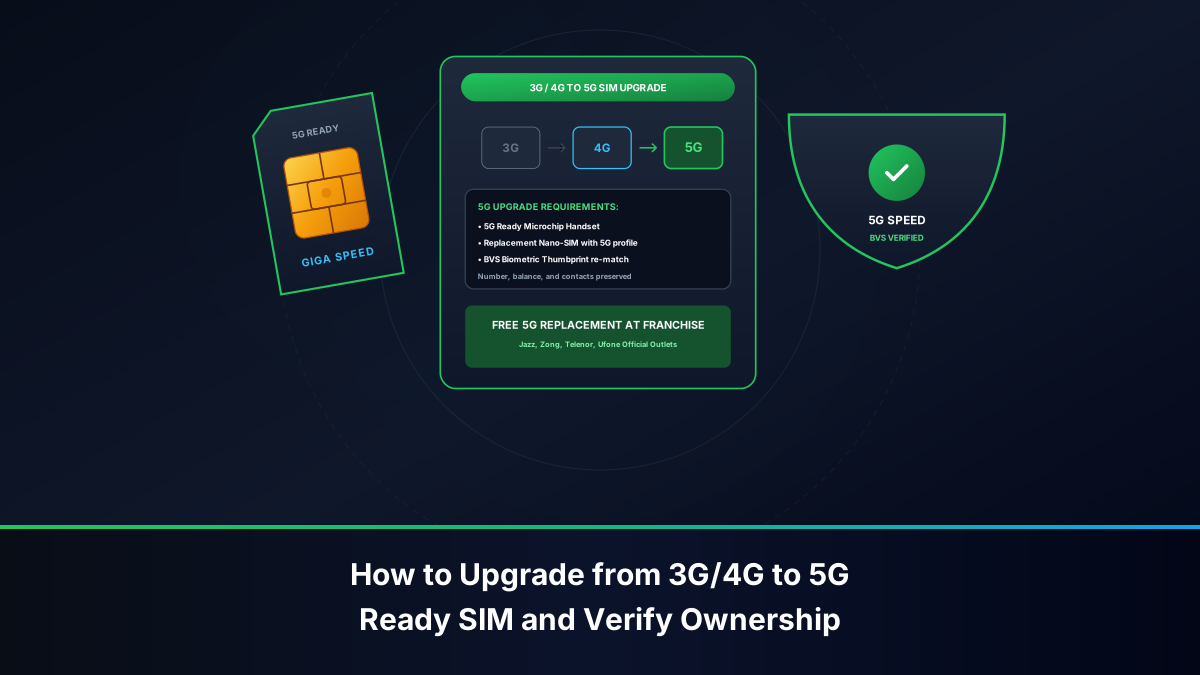
With modern flagship smartphones (such as Apple iPhone 14/15/16 series originating from North America) completely abandoning physical nano-SIM trays in favor of dual digital eSIM technology, South Asian expatriates must navigate the transition to electronic subscriber profiles.
| Feature / Parameter | Physical Nano-SIM | Digital Embedded SIM (eSIM) |
|---|---|---|
| Initial Onboarding Requirement | Physical pickup at franchise; mandatory live BVS fingerprint scan | QR code download; requires digital BVS or authorized app onboarding |
| Hardware Portability | Easily swapped between spare phones or roaming hotspot modems | Bound to device firmware; transferring between phones requires new QR |
| Overseas Recovery if Lost | Extremely difficult; requires biometric proxy power of attorney in Pakistan | Recoverable via verified digital operator portals for supported accounts |
| Physical Wear & Oxidation | Copper contact pads can corrode or degrade over years abroad | Immune to physical degradation; stored directly in motherboard eUICC |
| Dual-SIM Capability | Consumes physical slot; prevents use of dual physical foreign carriers | Allows co-existence of local foreign physical SIM + Pakistani digital eSIM |
For individuals residing abroad permanently, migrating to an eSIM before leaving Pakistan offers substantial advantages. An eSIM eliminates the catastrophic vulnerability of physical SIM card deterioration, contact oxidation, or accidental tray loss. However, caution is required: if you upgrade your phone while abroad, re-generating an eSIM QR profile may require biometric re-verification that cannot be conducted without physical access to a NADRA kiosk, unless your carrier supports verified digital app re-issuance.
Comprehensive Troubleshooting Matrix for International Roaming Failures
When encountering cellular disconnects or signaling rejections while overseas, follow this structured diagnosis protocol before contacting international customer support helplines:
| Observed Handset Symptom | Probable Technical Cause | Recommended Step-by-Step Remediation |
|---|---|---|
| "No Service" immediately upon landing | Handset's network search is locked on 'Automatic' and polling non-partner carriers. | Go to Settings > Mobile Data > Network Selection. Disable 'Automatic'. Allow the device to scan all available networks (2–3 minutes). Manually select a recognized partner (e.g., STC or Mobily in KSA; e& or du in UAE; EE or O2 in UK). |
| "SIM Not Provisioned: MM #2" or "Emergency Calls Only" | International Roaming profile flag is marked inactive in the Home HLR/HSS. | Connect device to airport Wi-Fi. Launch your carrier app (Jazz World, My Zong, etc.). Check roaming toggle. If disabled, submit activation. If persistent, dial operator international helpline via Skype or WebRTC. |
| Network connects, but Bank OTPs fail to arrive | SMSC (Short Message Service Center) number corrupted or port 2FA filtering active. | Check the SMSC number in your messaging settings. For Jazz: +92300000012; Zong: +923180000012; Telenor: +923455000012; Ufone: +923330000012. Ensure memory is not full and reboot device to clear cached SMS bearer tokens. |
| Carrier drops connection every few minutes | 5G / VoLTE protocol handshake incompatibility on visited foreign network. | Navigate to cellular settings and temporarily downgrade voice preference from 5G / LTE to 3G / 2G / GSM Only. Legacy 2G/3G signaling networks have nearly 100% interoperable SS7 roaming fallbacks compared to newer VoLTE interconnects. |
| Prepaid balance rapidly drains to zero without calls | Background cellular data leakage via automatic app refresh or DNS lookups. | Immediately verify that 'Data Roaming' is toggled OFF. Alter the cellular APN to a dummy string (e.g., none). Request your carrier helpline to apply an operator-level data roaming bar. |
Frequently Asked Questions (FAQs)
Review the comprehensive FAQ section below for practical answers to high-frequency diaspora inquiries concerning cross-border subscriber compliance, biometric re-verification, and international telecommunications law.