The Genesis of PTA 668: Transitioning from Anonymity to Biometric Accountability
During the early expansion of cellular telecommunications in Pakistan between 2000 and 2008, mobile subscriber growth outpaced regulatory compliance. Street vendors, corner grocers, and roadside stalls routinely distributed pre-activated prepaid SIM cards with zero identity verification. A buyer could purchase an active connection for fifty rupees without presenting a Computerized National Identity Card (CNIC) or signing a Customer Application Form (CAF). This regulatory vacuum created an untenable national security hazard: untraceable mobile connections became the primary operational tool for extortionists, kidnap-for-ransom syndicates, financial con artists, and militant organizations operating across the country.
In response to escalating security threats, the Pakistan Telecommunication Authority (PTA)—acting pursuant to its statutory powers under the Pakistan Telecommunication (Re-organization) Act, 1996—embarked on a multi-phase national subscriber clean-up campaign. The foundational pillar of this initiative was the deployment of the 668 SIM Information System (SIS) in 2009. For the first time in Pakistani telecommunications history, citizens were provided with a centralized, transparent mechanism to verify the total count of cellular connections legally registered under their CNIC. This framework culminated in 2015 with the nationwide National Action Plan biometric re-verification drive, which purged over 25 million unverified connections and mandated that every active MSISDN in Pakistan be tied to a verified biometric record in the National Database and Registration Authority (NADRA) repository.
The Technical Architecture: How the 668 Federated Query Engine Works
The PTA 668 platform is not a monolithic, static database. It operates as a high-throughput, federated query engine designed to bridge disparate telecom carrier databases with the regulatory authority in real time. Understanding the technical architecture clarifies how data flows during a verification check.
SMS Gateway vs. Web Portal (cnic.sims.pk): Protocol Dissection
Citizens interface with the 668 system through two primary digital conduits:
- The SMS Shortcode Gateway (668): When a user dispatches a text message containing their 13-digit CNIC to shortcode
668, the originating carrier's Short Message Service Center (SMSC) routes the payload across an SS7/SIGTRAN signaling link to the PTA's centralized SMS Aggregator Gateway. The gateway validates the numeric syntax (confirming exactly 13 numeric digits without hyphens, spaces, or alpha characters), sanitizes the input to prevent SQL injection or buffer overflow exploits, and queries the Central SIM Information Register (CSIR). The aggregated carrier-by-carrier count is formatted into a standardized SMPP (Short Message Peer-to-Peer) response packet and delivered back to the handset within 3 to 10 seconds. - The Official Web Portal (cnic.sims.pk): The web-based gateway provides an identical analytical report via an HTTPS-secured web browser session. The portal incorporates Google reCAPTCHA v3 and enterprise rate-limiting algorithms (restricting rapid sequential queries from identical IP subnets) to thwart automated scraping bots, distributed denial-of-service (DDoS) vectors, and bulk unauthorized citizen profiling scripts.
Federated Database Synchronization Between PTA, NADRA, and CMO Switches
The integrity of the 668 service relies on continuous, scheduled synchronization between three administrative tiers:
- Tier 1: Cellular Mobile Operators (CMOs): Jazz (VEON), Zong (CMPak), Telenor Pakistan, and Ufone (PTCL Group) maintain internal Home Location Registers (HLR), Home Subscriber Servers (HSS), and customer relationship management (CRM) billing databases. Whenever a new SIM is activated via BVS or an existing SIM is canceled, the operator's provisioning switch writes the transaction record locally.
- Tier 2: The Automated Delta Batch Feed: Every 24 hours (typically during off-peak maintenance windows between 01:00 and 04:00 PKT), each telecom operator pushes an encrypted cryptographic delta file (containing additions, portings, suspensions, and terminations mapped by CNIC) over a dedicated IPsec virtual private network (VPN) tunnel to the PTA central data repository.
- Tier 3: The Central SIM Information Register (CSIR): The PTA's CSIR processes the delta streams, reconciles Mobile Number Portability (MNP) routing tables, cross-references active citizen statuses with NADRA Verisys validation tokens, and updates the aggregate subscriber balance tables utilized by the 668 query engine.
Granular Audit: Exactly What Information PTA 668 Displays to the Public
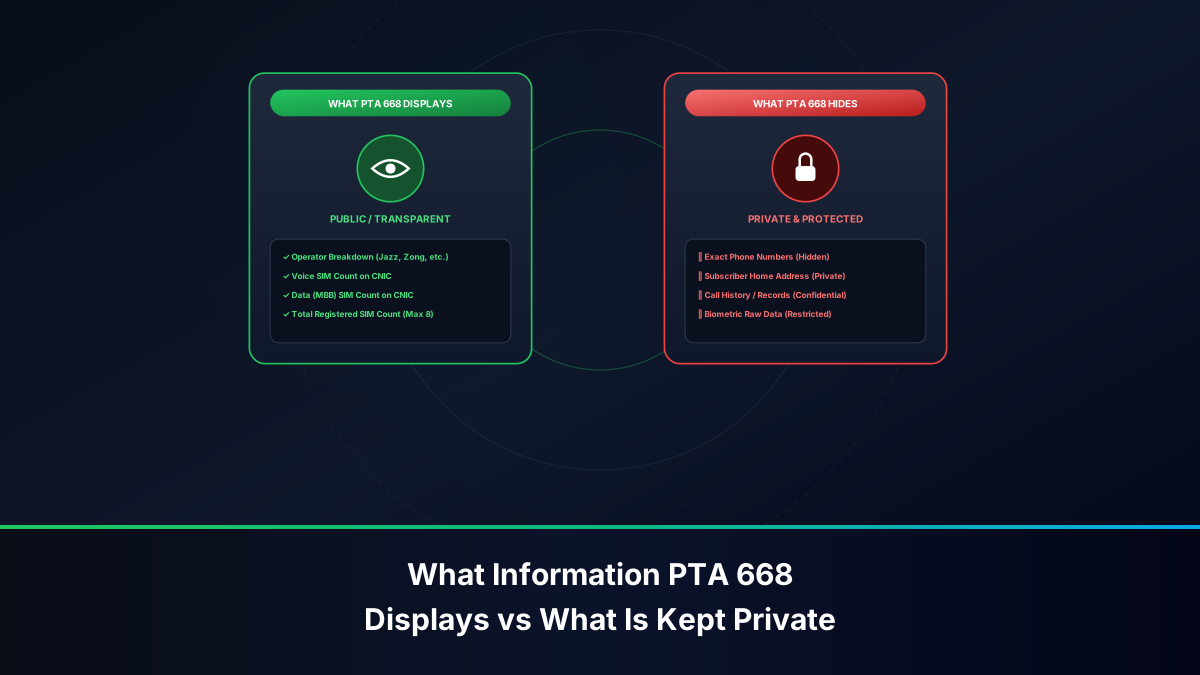
When a citizen queries 668 via SMS or the official web interface, the system returns a concise, structured administrative summary. The returned report contains specific, highly controlled fields:
| Returned Field / Parameter | Information Disclosed | Operational / Regulatory Significance |
|---|---|---|
| Queried CNIC Number | The 13-digit national identity number submitted by the user | Confirms the exact government identity card evaluated by the database |
| Jazz (Mobilink + Warid) Count | Discrete count of active voice and broadband SIMs | Identifies lines registered under Jazz HLR (MCC 410, MNC 01) |
| Zong (CMPak) Count | Discrete count of active voice and broadband SIMs | Identifies lines registered under Zong HLR (MCC 410, MNC 04) |
| Telenor Pakistan Count | Discrete count of active voice and broadband SIMs | Identifies lines registered under Telenor HLR (MCC 410, MNC 06) |
| Ufone (PTCL Group) Count | Discrete count of active voice and broadband SIMs | Identifies lines registered under Ufone HLR (MCC 410, MNC 03) |
| Special Communications Org (SCO) | Count of active lines in AJK and Gilgit-Baltistan | Identifies SCOM connections registered in northern territories |
| Total Voice SIMs & Total Data SIMs | Mathematical sum of all active connections | Measures citizen compliance against the 5-Voice and 3-Data statutory caps |
Carrier-by-Carrier Aggregate Allocation Breakdown
The response explicitly lists how many connections are active under each individual licensed operator. For example, a typical 668 SMS response will read:
CNIC: 35201-xxxxxxx-x
Jazz: 2 Voice, 0 Data
Zong: 1 Voice, 1 Data
Telenor: 1 Voice, 0 Data
Ufone: 0 Voice, 0 Data
SCO: 0 Voice, 0 Data
Total Voice: 4, Total Data: 1
This carrier-by-carrier attribution is critical. If a citizen has only ever patronized Jazz and Zong in their lifetime, yet the 668 report reveals an active voice line under Telenor, the subscriber receives immediate, actionable intelligence that an unauthorized connection has been fraudulently registered on their CNIC.
Strict Delineation Between Voice SIMs and Dedicated Broadband (MBB) Lines
Under statutory PTA directives, mobile lines are strictly partitioned into two regulatory buckets: Voice SIMs (standard phone SIMs that support two-way circuit-switched and VoLTE voice calls, SMS, and data) and Data-Only Broadband SIMs (MBB devices, 4G/5G Wi-Fi routers, dongles, and industrial telemetry modems). Every Pakistani citizen is legally capped at an aggregate maximum of 5 active voice SIMs and 3 active data-only SIMs (total aggregate ceiling: 8 SIM cards across all carriers combined). The 668 system clearly delineates between these two asset classes, enabling subscribers to identify which quota bucket is being consumed.
Privacy by Design: Why PTA 668 Strictly Hides Granular Personal Identity Data
While consumers frequently wonder why the 668 system does not simply display the actual ten-digit telephone numbers (MSISDNs) or customer names, this architectural restriction is a deliberate, highly sophisticated Privacy by Design protection mandated by constitutional privacy doctrines and international data security standards.
Masking the Actual Phone Numbers (MSISDNs): Anti-Stalking Protections
Because a citizen's 13-digit CNIC is widely shared across daily commercial life—written on bank deposit slips, employment applications, property leases, utility bills, hotel check-in registers, and educational admission forms—it is essentially semi-public knowledge. If the PTA 668 system were configured to return the exact phone numbers (e.g., 0300-9876543) upon receiving a CNIC query, any malicious actor, blackmailer, disgruntled acquaintance, or criminal operative possessing someone's CNIC could effortlessly unmask all their private, unlisted phone numbers.
This would immediately expose female citizens to rampant telephonic harassment, enable corporate espionage against business executives, facilitate targeted phishing scams, and allow stalking syndicates to track victims across personal lines. By masking the actual digits and presenting strictly anonymous counts, 668 provides an integrity audit without compromising subscriber confidentiality.
Protection of Subscriber Names, Physical Addresses, and Biometric Minutiae
The 668 gateway is architecturally decoupled from Personally Identifiable Information (PII) databases. The query endpoint has zero programmatic access to:
- The subscriber's full legal name, alias, or tribal title.
- The subscriber's permanent or present residential address recorded at NADRA.
- Father's name, mother's maiden name, or family tree linkages.
- Biometric fingerprint minutiae templates or facial photographs.
The system verifies the numerical quantity of active network sessions; it does not distribute digital identity dossiers over unsecured public telecommunication channels.
Shielding Call Detail Records (CDRs), Cell Tower Triangulation, and IMEI Data
Under no circumstances does 668 reveal telemetry or behavioral data. Information strictly barred from the system includes:
- Call Detail Records (CDRs): Outgoing/incoming dialed numbers, call duration, timestamp logs, and SMS metadata.
- Geographic Location & Cell Tower Triangulation: The real-time physical coordinates, visited Base Transceiver Station (BTS) Cell IDs, and historical location traces of the SIM.
- Hardware Telemetry: Device IMEI numbers, smartphone model designations, or SIM serial numbers (ICCID).
Official Protocols: How to Lawfully Discover the Exact Phone Numbers on Your CNIC
When a citizen queries 668 and observes that they have three active SIM cards registered under Jazz, but they only recall purchasing one, how can they identify the rogue telephone numbers without violating privacy laws? The state provides specific, lawful procedural avenues:
Carrier USSD Codes and Shortcode 667 Verification
If you have physical possession of the SIM cards in question, you can immediately query their registered identity from the handset itself:
| Mobile Operator | Primary On-Device USSD Code | SMS Verification Protocol (667) | Information Returned to Screen |
|---|---|---|---|
| Jazz (Mobilink) | Dial *444*6*1# |
Send blank SMS to 667 |
Displays registered CNIC, Owner Name, and IMSI status |
| Zong (CMPak) | Dial *100# or *567# |
Send MNP to 667 |
Returns registered subscriber name and primary identity number |
| Telenor Pakistan | Dial *777# |
Send blank SMS to 667 |
Displays active MSISDN registration title and BVS date |
| Ufone 4G | Dial *336*1# |
Send blank SMS to 667 |
Shows owner CNIC, registration timestamp, and account status |
Carrier Smartphone Applications and Authenticated Digital Portals
Operators offer verified self-care smartphone apps—including Jazz World, My Zong, My Telenor, and My Ufone. When logged into an active account, the user can navigate to account settings to view the registered legal name, masked CNIC, billing address, and associated secondary lines linked under the unified multi-account management dashboard.
Company-Owned Customer Care Centers: Full Biometric BVS Account Audits
For SIM cards that are not in your physical possession (e.g., ghost SIMs or lost cards), the only lawful, authoritative method to obtain the exact phone numbers is visiting an official Company-Owned Customer Service Center (CSC):
- Physical Appearance: The CNIC owner must appear in person. Representatives or blood relatives holding photocopies will be turned away.
- Identity Verification: Present your original, physical Smart CNIC.
- Live Biometric Handshake: Place your finger on the operator's encrypted BVS terminal. The system queries NADRA Verisys in real time to prove your physical presence and identity.
- Full Ledger Disclosure: Once authenticated, the customer care representative is authorized to display the complete, unmasked list of every single MSISDN, activation date, and franchise origin registered under your CNIC across their network.
Remediation Workflow: Handling Unauthorized 'Ghost' SIMs Found on Your CNIC
If your 668 audit reveals unauthorized or fraudulent SIM cards, immediate remediation is vital. Any criminal activity, financial scam, or threatening message dispatched from a line registered under your CNIC renders you legally culpable under Pakistani law.
Execute this remediation sequence without delay:
- Visit the Respective Operator CSC: Do not visit a third-party retailer; proceed directly to an official flagship customer center of the operator hosting the rogue connection.
- Undergo BVS Identification: Authenticate your identity via fingerprint scan.
- Execute a Disclaimer Undertaking: Complete and sign a formal PTA Subscriber Disclaimer Affidavit, stating under oath that the specific unauthorized MSISDN was activated without your consent, knowledge, or lawful authorization.
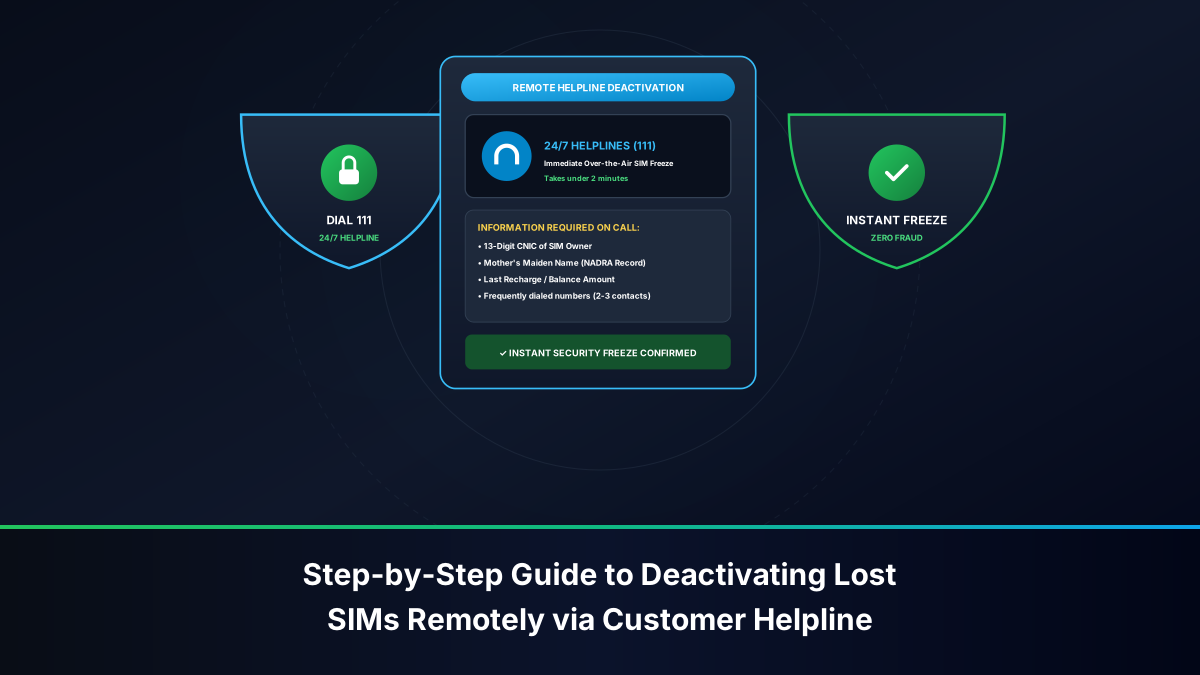
- Immediate Line Blocking: Demand that the representative execute an immediate Permanent Disconnection & Regulatory Blacklist command on the disputed line.
- File a Complaint on the PTA CMS: If the telecom operator delays or hesitates to cancel the line, log into the PTA Complaint Management System (cms.pta.gov.pk) or the PTA CMS Mobile App. Submit a formal regulatory complaint under the category "Unauthorized SIM Registered on CNIC", attaching your 668 screenshot and franchise visit token. PTA consumer protection officers will intervene to enforce mandatory termination within 72 hours.
The Peril of Illicit 'Live Tracker' APKs and Black-Market Telemetry Scams
The internet in Pakistan is plagued by predatory third-party websites and Android APK files advertising "Live SIM Tracker", "Pakdata CF", or "Trace Phone Number Details with Name and Address". Consumers searching for ways to see the phone numbers hidden by 668 frequently fall into these cyber traps.
The harsh technological and legal reality of these illicit services involves severe risks:
- Stale and Fabricated Data: The vast majority of these platforms operate on pirated, obsolete relational database dumps stolen in 2011 and 2018. Over 80% of their records are wildly inaccurate, displaying obsolete addresses and former owners who transferred or ported their numbers years ago.
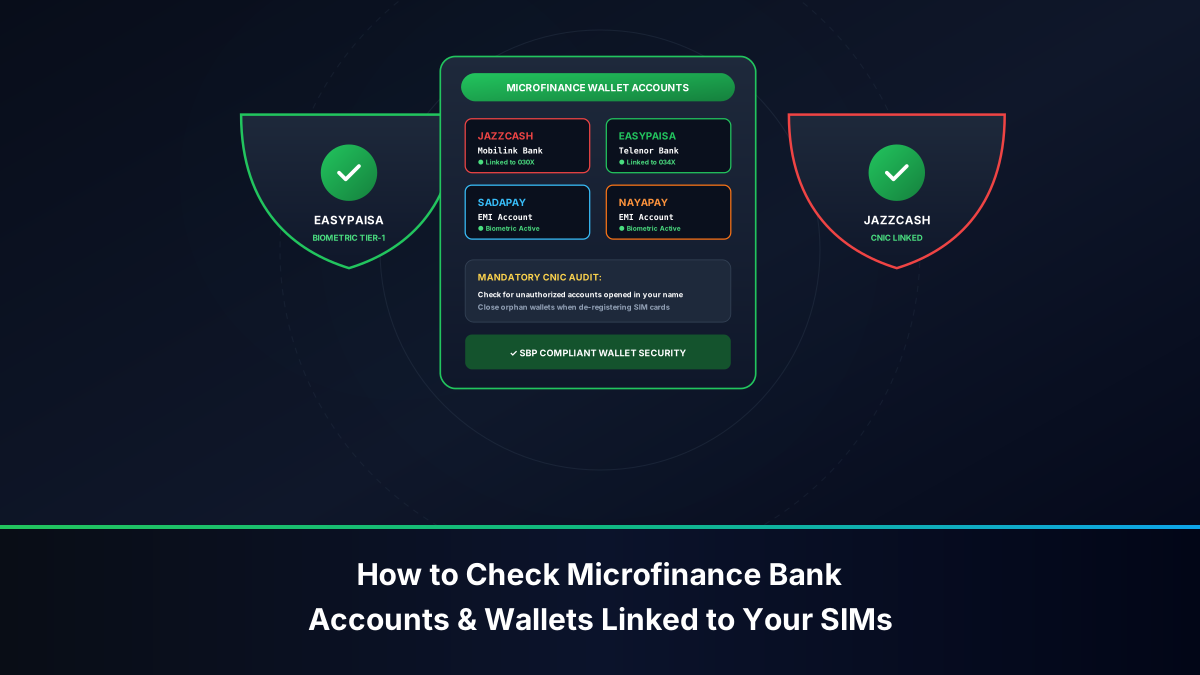
- Malware and Banking Credential Theft: Sideloading "Live Tracker" APK files from outside the Google Play Store is the primary distribution vector for banking trojans, SMS forwarders, and spyware in Pakistan. These malicious applications secretly read your incoming bank OTPs, hijack WhatsApp authentication codes, and drain your digital wallets (Nayapay, Sadapay, Easypaisa, and JazzCash).
- Criminal Penalties for Users: Accessing or paying for unauthorized personal data queries violates Pakistani federal law. Consumers caught utilizing these services are subject to immediate investigation by the FIA Cyber Crime Wing.
Legal Framework & Penalties Under PECA 2016 and Telecom Regulations
Telecommunications privacy and subscriber identity integrity are vigorously defended under the Prevention of Electronic Crimes Act (PECA 2016):
- Section 14 (Unauthorized Access to Information System): Gaining unlawful access to telecom subscriber records, HLR databases, or internal customer data carries up to 3 years imprisonment and fines up to PKR 1,000,000.
- Section 16 (Unauthorized Use of Identity Information): Obtaining, selling, or utilizing another citizen's CNIC, biometric data, or identity documents to acquire telecom services is a major criminal offense carrying 3 years imprisonment and heavy financial penalties.
- Section 17 (Unauthorized Issuance of SIM Cards): Franchise agents or retail operators who activate SIM cards by misusing customer fingerprints or spoofing BVS terminals face rigorous imprisonment of up to 3 years, fines up to PKR 500,000, and immediate revocation of their commercial telecom franchise license.
The PTA 668 system stands as an essential national safeguard—balancing the imperative of citizen security audits with the non-negotiable right to digital privacy.
Frequently Asked Questions (FAQs)
Browse the exhaustive FAQ repository below for direct, expert solutions regarding the PTA 668 SIM Information System, privacy boundaries, and ghost SIM elimination.